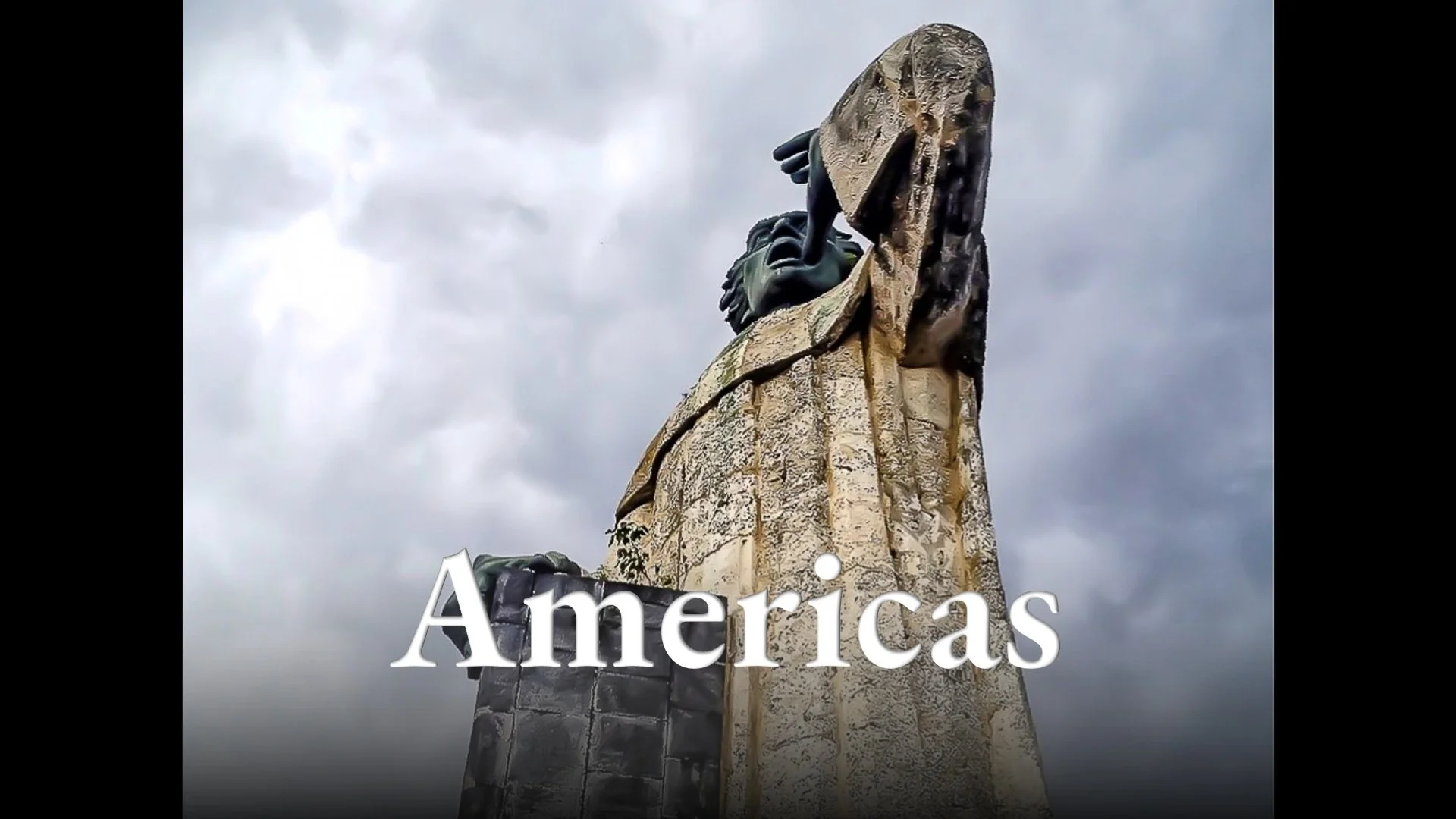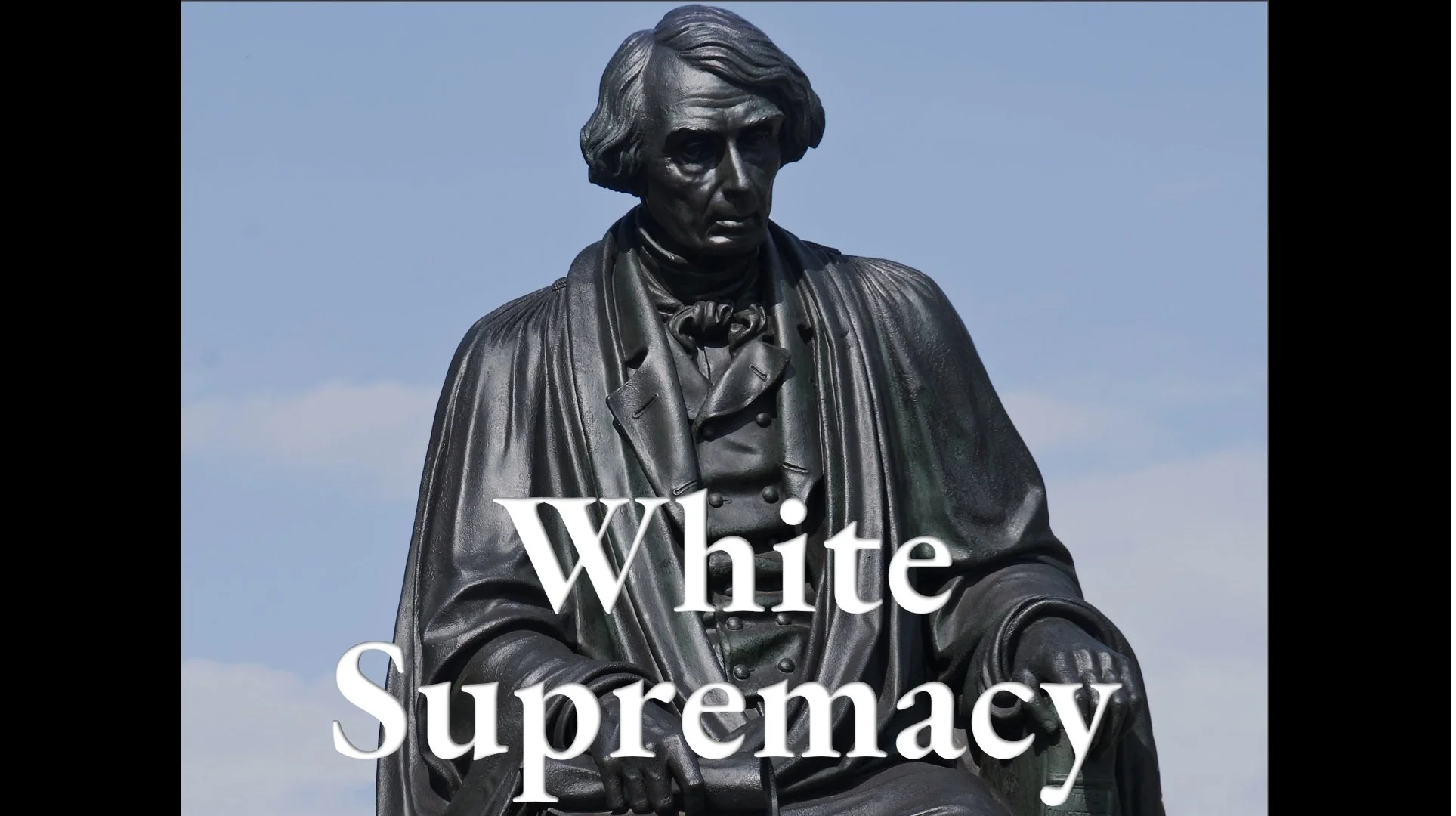
Photograph: Statue of Supreme Court Justice Roger B. Taney (1777 - 1864), who gave the infamous Dred Scott decision in 1857, declaring that black people, whether enslaved or free, could not become US citizens and could not sue in federal court. This statue of Taney was made in 1887 and placed in Baltimore, Maryland. It is a monument to white supremacy. No possible argument can be made to defend the statue on the grounds of Civil War memory, since it is not a monument to Confederate soldiers. The statue was removed by the City of Baltimore on August 18, 2017. Photo credit: Ron Cogswell | CC2.0, Flickr.
Introduction
This page examines white supremacy in the United States, beyond the other topics covered in the section Race and Politics. Under our own resources, we curate other resources, broken out by time period.
From Founding to Reconstruction (1877) involves the origins of “whiteness” at the expense of European ethnicities, and how African American and Native American people were marginalized.
Imperialism, the Progressive Period, and the Gilded Age (1877 - 1929) highlights foreign policy, the treatment of immigrants, corporations and labor, and the racial selectivity of some progressives.
The New Deal, World War II, the Civil Rights Movement, and the New Deal Coalition (1930 - 1980) spotlights the white supremacy in the New Deal, the racial diversity that resulted from WWII, and the Civil Rights efforts of the 1950s - 60s.
The Rise of Neoliberalism and Globalism (1981 - present) focuses on Reagan’s policies and dismantling of the New Deal Coalition, and the racial impact and animus that resulted.
Messages and Resources on Race and Politics
See also the slides to this presentation. The introduction features John Winthrop vs. Roger Williams to highlight the debate over freedom of religious Conscience vs. Christendom. The presentation highlights Christian accomplishments in health and hospitals, education and schools, land ownership and economic justice, and criminal justice reform.
How do Christian heresies contribute to America’s racial and political climate? Could Christian history have gone differently? Could it still? Examine U.S. history from the standpoint of church history. See the whole course or just the blog posts.
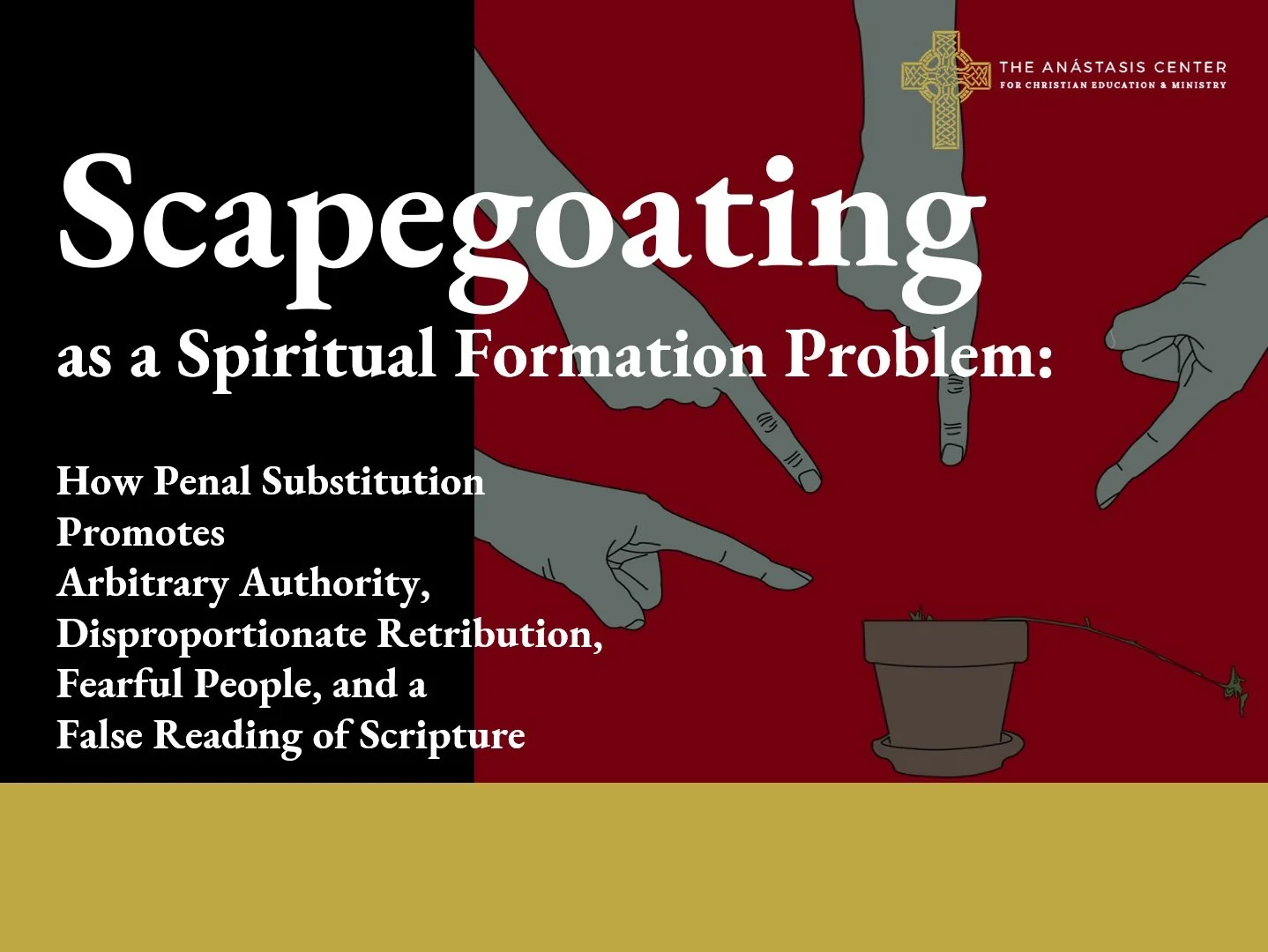
This blog post series relates to both the topic of atonement and the topic of desire because, like fallen Adam in the garden, we desire to deflect blame, and therefore we scapegoat others. On the political level, this builds group cohesion and creates a social outsider, who is blamed for the group’s woes, who the group must exile or kill or marginalize in order to maintain a hopeful lie. This series explores what political scapegoating has looked like in the U.S.
White American Evangelical Political Attitudes and Behavior: Explanation and Correctives
White American evangelical political attitudes can be characterized by the debate between John Winthrop and Roger Williams, and their respective attitudes towards Native Americans, slavery, fairness, and faith in civic space. This is a presentation also explores Scripture and church history to argue that Roger Williams was correct. Given to the staff of Emmanuel Gospel Center, Apr 18, 2018, as a follow-up to how Christian restorative justice impacts ministry; audio file here.
The Role of Jesus in Revolution and the Pursuit of Justice
This is an evangelistic message that highlights the Christian-led and Christian-influenced non-violent resistance movements throughout the world in the 20th century. They show the connections and spiritual vitality of Christian faith under empire or empire-like oppression.
-
A Different Asian American Timeline (ChangeLab website) excellent material, presented cleanly, giving a global perspective on global capitalism and international relations, not just race relations in the U.S. domestically
African American Intellectual History Society (website) has excellent book and article recommendations
Alex Mikulich, Race, Racism, and Whiteness. Loyola University New Orleans. a helpful Catholic perspective.
Ronald Takaki, Iron Cages: Race and Culture in 19th Century America. Oxford University Press | Amazon page, 1979, edited 2000.
Alexander Saxton, The Rise and Fall of the White Republic: Class Politics and Mass Culture in Nineteenth Century America. Verso | Amazon page, 1991.
Theodore Allen, The Invention of the White Race, Vol.1: Racial Oppression and Social Control. Verso | Amazon page, 1994. and Theodore Allen, The Invention of the White Race, Vol.2: The Origin of Racial Oppression in Anglo-America. Verso | Amazon page, 1997.
Noel Ignatiev, How the Irish Became White. Routledge | Amazon page, 1995.
Howard Zinn, A People's History of the United States: 1492 - Present. Harper Perennial | Amazon page, 1995.
Katherine Holmes, Arica L. Coleman: That the Blood Stay Pure: African Americans, Native Americans, and the Predicament of Race and Identity in Virginia. New Books Network, Mar 18, 2014. exploring racial mixing in Virginia; see also Kelly April Tyrrell, Challenging Our Past. University of Delaware, Nov 14, 2013. and Arica Coleman, Black/Indian Relations. Spreaker, Nov 14, 2013. a 30 minute lecture; see also Barnard Shipp, The History of Hernando De Soto and Florida: Or, Record of the Events of Fifty-Six Years, 1512 to 1568. Forgotten Books | Amazon page, Nov 17, 2016.
Philip Leigh, The Politics and Economics of Reconstruction. Discerning History, Nov 8, 2015. includes valuable stats and information about the Southern economy, with a sympathetic view of the South as a region. Leigh makes this intriguing comment: “One annoyed victim of Reconstruction-era US tariffs was Georges Clemenceau who became France’s Prime Minister during World War I. While working as a correspondent for a French newspaper in New York he wrote, “Protectionism is rampant in [America]…People have been made to pay ridiculous prices for articles of primary necessity.” Perhaps by observing that Southerners were forced to abide punitive federal budgetary and taxing policies, he later erroneously concluded that France could extract sizeable reparations from Germany after World War I, without consequence. If so, he failed to anticipate that the German reparations would cause the Weimar Republic to collapse, which would lead to the rise of the Nazi Party and a renewal of the war twenty years after the Versailles Treaty.” It is worth wondering whether better economic assistance and conditions could have mitigated the white supremacy in the South, just as it could have mitigated the rise of the Nazi Party in Germany. It is also worth stating that the underlying causes of the American Civil War and World War I are also similar: colonialism and racism in the framework of the Enlightenment nation-state. See also Ed Ayers, Nell Painter, and Eric Foner, Sharecropping and Changes in the Southern Economy (PBS: The American Experience. Eric Foner, Clarence Walker, Ed Ayers, Russell Duncan, Ted Tunnell, and David Blight, Schools and Education During Reconstruction. PBS: The American Experience. Eric Foner, Dana Nelson, David Blight, Ed Ayers, Rebuilding the South After the War. PBS: The American Experience. Drew Gilpin Faust, Eric Foner, Clarence Walker, White Southern Responses to Black Emancipation. PBS: The American Experience. Eric Foner, David Blight, Ed Ayers, Ted Tunnell, Civil Rights During Reconstruction. PBS: The American Experience.
Ryan Walters, Jeffersonian Conservatism. Abbeville Institute, Oct 18, 2016. on Hamiltonian federalism vs. Jeffersonian state-localism
Brad Mason, Correcting (My Own) Normativity of Whiteness: 1. From the Arrival of the First African Slaves to “Partus Sequitur Ventrem”. Bradly Mason, Dec 5, 2018. and Correcting (My Own) Normativity of Whiteness: 2. From Bacon’s Rebellion to “White Men” and “White Women”. Bradly Mason, Dec 10, 2018. and Correcting (My Own) Normativity of Whiteness, Conclusion: From “Racial Biology” to “White Supremacy”. Bradly Mason, Dec 12, 2018. Excellent discussion of history, culture, and law.
Cynical Historian, Reconstruction: America's Unfinished Revolution, 1863-1877 | US History Lecture. Cynical Historian, Dec 9, 2021. an outstanding 36 minute video, well sourced.
-
Christopher Lasch, The Agony of the American Left. Vintage Books | Amazon page, 1973. analyzes the demise of the Socialist Party as provoking an intellectual alienation from politics for economic progressives. Notes the Irish American institutions and political machinery as successful in helping the Irish succeed, although this is perhaps optimistic given that the Irish had the option of becoming "white." See Democratic Socialists of America (website) supported by Cornel West, A. Philip Randolph, Martin Luther King Jr, John P. Davis, Bayard Rustin, and Lester Granger; see Connor Kilpatrick, Everybody Hates Cornel West (Jacobin Magazine, Nov 2016.
Orlando Patterson, The Ordeal of Integration. Civitas Books | Amazon page, 1998.
PBS News Hour, How a Georgia County Became a Site of Racial Cleansing. PBS, Jan 16, 2017. “In 1912, news of a violent sexual assault enraged the residents of Georgia's Forsyth County and led to a lynching and the execution of two African American teens, as well as a campaign of terror to drive out the entire black community. Special correspondent Duarte Geraldino talks with Patrick Phillips, author of “Blood at the Root,” about healing from a history of racial cleansing.”
Laura Smith, The KKK Started a Branch Just for Women in the 1920's, and Half a Million Joined. Timeline, Jun 28, 2017.
Jack Christian and Warren Christian, The Monuments Must Go: An Open Letter from the Great, Great, Grandsons of Stonewall Jackson. Slate, Aug 16, 2017.
Southern Poverty Law Center, Chronology Chart: The Building of Pro-Confederacy Monuments, Courthouse Adornments, and Schools. Southern Poverty Law Center.
Kevin M. Levin, The Pernicious Myth of the ‘Loyal Slave’ Lives on in Confederate Memorials. Smithsonian, Aug 17, 2017.
Rachel B. Doyle, Meet the Black Architect Who Designed Duke University 37 Years Before He Could Have Attended It: His Name Was Julian F. Abele. Curbed, Dec 6, 2017. Duke was white-only until 1961
Kim Kelly, White Women Must Hold Each Other Accountable for Racism. Bitch Media, Feb 26, 2018. an historical account of how white supremacy used white motherhood and family-values
Melissa Sartore, Meet the Evil, Racist Mastermind Who Saved The KKK From Going Extinct. Ranker, Nov 18, 2018. re: Mary Elizabeth Tyler, who combined first wave feminism and xenophobia with the KKK
Adam Serwer, White Nationalism’s Deep American Roots. The Atlantic, Apr 2019. Although Serwer doesn’t mention it, Protestant roots. Explores pre-WW2 history of eugenic thought, starting with Madison Grant’s The Passing of the Great Race. Ironically, the very designation of “whiteness” that Anglo-Saxon Protestant elites created, created as its flip side a fear of becoming genetically bred into non-existence and becoming mongrelized.
Michelle McGhee, Mapped: Conferederate Monuments Over Time. Axios, May 18, 2021. established mostly in 1900 - 1920
Ryan Grim, Was The 20th C. Political Realignment a Mirage? Rising | The Hill, Nov 18, 2021. argues from a historical perspective that the two party system made the Build Back Better Act difficult because it neutralizes working class interests. See also Ryan Grim, The Two-Party System Was Designed To Crush Social Uprisings, And It's (Mostly) Working. Rising | The Hill, Nov 23, 2021. argues from a historical perspective that the two party political system was designed by Martin Van Buren etc. to obstruct abolition, which echoes the entrenchment of big business today.
-
Ron Takaki, Strangers from a Different Shore: A History of Asian-Americans. Little, Brown and Company | Amazon page, 1998.
Andrew Hacker, Two Nations: Black and White, Separate, Hostile, Unequal. Scribner | Amazon page, 2003.
Tanner Colby, Some of My Best Friends Are Black: The Strange Story of Integration in America. Penguin Books | Amazon page, 2013.
Alia Wong, History Class and the Fictions About Race in America. The Atlantic, Oct 21, 2015. how government oppressed racial minorities
Joanne Theoharis, How History Got the Rosa Parks Story Wrong. Washington Post, Dec 1, 2015. vitally important for understanding gender and racism
Graham Lyse, How Democrats Can Bridge Identity Politics and Economic Populism. The New Republic, Dec 13, 2016. “Some on the left are touting "the Bobby Kennedy coalition" as a model of multicultural working class politics.” “Unlike most politicians of his day, the senator concluded there could be no middle group standing up to bigotry in the form of segregation. “Kennedy finally understood that the only way to take on arch segregationists was to take them on directly, because you’re not going to compromise with them,” Tye said… Kennedy was willing to adopt ideas from across the political spectrum, like tax breaks for businesses investing in Brooklyn’s Bedford-Stuyvesant. He also made the case that white working class Americans shared struggles with poor inner-city blacks, and he delivered the same message to crowds of all colors. On some level, this is the kind of “Americans as Americans” appeal Lilla advocates, but Tye stressed that Kennedy was a principled progressive, not at all a third-way centrist like Bill Clinton.” This article may be underestimating RFK’s Catholic heritage and vision, however, along with whatever appeal he had to faith communities.
Scott Kurashige, The Fifty Year Rebellion: How the U.S. Political Crisis Began in Detroit. University of California Press | Amazon page, Jul 4, 2017.
Jon Schwarz, The Incredible Lost History of How "Civil Rights Plus Full Employment Equals Freedom". The Intercept, Jul 17, 2017.
Akilah Johnson, The Forgotten Riot That Sparked Boston's Racial Unrest. Boston Globe, Jun 2, 2017.
Kimberly Yam, These Anti-Japanese Signs From World War II Are A Warning Against Bigotry Today. Huffington Post, Dec 7, 2017.
Shaun Assael and Peter Keating, The Massacre That Spawned the Alt-Right. Politico, Nov 3, 2019. “Forty years ago, a gang of Klansmen and Nazis murdered five communists in broad daylight. America has never been the same.”
Park MacDougald, A New Conservative Theory of Why America Is So Polarized. New York Magazine, Jan 21, 2020. “how is the Civil Rights Act of 1964 a “de facto constitution” incompatible with the original one? In a strict legal sense, Caldwell argues, it is that the Civil Rights Act and associated Supreme Court decisions, such as Brown v. Board of Education, conflicted with or modified what had traditionally been understood as Americans’ constitutionally guaranteed rights. Court- or legislatively-mandated integration, for instance, curtailed freedom of association, in the same way that legal prohibitions on discrimination in hiring or renting out a room curtailed the property rights of a business or hotel owner. Such objections to the 1964 act have long been aired by paleoconservatives and libertarians — in 2010, Rand Paul came under fire for voicing a version of them — and they are pretty small-bore. Caldwell’s concern is less legalistic and has more to do with how “civil rights ideology… became, most unexpectedly, the model for an entire new system of constantly churning political reform.” He argues that the act and its subsequent expansions provided a blueprint, a moral rationale, and a legal toolkit for ambitious and frequently unpopular social engineering projects, justified in the name of an ever-proliferating suite of rights and operating outside the bounds of traditional democratic and constitutional legitimacy.”
Hannah Giorgis, When the FBI Spied on MLK. The Atlantic, Jan 18, 2021. “The bureau’s surveillance of Martin Luther King Jr. reflects a paranoia about Black activism that’s foundational to American politics.”
Vox, Why the US Government Murdered Fred Hampton. Vox, Jun 2, 2021. an 18 minute video; the Black Panther Party was calling for a rejection of capitalism and embrace of socialism, police accountability and reform of prisons, etc. Fred Hampton was charismatic and drew support from poor white and Latino communities in Chicago.
Ryan Grim, Was The 20th C. Political Realignment a Mirage?. Rising | The Hill, Nov 18, 2021. argues from a historical perspective that the two party system made the Build Back Better Act difficult because it neutralizes working class interests. See also Ryan Grim, The Two-Party System Was Designed To Crush Social Uprisings, And It's (Mostly) Working (Rising | The Hill, Nov 23, 2021. argues from a historical perspective that the two party political system was designed by Martin Van Buren etc. to obstruct abolition, which echoes the entrenchment of big business today.
Gene Demby, Camila Domonoske, Shereen Marisol Meraji, Maria Gutierrez, Sami Yenigun, Leah Donnella, Jess Kung, The Black Civil Rights Leader Who Sued to be Called “Miss”. NPR, Mar 14, 2026.
Tim Miller and Catherine Rampell, Tucker Carlson Called Catherine "Repulsive". The Bulwark, Apr 22, 2026. Tucker Carlson still wants White-only clubs, perhaps especially male-only clubs.
-
Life After Hate (website) former white supremacist now de-radicalizing extremists
William Toll and Marshall F. Stevenson, Boston's African-Americans and American Jews: Two Views. A chapter from The Death of an American Jewish Community, 1992.
Paula J. Giddings, When and Where I Enter: The Impact of Black Women on Race and Sex in America. W. Morrow | Amazon page, 3rd edition, Feb 27, 2007.
Bill Moyers, Grace Lee Boggs on Shaking Up the Status Quo in America. Bill Moyers, Jun 8, 2007.
Grace Lee Boggs and Scott Kurashige, The Next American Revolution: Sustainable Activism for the Twenty-First Century. University of California Press | Amazon page, May 31, 2012.
Stephen Colbert, Alpha Dog of the Week - Virginia State Senate Republicans. The Colbert Report, Jan 23, 2013.
Tim Wise, Terrorism and Privilege: Understanding the Power of White Privilege. Tim's blog, Apr 16, 2013.
Rebecca Baird-Remba and Gus Lubin, 21 Maps of Highly Segregated Cities in America. Business Insider, Apr 25, 2013.
Daphne R, Whites Believe They Now Face More Racism Than Blacks. Black Blue Dog blog, Dec 26, 2013.
Zack Beauchamp, How Racism Caused the Shutdown. Think Progress, Oct 9, 2013. how the New Deal drove the racists to the Republican party
Zack Beauchamp, Yes, the South Really Is Different - And It’s Because of Race. Think Progress, Oct 18, 2013.
Mychal Denzel Smith, The Effects of Ignoring Systemic Racism. The Nation blog, Jan 27, 2014.
Zachary Davies Boren, Major Study Finds The US Is An Oligarchy. Business Insider, Apr 16, 2014. although it was designed that way
Julianne Hing, Gentrification Report: Black and Latino Displacement is Remaking the Bay Area. Color Lines, Apr 7, 2014.
Brittney Cooper, It’s Not About You, White Liberals: Why Attacks On Radical People of Color Are So Misguided. Salon, Apr 8, 2014.
David Daley, "America as the No. 1 Warmonger: President Jimmy Carter Talks to Salon About Race, Cable News, "Slut-Shaming" and More. Salon, Apr 10, 2014.
U.S. Census Bureau, The Asian-American Population in the U.S. US Census Bureau, May 21, 2014.
Matthew Pulver, The South's Victim Complex: How Right-Wing Paranoia is Driving a New Wave of Radicals. Salon, Sep 30, 2014.
Joseph A. Califrano, Jr., The Movie Selma Has a Glaring Flaw. Washington Post, Dec 26, 2014.
Chris Rock, It's Not Black People Who Have Progressed; It's White People. Vox, Dec 1, 2014.
Southern Poverty Law Center, Charles Murray, White Nationalist. Southern Poverty Law Center. author of The Bell Curve
David W. Blight, The Civil War Isn't Over. The Atlantic, Apr 8, 2015.
Joan Walsh, White Progressives’ Racial Myopia: Why Their Colorblindness Fails Minorities — and the Left. Salon, Jun 1, 2015.
Robin Deangelo, 11 Ways White America Avoids Taking Responsibility for Its Racism. Alternet, Jun 16, 2015.
Chris Lebron, Time for a New Black Radicalism. New York Times, Jun 22, 2015.
Stacy Patton, Black America Should Stop Forgiving White Racists. Washington Post, Jun 22, 2015.
Michael Wines and Lizette Alvarez, Council of Conservative Citizens Promotes White Supremacy and GOP Ties. New York Times, Jun 22, 2015.
Southern Poverty Law Center, Hate and Extremism (SPLC) about the rise of hate groups
Caitlin MacNeal, Carson Calls Out GOPers Who Won't Say Charleston Shooter Is Racist. TPM, Jun 22, 2015.
Mea Culpa, The ‘Southern Avenger’ Repents: I Was Wrong About the Confederate Flag. The Daily Beast, Jun 22, 2015.
Justin Worland, This Is Why South Carolina Raised the Confederate Flag in the First Place. Time, Jun 22, 2015.
Public Religion, Most Americans Believe Protests Make the Country Better; Support Decreases Dramatically if Protesters are Identified as Black. Public Religion, Jun 23, 2015.
Jamilah Lemieux, Stop Trying to Be Good — Be Black. Mic, Jun 30, 2015.
Tim Wise, The Oblivious, Casual Racism of Modern Conservatism. Salon, Jul 1, 2015.
John Prager, It Turns Out White Support For Confederate Flag Really IS About Racism, Not Heritage. Addicting Info, Jul 1, 2015.
Travis Gettys, SC Raised Confederate Flag in 1961 To Insult Nine Black Protesters - And Took It Down to Honor Nine Slain. Raw Story, Jul 9, 2015.
Max Blau, "Still a Racist Nation": American Bigotry on Full Display at KKK Rally in South Carolina. The Guardian UK, Jul 19, 2015.
Dylan Stableford, Black Officer Helps White Supremacist Suffering from Heat at KKK Rally. Yahoo News, Jul 19, 2015.
David Weigel, Do White Liberals Have a Bernie Sanders Problem? Washington Post, Jul 21, 2015.
Mark Guarino, Misleading Reports of Lawlessness After Katrina Worsened Crisis, Officials Say. The Guardian, Aug 16, 2015. “National guard coordinator and ex-governor say tales of violence and looting – which hampered rescue work and led to quasi-militia groups – were exaggerated.” See also Jacob Remes, Finding Solidarity in Disaster. The Atlantic, Sep 1, 2015. “In banner headlines on September 2, 2005, both The New York Times and The Washington Post paired New Orleanians’ “despair and lawlessness,” suggesting that one of these states necessarily led to the other. The very next week, though, it emerged that the stories broadcast from New Orleans were, at best, exaggerations. Nobody could find the helicopter pilot who had supposedly been shot at. Violence on the ground, too, turned out to be much less common than imagined. “I kept hearing the word animal, and I didn’t see animals,” a woman named Denise Moore told the public-radio program This American Life about her time at the Superdome. Instead, she saw self-organized activities by “gangster guys” who broke into abandoned stores. Although they might have looked like looters, they were salvaging fresh clothes for those who needed them, “juice for the babies, water, beer for the older people, food, raincoats so that they could all be seen by each other.””
Max Ehrenfreund, I Asked Psychologists to Analyze Trump Supporters. This is What I Learned. Washington Post, Oct 15, 2015.
Karen Mahajan, The Two Asian-Americas. The New Yorker, Oct 21, 2015.
Jesse McCarthy, Why Does Ta-Nehisi Coates Say Less Than He Knows? The Nation, Nov 15, 2015.
Matt Ford, The Return of Korematsu. The Atlantic, Nov 19, 2015.
Drew Gilpin Faust, John Hope Franklin: Race & the Meaning of America. New York Review of Books, Dec 17, 2015.
Peter Holley and Sarah Larimer, How America's Dying White Supremacist Movement is Seizing on Donald Trump's Appeal. Washington Post, Dec 21, 2015.
Husna Haq, The Surprising Relationship Between Intelligence and Racism. Christian Science Monitor, Jan 7, 2016.
Christian Science Monitor, Racial Equality in America: How Far Have We Come? Christian Science Monitor, Jan 7, 2016.
Evan Osnos, The Far-Right Revival: A Thirty-Year War? The New Yorker, Jan 12, 2016.
Steve Phillips, Brown is the New White: How the Demographic Revolution Has Created a New American Majority. The New Press | Amazon page, Feb 2, 2016.
Daniel White, Nearly 20% of Trump Fans Think Freeing the Slaves Was a Bad Idea. Time, Feb 24, 2016.
Amanda Taub, The Rise of American Authoritarianism. Vox, Mar 1, 2016. says that authoritarian leaders are simple, powerful, and punitive; connected to Jonathan Haidt's thesis of moral impulses
Jonathan Chait, How Donald Trump Made Republicans Half-Aware of Racism. NY Magazine, Mar 1, 2016.
Max Ehrenfreund, Researchers Have Found Strong Evidence That Racism Helps the GOP Win. Washington Post, Mar 3, 2016. study of Southern patterns
German Lopez, Study: White Southerners in Counties That Had More Slaves Are Likely to Back Republicans. Vox, Mar 8, 2016.
Jamelle Bouie, How Trump Happened. Slate, Mar 13, 2016. not just jobs and immigration, but racial hierarchy.
Chris Boeskool, When You're Accustomed to Privilege, Equality Feels Like Oppression. Huffington Post, Mar 14, 2016.
Rod Dreher, How the Right Created Trump. The American Conservative, Mar 21, 2016.
Brian Whittle, We Want Our Country Back! Facebook video, Apr 3, 2016. about portraying welfare recipients as black, to generate anti-welfare and anti-tax feelings
Annie Holmquist, Bonhoeffer on the ‘Stupidity’ That Led to Hitler’s Rise. Intellectual Takeout, Apr 8, 2016. “Americans today might do well to heed Bonhoeffer’s warning.”
Matt Ford, The Racist Roots of Virginia's Felon Disenfranchisement. The Atlantic, Apr 27, 2016.
Calvin Schermerhorn, Civil Rights Don't Always Stop Racism: The 1866 Memphis Massacre. The Atlantic, May 8, 2016.
Max Ehrenfreund, How Psychologists Used These Doctored Obama Photos to Get White People to Support Conservative Politics. Washington Post, May 13, 2016.
Sean McElwee and Jason McDaniel, Yes, Trump's Biggest Asset is Racism: Why Bigotry (Not the Economy. is the Biggest Factor Driving His Rise. Salon, Mar 22, 2016.
Jonathan Chait, Conservatives Have Never Understood What Obama Thinks About Racism. Daily Intelligencer, Jun 9, 2016. cites that 55% of Obama voters in 2012 were white, whereas 90% of Republican voters are consistently white
Vice News, The Movement That's Fueled Donald Trump's White Nationalist Movement. Vice News, Jun 28, 2016.
Zack Beauchamp, A Republican Intellectual Explains Why the Republican Party Is Going to Die. Vox, Jul 25, 2016. very important history about how conservative ideology was co-opted by white nationalism, although he does not explore whether it was motivated that way to begin with.
Anna Kegler, The Sugarcoated Language of White Fragility. Huffington Post, Jul 22, 2016.
Isaac J. Bailey, What's a Class Revolution Without Black People? Politico, Aug 3, 2016. on the value of consistent pressure but not magical thinking or all-or-nothing rhetoric
Jonathan Chait, Trump Proves Republican Obama Hate Was Never About Obama’s Ideas. New York Magazine, Aug 4, 2016.
James Kirchick, If Donald Trump Were Black, Would the GOP Base Accept Him? The Answer is Obvious. Los Angeles Times, Aug 12, 2016.
David Iaconangelo, Who Are Trump Voters? A New Portrait Emerges. Christian Science Monitor, Aug 13, 2016.
Michael E. Miller, Armed, Confederate Flag-Waving White Lives Matter Protesters Rally Outside Houston NAACP. Washington Post, Aug 22, 2016.
Judd Legum, Is Hillary Clinton Right About Trump Supporters? This Is What The Polling Data Says. Think Progress, Sep 10, 2016.
Paul Lewis and Tom Silverstone, Trump Campaign Chair in Ohio Resigns Over "No Racism Before Obama" Remarks. The Guardian UK, Sep 22, 2016.
Jonathan Drew, NC GOP Rep: Charlotte Protesters "Hate White People". Talking Points Memo, Sep 22, 2016.
Eugene Robinson, In America, Gun Rights Are for Whites Only. Washington Post, Sep 22, 2016.
James E. Kenyon, Historian Chronicles How White Rage Erupts Whenever Blacks Seek Equality. Page One Post, Aug 9, 2016. A book review of Carol Anderson, White Rage: The Unspoken Truth of Our Racial Divide. Bloomsbury USA | Amazon page, May 31, 2016.
Andrew O'Hehir, White Supremacy and Trump Fever: The Toxic Combo That's Killing People - White People. Salon, Sep 24, 2016.
David Wong, How Half Of America Lost Its F**king Mind. Cracked, Oct 12, 2016. rural vs. urban
Eli Saslow, The White Flight of Derek Black. Washington Post, Oct 15, 2016. story of a father-son relationship and white nationalism
Dylan Matthews, Taking Trump Voters' Concerns Seriously Means Listening to What They're Actually Saying. Vox, Oct 15, 2016. white nationalist cultural power, not economics
Emma Green, The Tide of Hate Directed Against Jewish Journalists. The Atlantic, Oct 19, 2016.
David French, The Price I've Paid for Opposing Donald Trump. National Review, Oct 21, 2016. extreme harassment from the alt-right
Matthew D. Luttig, Christopher Federico, Howard Lavine, We Showed Trump Voters Photos of Black and White Americans. Here’s How It Affected Their Views. Washington Post, Oct 24, 2016.
Jamelle Bouie, The Most Astute Analysis of American Politics in 2016? SNL’s “Black Jeopardy!” Sketch. Slate, Oct 24, 2016.
Lori Janjigian, George Soros Is the Subject of One of the More Misguided Conspiracy Theories of the Election. Business Insider, Oct 25, 2016. 57,000 people signed a petition to investigate?
PBS NewsHour, Why White Nationalists Hear a Political Ally in Donald Trump. PBS NewsHour, Oct 26, 2016.
James Fallows, White Nationalists on Twitter. The Atlantic, Oct 28, 2016. 3,549 of 10,000 Trump supporters surveyed follow white nationalist groups
Janet Adamy and Paul Overberg, Places Most Unsettled by Rapid Demographic Change Are Drawn to Donald Trump. Wall Street Journal, Nov 1, 2016. about immigration as a cultural challenge even while it is an economic help
Luke O’Brien, My Journey to the Center of the Alt-Right. Huffington Post, Nov 3, 2016. predicts white nationalists will be a political force for a while
Garrison Keillor, Trump Supporters Will Not Like What Happens Next. Washington Post, Nov 9, 2016.
E.J Dionne, Trump Won. Here's How to Fight Back. Washington Post, Nov 9, 2016. raises a good question about why Republican House/Senate incumbents were re-elected
Matt Durr, DeWitt Junior High Students Formed Wall to Block Minorities. USA Today, Nov 10, 2016.
Daniel Engber, Donald Trump Is a Racist: Here’s Why Many Americans Don’t See Him That Way. Slate, Nov 11, 2016. and a list of articles by Reddit, Final Response to Why Trump Is Racist
John McWhorter, The Idea That America Doesn't Talk About Racism Is Absurd. Boston Globe, Nov 13, 2016. good advice about both relaxing the vigilance and also being more precise
Tom Boggioni, Busted: Teacher Caught Taunting Students Their Parents Will Be Deported Now That Trump is President. Raw Story, Nov 12, 2016.
Judd Legum, Trump Names White Nationalist Figure "Chief Strategist to the President". Think Progress, Nov 13, 2016. re: Steve Bannon, former editor of Breitbart
Ian Tuttle, Steve Bannon Is Not a Nazi—But Let’s Be Honest about What He Represents. National Review, Nov 14, 2016. See also J. Lester Feder, This is How Steve Bannon Sees the World. BuzzFeed News, Nov 15, 2016. An actual speech from 2014 - Bannon claims to be a center-right conservative nationalist, although Willa Frej, Steve Bannon Suggests There Are Too Many Asian CEO's in Silicon Valley. Huffington Post, Nov 16, 2016.
Lexi Browning and Lindsey Bever, ‘Ape in Heels’: W.Va. Mayor Resigns Amid Controversy Over Racist Comments About Michelle Obama. Washington Post, Nov 15, 2016.
Jamelle Bouie, The Democrats Are Screwing Up the Resistance to Donald Trump. Slate, Nov 16, 2016. Reading Trump as a white populist, not a general populist
Sara Peters, Ex-Neo Nazis And Skinheads Share The Moment They Realized They Were Horribly Wrong. Knowable, Nov 16, 2016.
Jeff Guo, The Real Secret to Asian American Success Was Not Education. Washington Post, Nov 19, 2016. and Jeff Guo, The Real Reasons the U.S. Became Less Racist Towards Asian-Americans. Washington Post, Nov 29, 2016.
George Michael, History of the Alt-Right: The Movement Isn't Just Breitbart and White Nationalists - It's Worse. Salon, Nov 24, 2016.
Noam Chomsky, The New Trump Era - UpFront Special. Al Jazeera English, Nov 25, 2016. makes the case that racial resentment is the larger factor than economics
Southern Poverty Law Center, Ten Days After: Harassment and Intimidation in the Aftermath of the Election. SPLC, Nov 29, 2016.
Joshua Rothman, When Bigotry Paraded Through the Streets. The Atlantic, Dec 4, 2016. about the second KKK of 1915, subtitled "A century ago, millions of Americans banded together in defense of white, Christian America and traditional morality—and most of their compatriots turned a blind eye to the Ku Klux Klan"
Emily Anne Epstein, A Hidden American Anger. The Atlantic, Dec 4, 2016. photojournalism of rural Ohio, small town Appalachia
Derek Thompson, The Dangerous Myth that Hillary Clinton Ignored the Working Class. The Atlantic, Dec 5, 2016.
Juju Chang, What It's Like as an Asian-American Journalist to Interview a White Nationalist. Yahoo News, Dec 9, 2016.
Jacob T. Levy, The Defense of Liberty Can't Do Without Identity Politics. Niskansen Center, Dec 13, 2016. although outside of black-white racial politics, ethnicity and culture really have more traction and biblical warrant
Eric Foner, American Radicals and the Change We Could Believe In. The Nation, Dec 14, 2016.
Ta-Nehisi Coates, My President Was Black. The Atlantic, Jan/Feb 2017. and Tressie McMillan Cottom, The Problem With Obama's Faith in White America. The Atlantic, Dec 13, 2016. and German Lopez, Obama: If You Were Fine With Big Government Until It Served Black People, Rethink Your Biases. Vox, Dec 13, 2016.
Aja Romano, How the Alt-Right's Sexism Lures Men Into White Supremacy. Vox, Dec 14, 2016.
Christopher Petrella and Justin Gomer, White Supremacy Is Not An Illness. (African American Intellectual History Society, Dec 15, 2016.
Shaun King, There's a Huge Education Level Drop-off With the Trump Cabinet Picks. NY Daily News, Dec 15, 2016.
Richard Florida, The Geography of Hate in the U.S. The Atlantic CityLab, Dec 15, 2016.
Susan McWilliams, This Political Theorist Predicted the Rise of Trumpism. His Name Was Hunter S. Thompson. The Nation, Dec 15, 2016. intriguing comparison to Harley riders and total retribution
Rick Jervis, Texas Campus Tense with Incidents Since Donald Trump Election. USA Today, Dec 17, 2016.
Michael Eric Dyson, What Donald Trump Doesn't Know About Black People. New York Times, Dec 17, 2016.
A.C. Thompson, As a White Nationalist, What Do You Do? A Conversation With a Scholar of America's Extreme Right. Salon, Dec 21, 2016.
Matt Brennan, Fresh Off the Boat Is Quietly, Brilliantly Exploring the Meaning of Citizenship. Paste, Jan 3, 2017.
German Lopez, Study: Racism and Sexism Predict Support for Trump Much More Than Economic Dissatisfaction. Vox, Jan 4, 2017.
Matthew Yglesias, Obama's Subtle Warning to Working-Class Trump Voters: You Played Yourselves. Vox, Jan 10, 2017.
The Young Turks, Why Trump Assumes John Lewis's District Is "Crime-Infested". The Young Turks, Jan 16, 2017.
Bill Moyers and Company, Lest We Forget: The Big Lie Behind the Rise of Trump. Moyers and Company, Jan 25, 2017.
Hatewatch Staff, League of the South Announces Formation of 'Southern Defense Force'. Southern Poverty Law Center, Feb 6, 2017.
Rosa Brooks, And Then the Breitbart Mob Came for Me. Moyers and Company, Feb 8, 2017.
Eric Hananoki, Neo-Nazis Blame “the Jews” for Michael Flynn’s Resignation. Salon, Feb 14, 2017.
Jonathan M. Hansen, In W. E. B. Du Bois, Finding An Identity Politics We Can All Believe In. WBUR, Feb 16, 2017.
Zack Beauchamp, No Easy Answers: Why Left-Wing Economics Is Not the Answer to Right-Wing Populism. Vox, Mar 13, 2017. but critiqued by Marshall Steinbaum, No Easy Answers, Just Bad History. Jacobin Magazine, Mar 17, 2017.
Megan McArdle, How Utah Keeps the American Dream Alive. Bloomberg, Mar 28, 2017. some discussion of Mormon historic views on race
Aaron Blake, Republicans' View of Blacks' Intelligence, Work Ethic Lag Behind Democrats at Record Clip. Washington Post, Mar 31, 2017.
Mehdi Hasan, Top Democrats Are Wrong: Trump Supporters Were More Motivated by Racism Than Economic Issues. The Intercept, Apr 6, 2017.
Thomas Wood, Racism Motivated Trump Voters More Than Authoritarianism. Washington Post, Apr 17, 2017.
Scott Lucas, How California Gave Us Trumpism. Politico, Apr 18, 2017.
Scott Farwell, My Aryan Princess: Fateful Introductions. Dallas News, Apr 25, 2017. drugs and the Aryan Brotherhood
Trevor Noah, Confederate Memorial Day Makes Waves in the South. The Daily Show, Apr 26, 2017. still a state holiday in Alabama and Mississippi; monuments with “white supremacy” chiseled into them; politicians who uphold the event
Deal W. Hudson, Steve Bannon: The Necessary Man. USA Today, May 4, 2017. a curious attempt to justify economic nationalism by a Catholic Republican
Laura Vozzella, White Nationalist Richard Spencer Leads Torch-Bearing Protesters Defending Lee Statue. Washington Post, May 14, 2017.
Stephanie Saul, The Conservative Force Behind Speeches Roiling College Campuses. New York Times, May 20, 2017.
Tim Stelloh, Portland Murder Suspect Appears Unlinked to Northwest's Racist Groups. NBC News, May 28, 2017. lists hate crimes
Leah Wright Rigueur, Neoliberal Social Justice: From Ed Brooke to Barack Obama. Items, May 30, 2017. on black capitalism
Dalton Conley and Jason Fletcher, What Both the Left and Right Get Wrong About Race. Nautilus, Jun 1, 2017. biology and genetics, but not history, epigenetics, law, and power
Sean Illing, Persuasive Proof That America Is Full of Racist and Selfish People. Vox, Jun 13, 2017.
Sophia A. McClennen, The Right Wing War on Facts: The New Partisan Divide That's Destroying Our Nation. Salon, Jun 24, 2017.
Philip Bump, If Donations to Democrats Mean You're Anti-Trump, the White House is in Very Deep Trouble. Washington Post, Jul 24, 2017. political donation histories; Trump's big shift when Obama was elected; race?
Jason Wilson, "Young White Guys Are Hopping Mad": Confidence Grows at Far-Right Gathering. The Guardian UK, Jul 31, 2017.
German Lopez, Trump Asked What Minority Americans Have to Lose by Voting for Him. We Now Have a Clear Answer. Vox, Aug 2, 2017.
Carol Anderson, The Policies of White Resentment. New York Times, Aug 5, 2017. how Trump draws from, and signals to, his white base
Amanda Marcotte, White Supremacy Week at the White House: Even by Trump Standards, the Racism Was Dialed to 11. Salon, Aug 6, 2017. to distract his base from the Russia scandal
Spencer Sunshine, The Largest Fascist Rally in Recent Memory Is Expected This Week -- Can the Left Unite Against It? Truthout, Aug 8, 2017. See also Jessica Chia, Brawls Erupt as Torch-Wielding White Supremacists March Through University of Virginia. New York Daily News, Aug 12, 2017. and Julia Manchester, Trump Condemns Charlottesville Violence 'On Many Sides'. The Hill, Aug 12, 2017. While Rep. Paul Ryan and Sen. Marco Rubio denounce white supremacy. See also Natasha Bertrand, Neo-Nazis and White Supremacists Are Celebrating Trump's Remarks About the Charlottesville Riots. Business Insider, Aug 12, 2017. and Lexington, President Trump Flunks a Moral Test. The Economist, Aug 13, 2017. re: the rioting in Charlottesville, VA and white supremacists. See also Joshua Seitz, What Happened in Charlottesville Is All Too American. Politico, Aug 13, 2017. American exceptionalism; lynching; etc. Matthew d'Ancona, Why Trump Can't Disavow the Charlottesville Neo-Nazi Carnage. The Guardian, Aug 13, 2017. John Oliver, White Supremacist Rally. Last Week Tonight, Aug 13, 2017. on Trump's initial silence, refusing to condemn neo-Nazis. Seth Meyers, Trump's Response to Charlottesville - A Closer Look. Late Night with Seth Meyers, Aug 14, 2017. also highlights GOP politicians: VA governor candidate Corey Stewart. Alabama Senator Jeff Sessions, Paul Ryan's support for Trump even after calling Trump's comments about Judge Curiel "textbook racism," Mitch McConnell's refusal to say whether Trump's comments about Judge Curiel were racist, Stephen Miller, Sebastian Gorka, and Steve Bannon. See also Stephen Colbert, Take A Side, Mr. President: Nazis Or Not Nazis. The Late Show with Stephen Colbert, Aug 16, 2017. about Trump's false equivalency on the violence in Charlottesville, which even Fox News' Shepard Smith condemned; see also MSNBC, Steve Bannon: Charlottesville Reaction A 'Defining Moment' For Donald Trump. MSNBC, Aug 16, 2017. about the connection between economic nationalism and white nationalism; see Lawrence O'Donnell, David Duke and White Supremacists Thank Trump. MSNBC, Aug 15, 2017. gives very important facts about how Gen. Robert E. Lee was fighting explicitly for the right to own slaves, against 40% of Virginians and members of his own family, and was indicted for treason; he fought for white supremacy post-Civil War; shattering the false equivalence between George Washington and Robert E. Lee. See also Timothy Zaal, I Used to Be a Neo-Nazi. Charlottesville Terrifies Me. Politico, Aug 18, 2017. .
Rachel Maddow, Racism Is 'A Persistent Infection' In White American Culture. The Rachel Maddow Show | MSNBC, Aug 15, 2017. the 1984 robbery of $3 million+ from an armored car in Ukiah, CA by the KKK; the 1986 hostage-taking attack by a white couple on Cokeville Elementary School in Cokeville, WY to finance a white-supremacist revolution; the 1980’s Aryan nation Congresses in Northern Idaho; the Oklahama city bombing by Timothy McVeigh; and other incidents in the modern era.
Dahlia Lithwick, Yes, What About the “Alt-Left”? Slate, Aug 16, 2017. What the counter-protesters Trump despises were actually doing in Charlottesville last weekend
Michael Herriot, 3 Facts That Prove the Reality of White Supremacy. The Root, Aug 18, 2017. (1) black college graduates make less money than white high school dropouts; (2) black schools funded less than white; (3) black unemployment double that of white, controlled for education and experience
Rod Dreher, Buchanan’s Shameful Defense of White Supremacy. The American Conservative, Aug 18, 2017) Buchanan was a 1980's proponent of economic nationalism, which he combines with racial-cultural supremacy; Dreher's response is significant and much needed
Mike Carter, Resurgent Hate Groups Have Long History in Washington State, Northwest. The Seattle Times, Aug 19, 2017.
George Hawley, The Alt-Right Is Not Who You Think They Are (The American Conservative, Aug 24, 2017. not Southern, uneducated, generational racists
Christopher D. Cantwell, The Digitally Entangled Lives of Two Christopher Cantwells. The Atlantic, Aug 29, 2017. A professor who shares a name with an alt-right leader became witness to his radicalization, and to the evolution of a movement
Shannon Weber, The Entwined History of White Supremacy and Fat Hatred. Bitch Media, Sep 7, 2017. how control of white women's bodies is a central feature of white supremacy
Graeme Wood, Is It Unethical To Pose as an Alt-Righter? The Atlantic, Sep 22, 2017. a 25-year-old graduate student went undercover, yielding captivating footage of extremists—and a moral dilemma.
Sarah Ruiz-Grossman, This Man Was Fighting White Supremacy In Charlottesville Long Before Neo-Nazi Rally. Huffington Post, Sep 26, 2017.
Ta-Nehisi Coates, The First White President. The Atlantic, Oct 2017. argues the foundation of Trump's presidency is the negation of Obama's legacy
Bob Moser, Clintonian Democrats Are Peddling Myths to Cling to Power. The New Republic, Oct 11, 2017.
David A. Hopkins, Republican Elites Cheered the Right-Wing Insurgency. Now It's Coming for Them. Vox, Oct 26, 2017.
P.R. Lockhart, The NAACP Warns Black Travelers Against Flying With American Airlines (Vox, Oct 26, 2017.
Ta-Nehisi Coates, When Words Don't Belong to Everyone. Random House, Nov 7, 2017. short youtube video
Luke O'Brien, The Making of an American Nazi. The Atlantic, Dec 2017. re: Andrew Anglin, "the alt-right's most vicious troll"
Adam Serwer, The Nationalist's Delusion. The Atlantic, Nov 20, 2017. a helpful, historically broad analysis of how racism manifests in politics
Editorial Staff, Asian American Doctor Put on Probation After Revealing He Gets Bullied at Work. Next Shark, Dec 5, 2017. Vanderbilt medical resident Eugene Gu
Thomas B. Edsall, Liberals Need to Take Their Fingers Out of Their Ears. New York Times, Dec 7, 2017.
German Lopez, The Past Year of Research Has Made It Very Clear: Trump Won Because of Racial Resentment. Vox, Dec 15, 2017.
German Lopez, Donald Trump's Long History of Racism, from the 1970's to 2018. Vox, Jan 14, 2018. includes charts of voter behavior as correlated with racial triggers
Vann R. Newkirk II, Five Decades of White Backlash. The Atlantic, Jan 15, 2018.
David Frum, An Exit From Trumpocracy. The Atlantic, Jan 18, 2018.
Ben Giles and Paulina Pineda, Legislative Staffers Say Pro-Trump Supporters Called Them 'Illegal' For Being Dark-Skinned. Arizona Capitol Times, Jan 26, 2018. and Snopes fact check with video
Liam Stack, He’s a Nazi, Republicans Warn, but He’s Their Likely Nominee for Congress. New York Times, Feb 7, 2018. re: Arthur Jones, a Holocaust denier described as a Nazi by the Illinois Republican Party, running in the state’s Third Congressional District
Kim Kelly, White Women Must Hold Each Other Accountable for Racism. Bitch Media, Feb 26, 2018. an historical account of how white supremacy used white motherhood and family-values
Chantal da Silva, White Male Workers Respond Poorly to Women and Racial Minorities in Power and Take It Out on Colleagues. Newsweek, Mar 11, 2018.
Tim Marcin, Nearly 20 Percent of Americans Think Interracial Marriage is Morally Wrong. Newsweek, Mar 14, 2018.
David Dayen, The Democrats’ Rural Voter Problem and How to Fix It. The New Republic, Mar 20, 2018.
Philip Bump, A Bright Spot for Republicans Among Millenials: Young White Men. Washington Post, Mar 21, 2018.
Jennifer Ruben, Trump Senior Staff Who Signed Non-Disclosure Agreements May Have Broken the Law. Washington Post, Mar 21, 2018.
Ralph Richard Banks, An End to the Class vs. Race Debate. New York Times, Mar 21, 2018. cites Raj Chetty's research at the Equality of Opportunity Project
Mitch Landrieu, In the Shadow of Statues: A White Southerner Confronts History. Viking | Amazon page, Mar 20, 2018. mayor of New Orleans; see interview by Trevor Noah. The Daily Show, Mar 26, 2018.
John Eligon, They Push. They Protest. And Many Activists, Privately, Suffer as a Result. New York Times, Mar 26, 2018. re: the emotional and physical toll of activism on activists.
Donald Yacovone, Textbook Racism. Chronicle of Higher Education, Apr 8, 2018. “How scholars sustained white supremacy” in the telling of American history starting from slavery.
Terry Gross, How America's White Power Movement Coalesced After The Vietnam War. NPR, Apr 25, 2018.
Terrence McCoy, 'Imploding': Lawsuits. Fundraising Troubles. Trailer-Park Brawls. Has the Alt-Right Peaked? Chicago Tribune, Apr 21, 2018.
Fred Hiatt, The Arc of White Supremacy's History in America Washington Post, Apr 22, 2018.
Sarah Gray, Neo-Nazis Burned a Swastika After Their Rally in Georgia. Time, Apr 23, 2018.
Niraj Chokshi, Trump Voters Driven by Fear of Losing Status, Not Economic Anxiety, Study Finds. New York Times, Apr 24, 2018.
Ashley Feinberg, Turning Point USA Keeps Accidentally Hiring Racists. Huffington Post, Apr 25, 2018. a white supremacist youth mobilization organization
Ta-Nehisi Coates, I’m Not Black, I’m Kanye. The Atlantic, May 7, 2018. about "white freedom."
Dana Milbank, The West Virginia Primary Shows Trump's Election Was No Aberration. New York Times, May 7, 2018. re: the significance of Don Blankenship's candidacy
Alvin Chang, When Russian Trolls Wanted to Divide America, They Knew What to Use: Race. Vox, May 15, 2018.
Jeff Diamant and Gregory A. Smith, Religiously, Non-White Democrats Are More Similar to Republicans Than to Democrats. Pew Research, May 23, 2018.
Chris Hedges, The Coming Collapse. TruthDig, May 20, 2018. a criticism of both the establishment left and right
Annie Kelly, The Housewives of White Supremacy. New York Times, Jun 1, 2018.
Today, More White Nationalists Are Running for Office. Today, Jun 1, 2018.
Zach Carter, Donald Trump’s Takeover Of The Republican Party Is Now Complete. Huffington Post, Jun 13, 2018. and David Weigel, Robert Costa and Seung Min Kim, Republicans Embrace 'Cult' of Trump, Ignoring Warning Signs. Washington Post, Jun 13, 2018.
German Lopez, Half of Republicans Say Increased Racial Diversity Will Be "Mostly Negative". Vox, Jul 24, 2018. cites an important PRRI study; 43% of Republicans believe it will be mostly positive; and most Americans agree
Ian Bremmer, Trump’s Not the Problem. He’s a Symbol of 4 Bigger Issues.. Big Think, Aug 1, 2018. neoliberal globalization drains work and wealth from people, making them resent immigrants for the opportunities and benefits they receive in the country; veterans return from wars feeling dejected and despondent; technology automates jobs away and drives people apart through social media. Compares populist movements to Japan, which largely rejected neoliberalism, immigration, war, and social media.
Zack Beauchamp, A Historian Explains How Mainstream Conservatives Made Trump. Vox, Aug 13, 2018. shortsighted as he only goes back to the 1990's, but interesting as he comments on the activities of Newt Gingrich and other revisionists
Eve Fairbanks, Trust Me, Mr. President, White South Africans Are Doing Just Fine. Politico, Aug 29, 2018.
Thomas B. Edsall, Who's Afraid of a White Minority? New York Times, Aug 30, 2018.
Pankaj Mishra, The Religion of Whiteness Becomes a Suicide Cult. New York Times, Aug 30, 2018. a history of white supremacist ideas from the early 20th century, both in the U.S. and abroad
Renee Graham, When It's OK to Be Black - Just Not Too Black. Boston Globe, Sep 14, 2018. colleges less likely to admit black students who express interest in racial justice
Terry Gross, How A Rising Star Of White Nationalism Broke Free From The Movement. NPR, Sep 24, 2018. after being home schooled by white nationalist parents, he made friendships in college
Liam Stack, Black Female Lawmaker in Vermont Resigns After Racial Harassment. New York Times, Sep 26, 2018. "these voters tended to score highly on measures of racial hostility and xenophobia — and were not especially likely to be suffering economically"
David Brooks, The Rich White Civil War. New York Times, Oct 15, 2018. "the most active groups are on the extremes — Progressive Activists on the left (8 percent of Americans) and Devoted Conservatives on the right (6 percent)...the richest of all the groups... the whitest of the groups... the highest education levels... high levels of personal security"
Zack Beauchamp, A New Study Reveals the Real Reason Obama Voters Switched to Trump. Vox, Oct 16, 2018. "these voters tended to score highly on measures of racial hostility and xenophobia — and were not especially likely to be suffering economically"
Jenee Osterheldt, White Feminism Isn't Feminism. And It's Not Forgivable. Boston Globe, Oct 18, 2018.
Melissa del Bosque, Border Patrol Union Endorses Extremist Video Featuring White Nationalists. The Intercept, Oct 23, 2018.
Anna Silman, We Thought We Knew Faith, Until We Didn’t. The Cut, Nov 9, 2018. subtitled "The making of a white-nationalist poster girl"
Mallory Simon and Sara Sidner, Trump Says He's Not a Racist. That's Not How White Nationalists See It. CNN, Nov 13, 2018. about the midterm elections and white nationalist opinion that they won
Jason Murdock, Kansas Official Tells Black Woman He's Member of the "Master Race": "Don't Ever Forget That". Newsweek, Nov 15, 2018.
Zack Beauchamp, A MAGA Outlet Just Published a Piece Blaming Trump for the GOP Midterm Loss. Vox, Nov 15, 2018. significant because of its claim to provide an "intellectual" defense of Trump's worldview
Carla Marinucci, RIP, California GOP: Republicans Lash Out After Midterm Election Debacle. Politico, Nov 17, 2018. regrets the white nationalism, but concedes that's all that's left. See also Stanley B. Greenberg, Trump Beginning to Lose His Grip. New York Times, Nov 17, 2018. presents data on rural and working class whites, by gender.
Daniel Yudkin, The Psychology of Political Polarization. New York Times, Nov 17, 2018. presents a more optimistic view, by focusing in on more basic questions about parenting styles, moral beliefs, views of personal responsibility, etc.
Ashton Pittman, Hyde-Smith Attended All-White ‘Seg Academy’ to Avoid Integration. Jackson Free Press, Nov 23, 2018. re: U.S. Senator Cindy Hyde-Smith
Max Boot, The GOP Is Now the Party of Neo-Conservatives. Washington Post, Nov 25, 2018.
Mary Kaye Schilling, America Is Racist. So What Do We Do Now? Activist Lawyer Bryan Stevenson Has Some Answers. Newsweek, Nov 29, 2018.
Paul Krugman, Climate Denial Was the Crucible for Trumpism. New York Times, Dec 3, 2018.
Thomas B. Edsall, White Identity Politics Aren’t Going Anywhere. New York Times, Dec 20, 2018.
Ashon Crawley, Jeremiah Wright Knew What America Was Becoming. The Obamas Can’t See What It Is. Huffington Post, Dec 19, 2018. subtitled "In her book, Michelle Obama continues to distance herself from her old pastor."
Adrienne Keene, Rebecca Nagle, and Joseph M. Pierce, The Syllabus: Elizabeth Warren, Cherokee Citizenship, and DNA Testing. Critical Ethnic Studies Journal, Dec 19, 2018. although Warren has said that ancestry is not tribal citizenship, and that she is not a person of color; nevertheless the history and legalities involved are important
Dawn Onley, Black Student Leader Sued Her Racist Online Harassers and Wins Groundbreaking Settlement. The Grio, Dec 23, 2018.
Sean Illing, Reciprocal Rage: Why Islamist Extremists and the Far Right Need Each Other. Vox, Dec 26, 2018. and resemble each other Jonathan Weisman, American Jews and Israeli Jews Are Headed for a Messy Breakup. New York Times, Jan 4, 2019. and Lee Fang, Texas Messianic Jewish Lobbying Group Builds Support for U.S.-Funded Ethnic Cleansing Plan in Palestine. The Intercept, Dec 16, 2018.
Colleen Flaherty, Q&A Goes Horribly Wrong. Inside Higher Ed, Jan 7, 2019. re: the field of classics
Adam Serwer, The Exceptions to the Rulers. The Atlantic, Jan 9, 2019. "When people of color enter elite spaces, they’re often attacked as undeserving charlatans. Alexandria Ocasio-Cortez is no different"; examines how whites deploy the myth of meritocracy in reverse.
Griffin Connolly, House Floor Erupts After Lawmaker Shouts 'Go Back to Puerto Rico'. MSN, Jan 17, 2019.
Mallory Simon and Sara Sidner, Inside the GM Plant Where Nooses and 'Whites Only' Signs Hung. CNN, Jan 17, 2019.
Philip Bump, The Multilevel Irony of Trump Embracing Pat Buchanan in this Moment. Washington Post, Jan 14, 2019. See also Patrick Buchanan, Memo to Trump: Declare an Emergency. Creators, Jan 11, 2019.
Renee Graham, White Women: From Slave Owners to Trump Voters. Boston Globe, Feb 15, 2019. has a conversation with Stephanie E. Jones-Rogers, They Were Her Property: White Women as Slave Owners in the American South. Yale University Press | Amazon page, Feb 19, 2019.
Timothy P. Carney, The One Trait That Predicts Trump Fever. Politico, Feb 16, 2019. a sense of decline, economic and/or cultural and/or religious
Maddie Kilgannon, Boston Police Arrest 3 Men Accused of Posting Racist Fliers. Boston Globe, Feb 17, 2019.
Sasha Ingber, Publisher Of An Alabama Newspaper Calls For The KKK To 'Clean Out' Washington. NPR, Feb 19, 2019. See also Antonia Noori Farzan and Michael Brice-Saddler, ‘Time for the Ku Klux Klan to Ride Again’: An Alabama Newspaper Editor Wants to Bring Back Lynching. Washington Post, Feb 19, 2019. See also Melissa Brown, ‘I Don’t Care What They Say’: Alabama Editor Who Called for KKK to ‘Ride Again,’ Lynch Won’t Back Down. USA Today, Feb 21, 2019.
Alan Sisto and Shawn Marchese, Episode 114: Race, Tolkien, and Middle-earth. The Prancing Pony Podcast, Feb 24, 2019. White nationalists claim Tolkien for his interest in “Northernness” and the rootedness of his stories in Anglo-Saxon and German tradition. However, Tolkien sharply distinguished between literary and linguistic interests and ethnic politics. See the excellent followup with interviews from people of color who are Tolkien fans, in Alan Sisto and Shawn Marchese, Episode 192: Race, Tolkien, and Middle-earth, Revisited. The Prancing Pony Podcast, Jan 10, 2021.
Larwrence O'Donnell, Racism In The Michael Cohen Hearing? The Last Word | MSNBC, Feb 28, 2019. includes footage of Rep. Mark Meadows (R-NC) saying "Send President Obama back to Kenya" on his political campaign in 2012, a classic racist political play; perhaps explains Meadows' later take-back of his reaction to Rep. Rashida Tlaib (D-MI) at the Michael Cohen testimony before Congress.
Hasan Minhaj, Civil Rights. Patriot Act, Mar 3, 2019. on Trump's Cabinet members dropping civil rights cases: Departments of Justice, Housing and Urban Development, Education, Health and Human Services, Commerce which oversees the U.S. Census.
Carla Hill, White Supremacists Have a New Strategy. Politico, Mar 5, 2019. “Extremist groups, fearing a crackdown, have launched a stealthy propaganda offensive.” See also Andy Campbell, Leaked Chats Reveal White Nationalist Plot To Keep Steve King In Office. Huffington Post, Mar 6, 2019.
Li Zhou, The Senate Confirms Allison Rushing, a Judicial Nominee Who Once Interned for a Hate Group. Vox, Mar 5, 2019. One of several young, conservative judges Republicans are continuing to push through to appointments.
Jonathan M. Metzl, Dying of Whiteness: How the Politics of Racial Resentment Is Killing America's Heartland. Basic Books | Amazon page, Mar 5, 2019. See also review by Tana Ganeva, Dying of Whiteness. Portside, Mar 13, 2019.
Emma Vigeland, Alexandria Ocasio-Cortez Was Right About Puerto Rico. Rebel HQ, Mar 12, 2019.
Sean Illing, How the Politics of Racial Resentment is Killing White People. Vox, Mar 19, 2019.
Adam Serwer, White Nationalism's Deep American Roots. The Atlantic, Apr 2019. explores the significance of the eugenics movement and Madison Grant's pseudo-science, which was supported by Hitler along with many Americans; points out that anti-racism only became popular in the U.S. because of America's fight against Hitler
Ibram X. Kendi, White Terrorists Give Political Cover to Other Americans’ Prejudices. The Atlantic, Apr 1, 2019. “The racial fears motivating white-nationalist killers are more widely shared than mainstream Americans would prefer to admit.” White fears of minorities are given priority and credence far above fears held by people of color about white terrorism and violence. “Counties that hosted Trump campaign rallies in 2016 saw a 226 percent increase in reported hate crimes over comparable counties that did not host a rally.”
Christopher Ingraham, Nearly Half of White Republicans Say It Bothers Them to Hear People Speaking Foreign Languages. Washington Post, May 8, 2019. this should be studied as a trauma response to losing power dominance and social insider status
Jamelle Bouie, Anti-Abortion and Pro-Trump Are Two Sides of the Same Coin. New York Times, May 20, 2019. “Both seek to reinforce and re-establish hierarchies that were beginning to lose force” namely, privileges of race, gender, and class exemplified by Trump’s personal lifestyle
David Neiwert, The Pontifex Maximus and His Lawyer: Glenn Greenwald and His Strange Far-Right Blind Spot. David Neiwert blog, May 20, 2019. notes Ben Klassen’s Nationalist White Party of 1970, born out of his conviction that Jews were too influential in both Rep and Dem parties. Klassen then moved to North Carolina and founded Church of the Creator.
Christopher Mathias, Not Allowed On Air Force One, Steve King Still Welcomed At GOP Fundraiser. Huffington Post, Jun 12, 2019.
Jamelle Bouie, The Trump Strain in American History. New York Times, Jul 29, 2019. “White supremacy has its own peculiar logic, to which the president is peculiarly attuned”
Ramsay Touchberry, Daughter of Notorious Segregationist George Wallace Says Trump Is Worse Than Her Father: ‘Never Seen Anything Like It’. Newsweek, Jul 31, 2019.
Sarah Mervosh and Niraj Chokshi, Reagan Called Africans ‘Monkeys’ in Call With Nixon, Tape Reveals. New York Times, Jul 31, 2019. “A newly released recording of a conversation from 1971 was the latest reminder of the long history of racism by American presidents.”
Yara Bayoumy and Kathy Gilsinian, A Reformed White Nationalist Says the Worst Is Yet to Come. The Atlantic, Aug 6, 2019. “Christian Picciolini discusses the mainstreaming of white nationalism, what it takes to de-radicalize far-right extremists, and why the problem is metastasizing”
Eve Fairbanks, The “Reasonable” Rebels. Washington Post, Aug 24, 2019. “Conservatives say we’ve abandoned reason and civility. The Old South used the same language to defend slavery.”
CNN, He Tweeted Hate at Her. She Sued. Then She Met Him. CNN, Sep 21, 2019. “A torrent of hate hit Taylor Dumpson after she became the first black female student body president at American University. She fought back with litigation. And then she agreed to accept an apology from one of her tormentors.” This was part of a restorative justice settlement.
Andrea Salcedo, Trump Is ‘Last Hope for White People,’ Said Police Chief on Trial. New York Times, Oct 1, 2019. “The former chief, accused of a hate crime after allegedly slamming a black teenager’s head into a doorjamb, has used “derogatory racial terms,” his lawyer said.”
Ian Allen, The Far Right’s Apocalyptic Literary Canon. New Republic, Oct 1, 2019. “When Trump tweets about "civil war," he's echoing books about race wars and nationalist coups that a violent fringe has long cherished.” See also Tomer Persico, The Far Right's Murderous Bible. Haaretz, Oct 14, 2019. “A rereading of ‘The Turner Diaries,’ the most popular anti-Semitic text since ‘Mein Kampf,’ reveals the depth of the anxiety over the imaginary takeover of the West by migrants. A modern incarnation of this conspiracy has infected the Jews”
Ayesha Rascoe, Twitter Analysis Shows How Trump Tweets Differently About Nonwhite Lawmakers. NPR, Oct 10, 2019.
David Montgomery, The Anti-Racist Revelations of Ibram X. Kendi. Washington Post, Oct 14, 2019. “Meet the historian who’s asking America to rethink the very nature of bigotry — and how to fight it.”
David Parkman, White Nationalist Richard Spencer Exposed by Leaked Audio. David Pakman Show, Nov 5, 2019. video leaked by Milo Yiannopoulis
Benjamin Fearnow, Leaked Stephen Miller Emails to Breitbart Directed Race, Anti-Immigrant News Coverage. Newsweek, Nov 12, 2019.
Asad Haider, Noel Ignatiev Understood White Privilege and White Supremacy—and How to Destroy Them. Slate, Nov 22, 2019. labor unity and class politics can overcome the construct of “whiteness” which divides working class people and disempowers them
Charles Postel, Bloomberg or Bernie: 2020 Democrats Should Look to the Past for Lessons on Progressive Coalitions. NBC News, Dec 7, 2019. includes mention of how women’s suffragists Elizabeth Cady Stanton and Susan B. Anthony stood against the 14th and 15th Amendments because they only enfranchised black men, how the Women’s Christian Temperance Union made an alliance with former Confederate white women at the expense of black women, and how the rural anti-monopolists included Southern farmers and demanded an end to Reconstruction efforts to empower freed blacks.
Morning Joe, An Inside Look At The Growing US White Supremacy Movement. Morning Joe | MSNBC, Dec 23, 2019. interview with David Haskell of NY Magazine
Adam Serwer, The Fight Over the 1619 Project Is Not About the Facts. The Atlantic, Dec 23, 2019. “A dispute between a small group of scholars and the authors of The New York Times Magazine’s issue on slavery represents a fundamental disagreement over the trajectory of American society.”
Rachel Maddow, E-Mails Show Racism Stephen Miller Brought To Trump White House. The Rachel Maddow Show | MSNBC, Dec 24, 2019. explores white supremacist organizations like VDare
Karen Ducey, Far Right Movements Suffered Big Losses in 2019. But They Are Far From Defeated.. TruthOut, Jan 1, 2020.
CBS News, Alleged White Supremacists Arrested Ahead of Virginia Gun Rights Rally. CBS News, Jan 17, 2020.
Francis Fukuyama, Why Red and Blue America Can’t Hear Each Other Anymore. Washington Post, Jan 24, 2020. reviews Ezra Klein, but places more weight on immigration as distinct from racial and cultural anxiety
Craig Timberg and Allyson Chiu, As the Coronavirus Spreads, So Does Online Racism Targeting Asians, New Research Shows. Washington Post, Apr 8, 2020. “documented a rise of conspiracy theories featuring both anti-Chinese sentiment and words such as “bioweapon” on 4chan’s notoriously racist “Politically Incorrect” message board and, to a lesser extent, on Twitter, according to a white paper published Wednesday evening.”
Colin Wolf, A White Supremacist Group Infiltrated Tampa’s George Floyd Protest Last Night. Creative Loafing Tampa, May 31, 2020.
Steve Majors, I’m a Black Man With White Privilege. I See How It Distorts America. Washington Post, Jun 11, 2020. a fascinating autobiography
Clare Malone, The Republican Choice: How a Party Spent Decades Making Itself White. FiveThirtyEight, Jun 24, 2020.
Andrew Wong, Why the Model Minority Myth Was Never True. Asian American Christian Collaborative, Jun 25, 2020. “The idea came out of historically discriminatory practices, and its damage continues today.”
Caroline Randall Williams, You Want a Confederate Monument? My Body Is a Confederate Monument. New York Times, Jun 26, 2020) “The black people I come from were owned and raped by the white people I come from. Who dares to tell me to celebrate them?”
Farron Cousins, Trump Retweets Video of Elderly Supporter Yelling “White Power”. Ring of Fire, Jun 28, 2020.
Diane Bernard, The Creator of Mount Rushmore’s Forgotten Ties to White Supremacy. Washington Post, Jul 2, 2020. “Sculptor Gutzon Borglum was deeply involved with the Ku Klux Klan while designing the Confederate memorial at Stone Mountain, Ga.”
Ryan Grim, National Review Is Trying to Rewrite Its Own Racist History. The Intercept, Jul 5, 2020.
WSLS Channel 10 News, Police: Richmond Riots Instigated by White Supremacists Disguised as Black Lives Matter. WSLS, Jul 28, 2020.
Ameen, Tweet “F*** Black Lives! And I Have Black Friends!” (Twitter, Jul 29, 2020) Video footage from Arkansas of white people responding to BLM signs
Krystal Ball and Saagar Enjeti, Police Say Instigator Of Minneapolis Violence Was White Supremacist. Rising | The Hill, Jul 29, 2020. the famous video of the white man in black with a black umbrella was a member of the Hell’s Angels, and associate of the Aryan Cowboys, a known prison gang out of Minnesota and Kentucky.
Jean Guerrero, Hatemonger: Stephen Miller, Donald Trump, and the White Nationalist Agenda. William Morrow | Amazon page, Aug 11, 2020. explores the anti-immigrant hostility from Miller, but also Trump’s base who wants to see vicious policies enacted against non-white immigrants, legal or illegal. See Morning Joe, Stephen Miller A 'Case Study In Radicalization,' Says Writer. Morning Joe | MSNBC, Aug 10, 2020.
Hobbie Stuart, Black Lives Matter and the Economics Profession ft. Carolina Alves. Unlearning Economics, Aug 24, 2020. is a blunt, well-sourced takedown of economics as a discipline
Liz Mineo, How Textbooks Taught White Supremacy. Harvard University, Sep 3, 2020. “A historian steps back to the 1700s and shares what's changed and what needs to change” re: Harvard’s Donald Yacovone
Associated Press, NH Lawmaker Advocated Burning Black Lives Matter Houses. Boston 25 News, Sep 4, 2020.
Samantha Schmidt, Fenit Nirappil, Abigail Hauslohner, and Tim Craig, Right-Wing Protesters Gather Outside Portland, Adding to Tensions. Washington Post, Sep 7, 2020. other cities as well; Trump’s influence as well.
John Berman, Pennsylvania Second Lady Reacts to Getting Called Racial Slur. CNN, Oct 13, 2020. re: Gisele Barreto Fetterman, who is Brazilian-American and married to PA Lt. Gov. John Fetterman.
Emily Peck, Trump’s Crackdown On Diversity Training Is Fascist. And Terrifying.. Huffington Post, Oct 22, 2020. “The White House ban on anti-racism training is an authoritarian attack on free speech and already doing serious damage.” “In an executive order and a series of administrative actions issued over the past month and a half, the Trump administration effectively banned diversity and inclusion training in the federal workforce and at any company or entity that contracts with the government or receives federal funding, a huge swath of American businesses and universities, covering millions of workers and students. As part of the administration’s continued efforts to effectively ban anti-racism training, the Labor Department announced Wednesday it would begin collecting information on diversity training from contractors (Verizon, which owns HuffPost, is one such company) as a way of policing the way diversity is discussed within private companies.”
David Doel, AOC Channels A Revolutionary's Thinking In CNN Appearance. The Rational National, Oct 27, 2020. why you have to fight fascism before you fight neoliberalism. Good quote from Leon Trotsky, communist political revolutionary, who wrote to the German communists encouraging them to defeat fascism first.
John Iadarola and Jayar Jackson, Poll Reveals How Racist Republicans Really Are. The Damage Report, Nov 2, 2020. show the impact of Fox News especially on survey responses, commenting on Harold Meyerson, How Racist Are Republicans? Very.. American Prospect, Oct 22, 2020. who summarized PRRI Staff, Dueling Realities: Amid Multiple Crises, Trump and Biden Supporters See Different Priorities and Futures for the Nation. PRRI, Oct 19, 2020.
Alex Lash, SF State’s Russell Jeung Documents Pandemic Stories of Anti-Asian Hate and Racism. The Frisc, Oct 14, 2020. “Verbal and physical abuse, shunning, spitting: “You’d never think that’s how people would treat each other.””
David Brooks, How the Democrats Won the War of Ideas. New York Times, Oct 24, 2020. "The era of big government is here." See response by Jared Peterson, David Brooks Gets It Wrong. American Thinker, Oct 24, 2020. who faults immigration for admitting people who are much more open to expansive government.
Tyler Kingkade, How One Teacher's Black Lives Matter Lesson Divided a Small Wisconsin Town. NBC News, Oct 24, 2020. “She wanted her fourth grade class to understand systemic racism. Parents said she was indoctrinating their children and wanted her fired.”
Yelena Dzhanova, Former Trump Organization VP: Trump Said He Didn’t Want People Thinking Trump Towers Are Being Built by Black People. Business Insider, Dec 7, 2020. “I don't want people thinking Trump Towers are being built by Black people," Res said Trump told her. Res also recalled Trump saying he didn't want Black people seen in his building lobbies.”
Amanpour and Company, Former White Nationalist Says Ideology Will Endure “Underground” Post-Trump. Amanpour and Company, Dec 16, 2020. former white nationalist Derek Black explains how white nationalists promote false claims: black communities are more violent; Latino immigrants are more lazy; white genocide is a real fear; etc.
Jessica Guynn, Donald Trump Executive Order Banning Diversity Training Blocked by Federal Judge. USA Today, Dec 23, 2020.
Chris Hayes, Why Are Some Tennessee Republicans Defending The First Grand Wizard Of The KKK?. All In | MSNBC, Mar 19, 2021. re: Nathan Bedford Forrest. TN state Republicans have moved to dissolve the state’s legislative historical commission altogether in order to preserve a 1978 bust (not 1878). His led the Fort Pillow Massacre, one of the worst war crimes committed by the Confederacy, involving the wholesale slaughter of Union soldiers who had already surrendered, many of whom were black. This terrorist truly distinguished himself only by his actions after the war as the leader of a racist insurgency which rose in armed, asymmetric rebellion against the US and committed crimes that in modern times would be characterized as mass casualty terrorism and ethnic cleansing. He became the first grand wizard of the KKK. This GOP action gives support to terrorists.”
Sharon Zhang, Republicans Have Introduced 81 Anti-Protest Laws in 34 States Just This Year. Truthout, Apr 21, 2021. because of the effectiveness of mass protest in addressing the need to hold police accountable for brutality, Republicans are trying to suppress protest itself
Charles Gaba, Twitter thread on Vaccination Rates vs. Trump Support (Twitter, May 16, 2021) a helpful graph
Lucian Truscott IV, You Can’t Rewrite History That Is Staring You in the Face. Substack, May 21, 2021. a white descendent of Thomas Jefferson invites the black descendants of Jefferson and Sally Hemings to a Jefferson family gathering. Truscott received death threats and other negative responses. See also Michael Killian, 1999’s Gathering of Jeffersons More Like a Family Feud. Chicago Tribune, May 15, 1999.
Amy Goodman, Richard Wright's Novel About Racist Police Violence Was Rejected in 1941; It Has Just Been Published. Democracy Now!, May 31, 2021. Julia Wright, daughter of Richard Wright, discovered the manuscript in the Wright home in Paris (he had moved his family there in 1946). The book is titled The Man Who Lived Underground, and Wright said of it, “I have never written anything in my life that stemmed more from sheer inspiration or executed any piece of writing in a deeper feeling of imaginative freedom, or expressed myself in a way that flowed more naturally from my own personal background, reading, experiences and feelings.”
Beau, Let’s Talk About Whether the US is Fundamentally Racist. Beau of the Fifth Column, Jun 13, 2021. Beau responds to complaints about “CRT,” the argument that the US is not racist, and brilliantly turns around the 1994 Crime Bill, including Biden’s role, as an example of racist legislation.
Benjamin Wallace-Wells, How a Conservative Activist Invented the Conflict Over Critical Race Theory. The New Yorker, Jun 18, 2021. “To Christopher Rufo, a term for a school of legal scholarship looked like the perfect weapon.”
Joshua Isaak, Marvel Confirms Captain America Would Have Switched Sides in Vietnam. ScreenRant, Jul 14, 2021. “Captain America switches sides in the Vietnam War and frees Communist prisoners in a story that Marvel wouldn't DARE tell 50 years ago...”
Jeremy W. Peters, In California, Republicans Struggle to Expand the Recall’s Appeal. New York Times, Sep 13, 2021. summarizes how the conservative minority in CA has long been the proving grounds for the conservative moment nationally, because they win popularity on the right and for the right by refusing to appeal to liberals. To wit, African American candidate Larry Elders says there is no systemic racism.
Astead W. Herndon, Black Voters in Virginia Refuse to Be Blamed for Major Democratic Defeat. New York Times, Nov 3, 2021. “It’s a trash take to look at us and not the middle,” she said. “The middle said Youngkin is more palatable than Trump and they were willing to take a chance with him… “Republicans are happy to come together to do the wrong thing,” Mr. McCright said, “but Democrats never come together to do the right thing.”" Among white suburban voters, there is clear evidence that when a GOP candidate uses white supremacist strategy (anti-CRT, local control, etc.), Dem turnout falls. This suggests that economic issues aren’t an effective counter to GOP religious-cultural-ethno-nationalism in swing states (e.g. VA, NJ, PA, FL, etc.). They sometimes appear to be because, in polling and rhetoric, many white voters use those issues as code for ethnonationalist sentiments. In short, they claim they’re concerned about economic-oriented bread and butter issues, when their real concerns, when they actually get to the ballot box, are all about racial and cultural identity. The Dem coalition also has a hard time developing consensus between the Dem center and progressives, on the one hand, and swing voters on economic issues.”
Jake Epstein, A Black Principal Who Resigned After Parents Accused Him of Teaching Critical Race Theory Says 'We're Dealing With People That Are Delusional'. Insider, Nov 15, 2021. On the “anti-CRT” craze sweeping white conservative communities and parents, consider how maNew York Times the n-word is said in Mark Twain’s books, which are very often required readings, therefore encouraging white students to say it. Adding stress to black students is itself a mark of school inequality.
Ryan Grim, Was The 20th C. Political Realignment a Mirage?. Rising | The Hill, Nov 18, 2021. argues from a historical perspective that the two party system made the Build Back Better Act difficult because it neutralizes working class interests. See also Ryan Grim, The Two-Party System Was Designed To Crush Social Uprisings, And It's (Mostly) Working. Rising | The Hill, Nov 23, 2021. argues from a historical perspective that the two party political system was designed by Martin Van Buren etc. to obstruct abolition, which echoes the entrenchment of big business today.
Mehdi Hasan, This State Lawmaker May Be ‘The Squad's’ Next Member. The Mehdi Hasan Show | MSNBC, May 11, 2022. Hasan spotlights AIPAC and its spending against candidates who challenge Israel’s treatment of the Palestinians. The Jewish Tree of Life synagogue is in the district that Lee is running for, yet AIPAC sees Lee as a bigger threat than the 37 Republicans who sided against democracy in Jan.6.
Dave Davies, Has Tucker Carlson Created the Most Racist Show in the History of Cable News? NPR, May 12, 2022.
Osagie Obasogie, Anti-Eugenics Legacy of Bioethics. Bioethics: Inclusive Voices | Georgia State University College of Law, 2022. Osagie Obasogie, the Haas Distinguished Chair and Professor of Law at the University of California, Berkeley School of Law with a joint appointment in the Joint Medical Program and School of Public Health, discusses the intersection between bioethics and eugenics historically and today.
Jason Burke, Revealed: How UK Targeted American Civil Rights Leader in Covert Campaign. The Guardian UK, Sep 13, 2022. “Secret Foreign Office unit distributed literature from fake sources to discredit Stokely Carmichael.
Mehdi Hasan, Fascism is on the Rise in Europe, Not Just in the U.S. Mehdi Hasan Show | MSNBC, Sep 14, 2022. Italy where Steve Bannon has been helping Georgia Maloney, France where Marine LePen has garnered support, Sweden where the anti-Muslim Sweden Democrats won 20% of the vote. Interviews political scientist Jason Stanley from Yale and Italian journalist Rula Jebreal from the University of Florida. Fascist policy moves include anti-immigrant sentiment based on “replacement theory”, cultural conservatism including criticism of the LGBTQ community and progressives, verbal attacks on journalists, etc.
Amy Goodman, Fascism Returns in Italy: Giorgia Meloni Claims Victory, Allied with Right-Wing Parties. Democracy Now, Sep 26, 2022. Interviews Ruth Ben-Ghiat, scholar of fascism, who gives details connecting Meloni, Berlesconi, and Mussolini. Ben-Ghiat also discusses the platform and policies of the Brothers of Italy, Meloni’s party. Key among them is restricting abortion access.
Nicole Winfield, Frances D’Emilio, and Giada Zampano, Italy Shifts to the Right as Voters Reward Meloni’s Party. Associated Press, Sep 26, 2022. Gives vote counts and political trends.
Emma Vigeland, White Supremacy's Deep US Roots w/ Donald Yacovone. The Majority Report w. Sam Seder, Oct 3, 2022. Starting at the 20:35 minute mark.
Ari Melber and Bob Woodward, 'He Failed': Woodward Reveals Trump's 'Danger' In Newly Released Tapes. The Beat | MSNBC, Oct 28, 2022. Bob Woodward released 8 hours of Trump audio tapes from 20 interviews, revealing that Trump denied that white privilege exists, failed to understand public office and public responsibility, and tightened his grip on power.
Diana Butler Bass, Virginia, There is Such a Thing as History. The Cottage | Substack, Nov 17, 2022. On Virginia’s educational curriculum. “It is clearly an attempt to “whitewash” history to support Youngkin’s main election promise — to eliminate “critical race theory” from Virginia schools… But it isn’t just about fun history. Teaching second graders about ancient Egypt is their first lesson in social structure — how communities should be shaped, who has power and who doesn’t, where wealth resides and who has status.”
Ryan Chapman, Why Are Identity Politics So Intense in America? Ryan Chapman, Nov 25, 2022. Starts with the communitarian, group-oriented behaviors of human beings historically and presently. We desire recognition and respect, and groups are the primary way we achieve that. Chapman critiques white supremacy. Samuel Huntington argues that national identity in countries forms over time and via organic channels, but not in the U.S.
Gregory S. Schneider, White Contractors Wouldn’t Remove Confederate Statues. So a Black Man Did It. Washington Post, Jan 2, 2023. Governor Ralph Northam of Virginia called Devon Henry, a Black man who owned a construction company and dismantled a statue of General Robert E. Lee.
Symone Sanders, The White Supremacy Behind the “Big Lie”. American Voices | MSNBC, Jan 8, 2023. Journalist Anthony Conwright argues that the claim that Trump won the 2020 election was not enough to mobilize the insurrectionists. They also had to believe in white supremacy, specifically that they owned democracy. “It comforts us to believe that one lie incited this violence because it gives us something to disprove,” Conwright says.
Mehdi Hasan, Free Speech Seems to See Different Standards for Anti-Israel Criticism. The Mehdi Hasan Show | MSNBC, Jan 9, 2023. Harvard’s Kennedy School denied a human rights fellowship to the former head of Human Rights Watch, Ken Roth. Roth himself is Jewish and his father survived Nazi Germany’s Shoah.
Karen Attiah, Florida Is Offering an Advanced Lesson in Anti-Blackness. Washington Post, Jan 24, 2023. See Joy Reid, ‘I Was Teaching Before He Was Born’: Professor Slams DeSantis for Quashing Black History Education. The Reid Out | MSNBC, Jan 24, 2023. Reid itemizes specific people and events that Governor DeSantis has penalized teachers for teaching. See Marvin Dunn, A History of Florida Through Black Eyes. Dunn History website.
Andrew Lapin, A Philadelphia High School Librarian Was Ordered to Remove a Poster with an Elie Wiesel Quote. Cleveland Jewish News, Jan 27, 2023.
Amy Goodman, The Fight over Black History: Keeanga-Yamahtta Taylor, Khalil Gibran Muhammad & E. Patrick Johnson. Democracy Now, Feb 3, 2023. A roundtable discussion with three leading Black scholars about the College Board's decision to revise its curriculum for an Advanced Placement course in African American studies after criticism from Republicans like Florida Governor Ron DeSantis. The revised curriculum removes Black Lives Matter, slavery reparations and queer theory as required topics, while it adds a section on Black conservatism. The College Board, the nonprofit organization that administers Advanced Placement courses across the country, denies that it buckled to political pressure. "Florida is a laboratory of fascism at this point," says Khalil Gibran Muhammad, professor of history, race and public policy at the Harvard Kennedy School. We also speak with two scholars whose writings are among those purged from the revised curriculum: Keeanga-Yamahtta Taylor, professor of African American studies at Northwestern University, and E. Patrick Johnson, dean of Northwestern's School of Communication and a pioneer in the formation of Black sexuality studies as a field of scholarship.
Leeja Miller, Why the US Is Still Segregated. Leeja Miller, May 19, 2023. Restrictive racial covenants; homeowners’ associations that were all white; the FHA and GI Bill; blockbusting by racist real estate agents who hired black women pushing strollers or black men driving cars with loud music.
Leeja Miller, How Reagan Ruined Everything. Leeja Miller, May 24, 2023. Reagan’s union-busting, dismantling of the New Deal welfare state, War on Drugs, and stance towards AIDS
Ari Melber, Hannity Exposed: 'Just Comply' Lie Shredded in DOJ’s Trump Charges. The Beat | MSNBC, Jun 23, 2023. “Donald Trump’s arrest shows the GOP’s double standard on FBI “compliance.” While many suspects are given minutes to comply with police, Trump was given months. In this special report, MSNBC Chief Legal Correspondent Ari Melber exposes the GOP’s double standard on “police rules.””
Tom Lasseter et.al., Slavery’s Descendants, Part 1: America's Family Secret. Reuters, Jun 27, 2023. “More than 100 U.S. leaders – lawmakers, presidents, governors and justices – have slaveholding ancestors, a Reuters examination found. Few are willing to talk about their ties to America's “original sin””
Alyse Martin, Resurfaced Video Shows Trump Outlining Plans to Give 'Reparations'...But There's a Big Catch. The Root, Nov 14, 2024. “Is President-Elect Donald Trump is considering reparations for white people who are "victims" of racial discrimination.”
Mitzi J. Smith, White Supremacy and Meritocracy. Womanist Scholar | Tiktok, Nov 14, 2024. Based on GOP support for Donald Trump and his cabinet picks, the political right’s leadership believes in meritocracy for everyone besides White men.
Roland S. Martin, Shameful! Musk, DOGE 'Idiots' Put Historic Montgomery Bus Station, Freedom Riders Museum Up For Sale. Roland S. Martin, Mar 8, 2025.
Darlene Superville, Trump Executive Order on Smithsonian Targets Funding for Programs with ‘Improper Ideology’. Associated Press, Mar 27, 2025. “President Donald Trump on Thursday revealed his intention to force changes at the Smithsonian Institution with an executive order that targets funding for programs that advance “divisive narratives” and “improper ideology,” the latest step in a broadside against culture he deems too liberal. Trump claimed there has been a “concerted and widespread” effort over the past decade to rewrite American history by replacing “objective facts” with a “distorted narrative driven by ideology rather than truth,” adding that it casts the “founding principles” of the United States in a “negative light.””
Andy Craig, Trump’s Policy of Shipping Innocents to the Salvadoran Gulag Shows Utter Contempt for Not Just the Constitution but Law Itself. The Unpopulist, Apr 15, 2025. His repudiation of due process, civil rights, and basic rules of justice means there is no check on who he can disappear next, citizen or noncitizen.
Andrew Gumble, ‘The Bomber’s Words Sound Mainstream. Like He Won!’ Oklahoma City’s Tragedy in the Time of Trump. The Guardian, Apr 19, 2025.
“McVeigh wanted to strike at what he saw as a corrupt, secretive cabal running the US government – what Donald Trump and his acolytes refer to as the Deep State and are now busy dismantling.
McVeigh believed the US had no business extending its influence around the world or becoming entangled in foreign wars when white working-class Americans from industrial cities such as Buffalo, his home town, were suffering – an early expression of Trump’s America First ideology, which won him tens of millions of blue-collar votes last November.
McVeigh’s favourite book, a white supremacist power fantasy called The Turner Diaries, blamed a cabal of Jews, black people and internationalists for perverting America’s true destiny – a sentiment now finding coded expression in Trump’s twin wars on immigration and on diversity, equity and inclusion.
McVeigh believed it was up to ordinary citizens like him to take up arms and fight against a tyrannical ruling order, no matter the cost in innocent lives, because that was what the country’s founders had done during the American war of independence. The T-shirt he wore when he was arrested carried a quote from Thomas Jefferson: “The tree of liberty must be refreshed from time to time with the blood of patriots and tyrants.””
Rick Pidcock, Trump, Harvard and Bob Jones University: The Resurrection of Racism. Baptist News Global, Apr 21, 2025.
Zuri Stevens, How Usha Vance Knows Why Erika Kirk Grabbed Her Husband So Intimately. We Need A Black Woman In Charge | Substack, Nov 1, 2025. “Or in other words, how white women assert racial dominance.”
Vashti Harris, Viral Black Stress-Relief Doll Sparks Widespread Outrage Over Its Videos Depicting Abuse. NJ.com and Advance Local Express Desk, Jun 7, 2026.
“A popular squishy decompression toy known as the “Natasha doll” has triggered global condemnation after videos surfaced showing users in China subjecting Black versions of the doll to physical abuse.
Clips shared on Chinese social media platforms feature individuals punching, stomping on, and pouring boiling water over the dark-skinned dolls. While lighter-toned variants were largely left untouched, OkayAfrica reported.
An alleged explanation circulating online from a social media user in China suggested that the dark-skinned doll is preferred for mistreatment because its lighter-skinned counterpart appears too human-like and elicits more sympathy when damaged, according to Bored Panda.”

Race and Power: Topics:
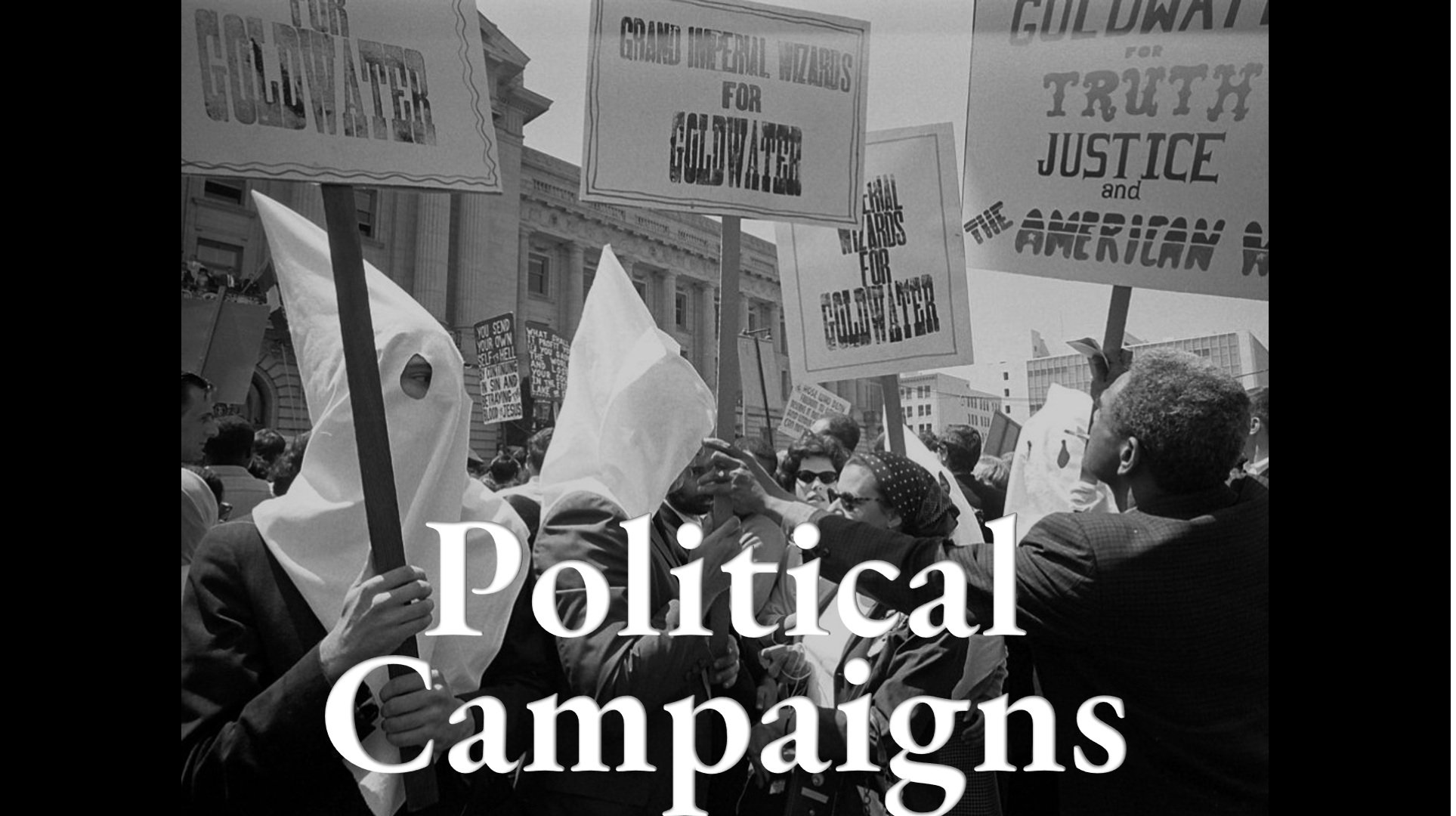
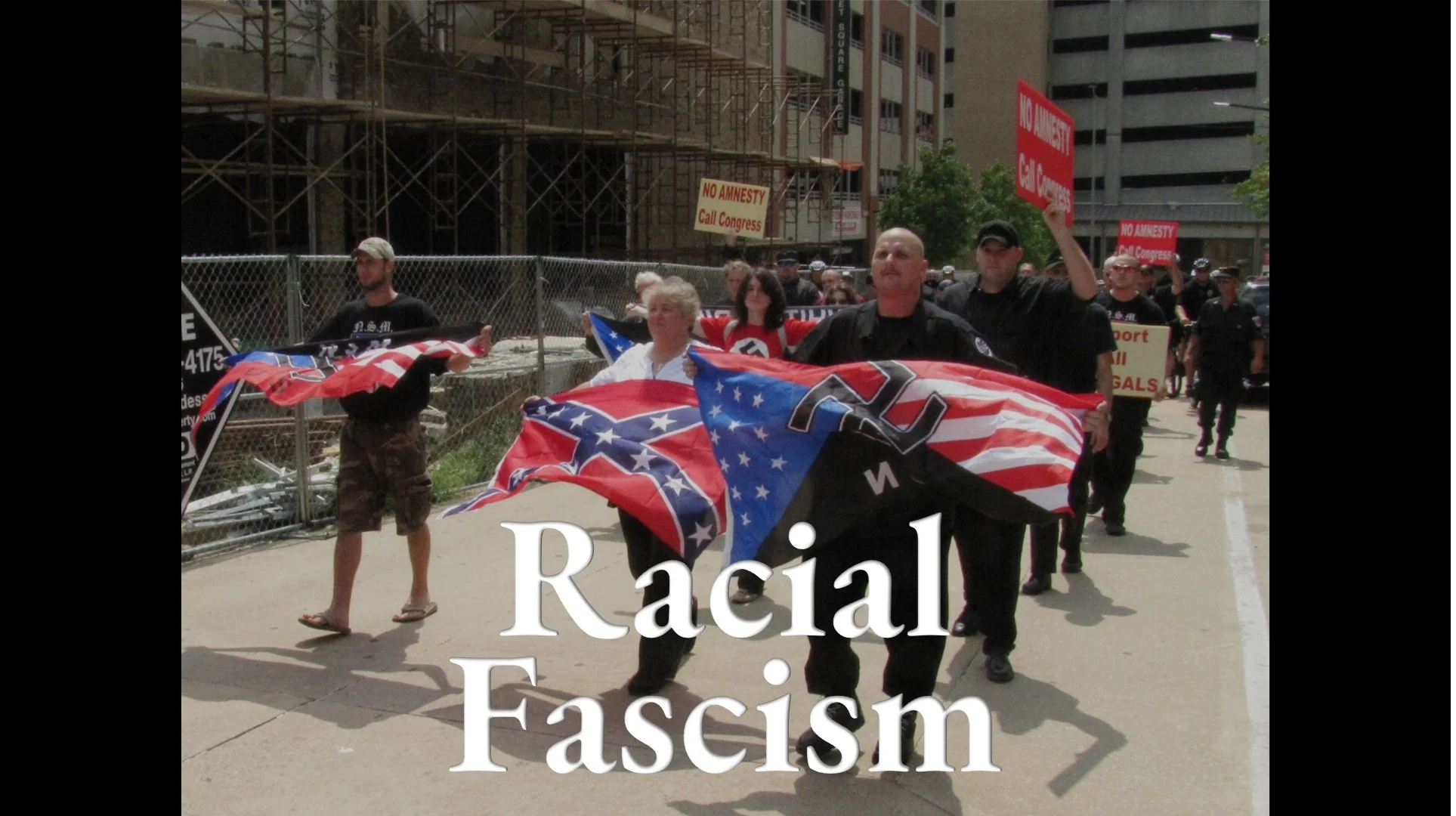
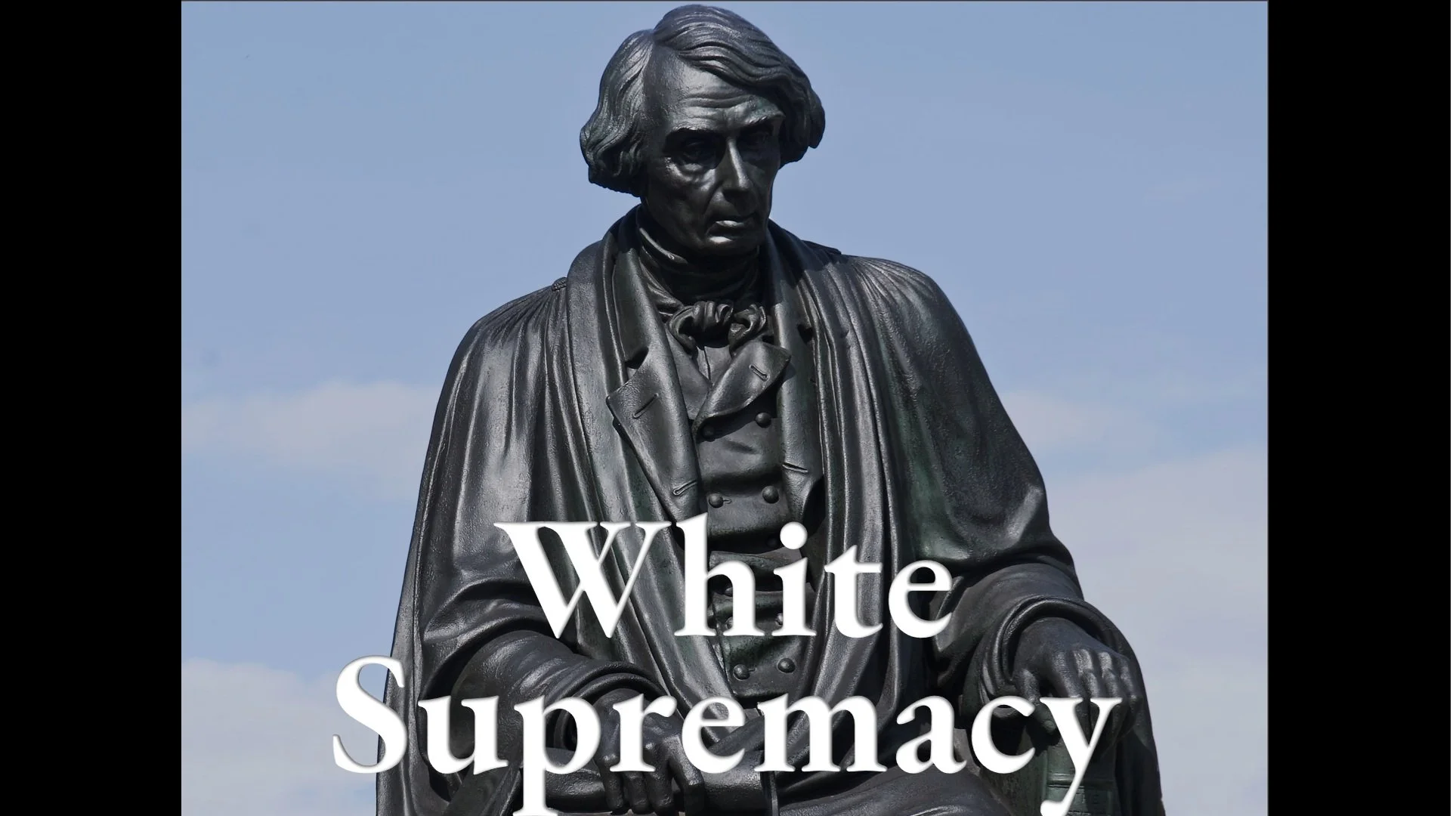
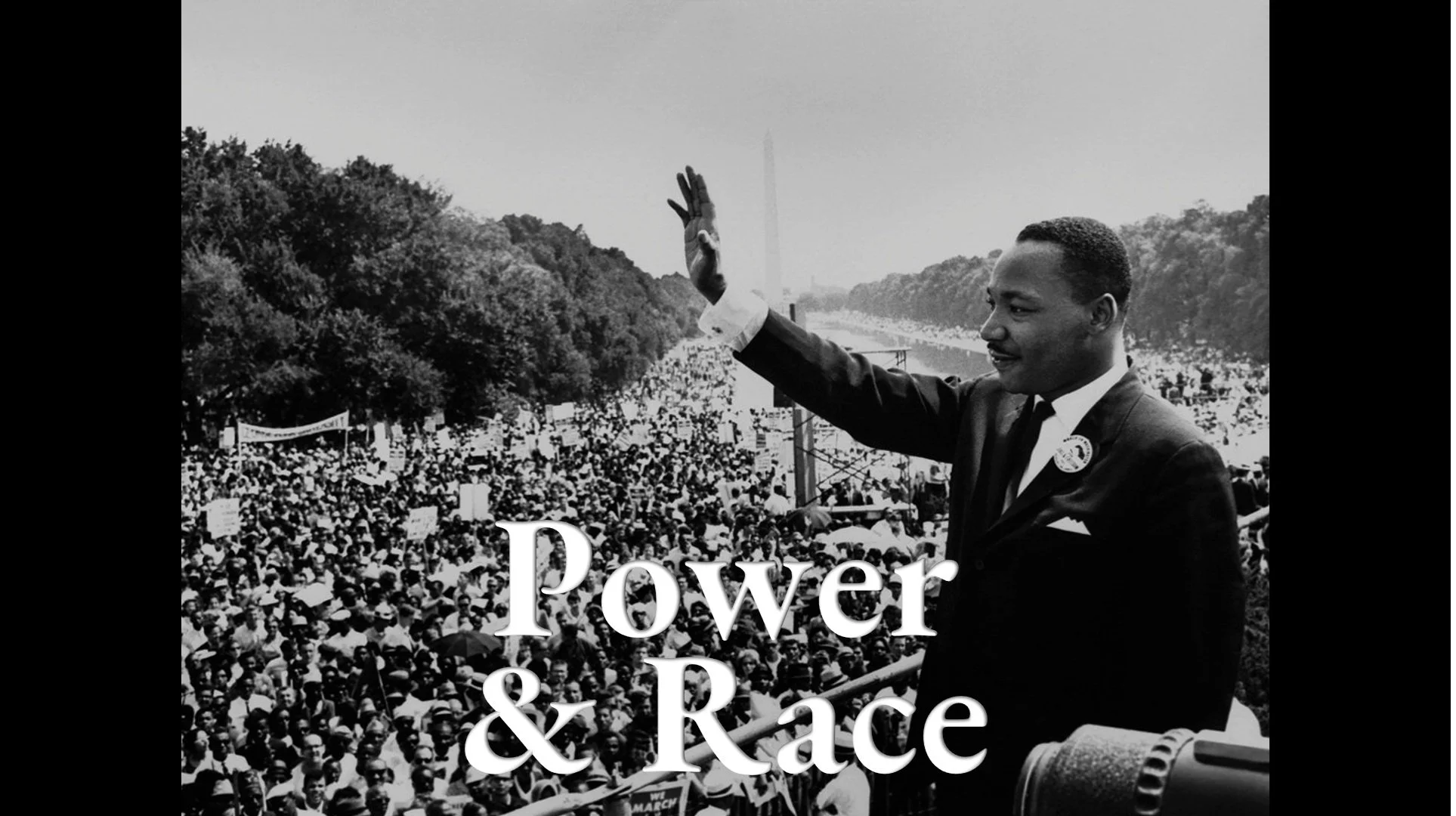
Race: Topics:


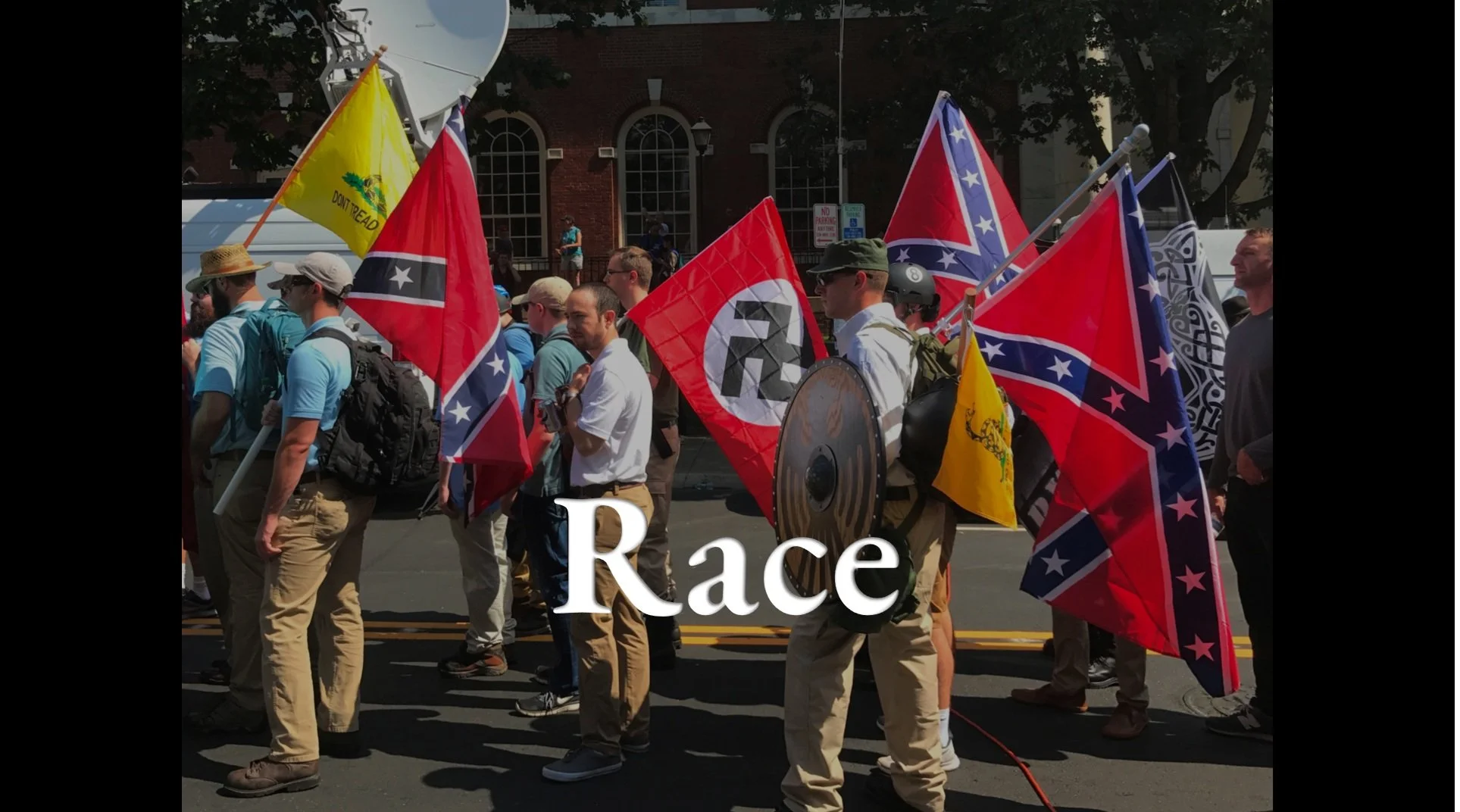
Christian Restorative Justice Critique of the Right: Domestic Policy Topics:


Church and Empire: Topics: