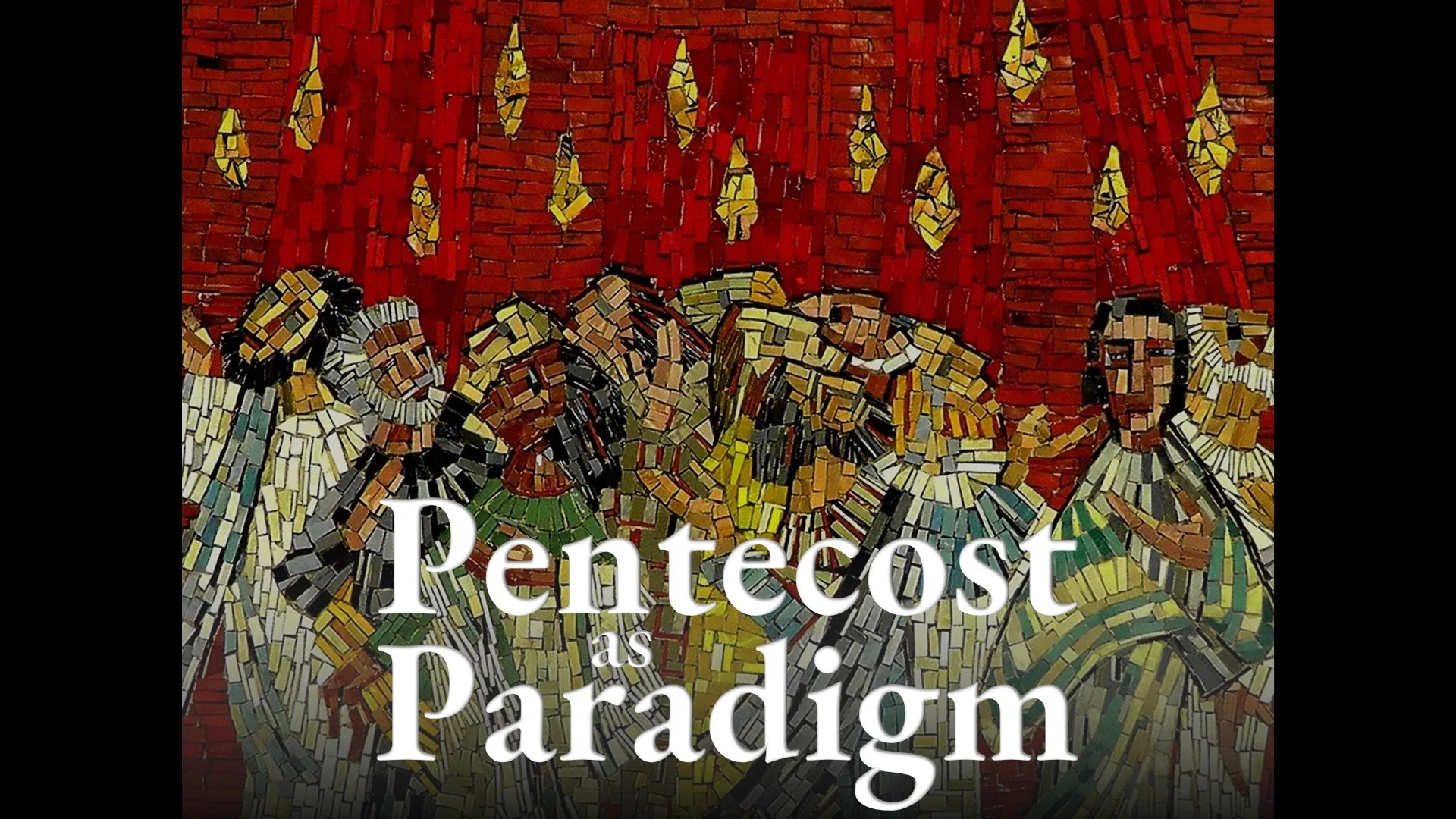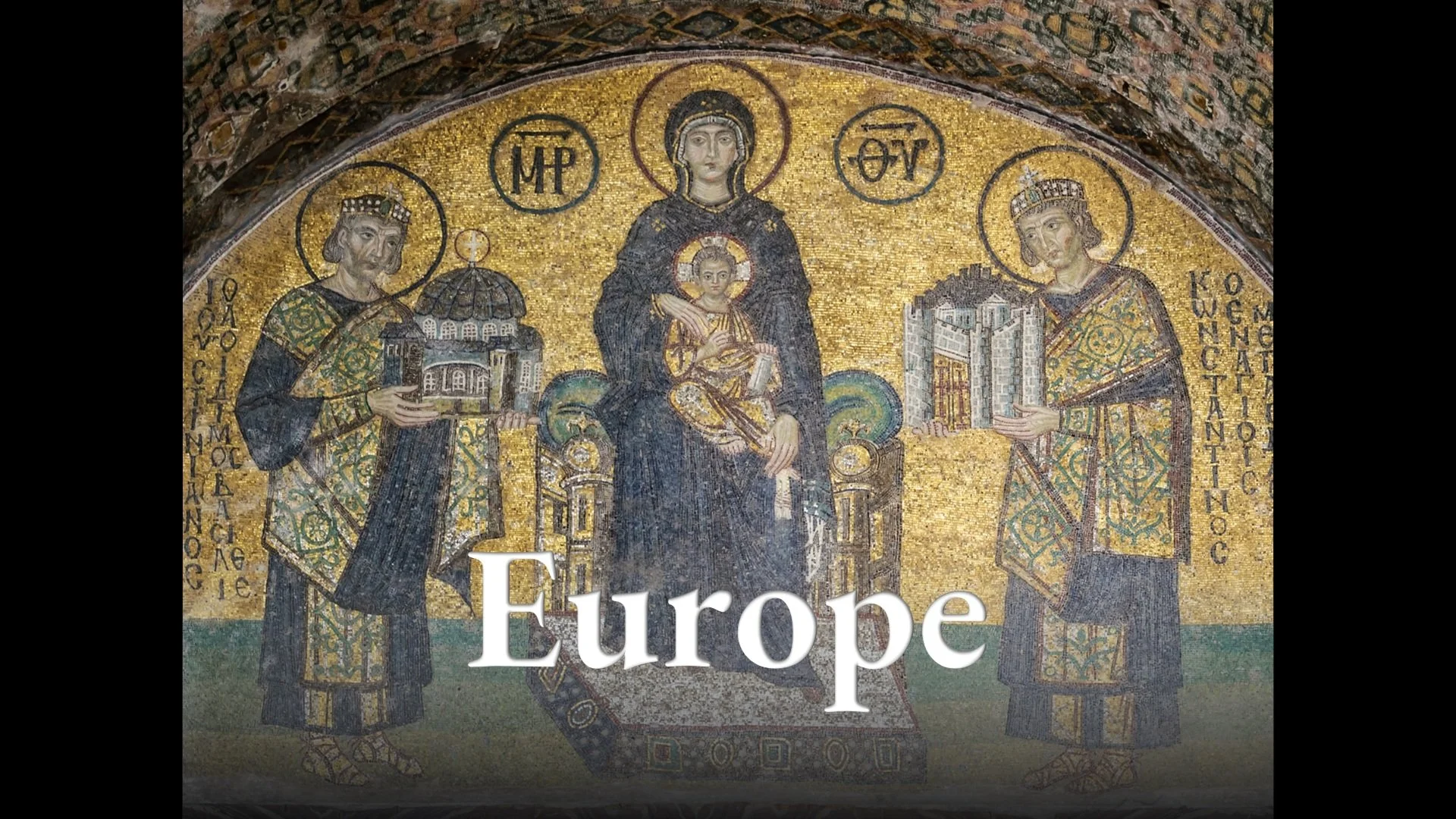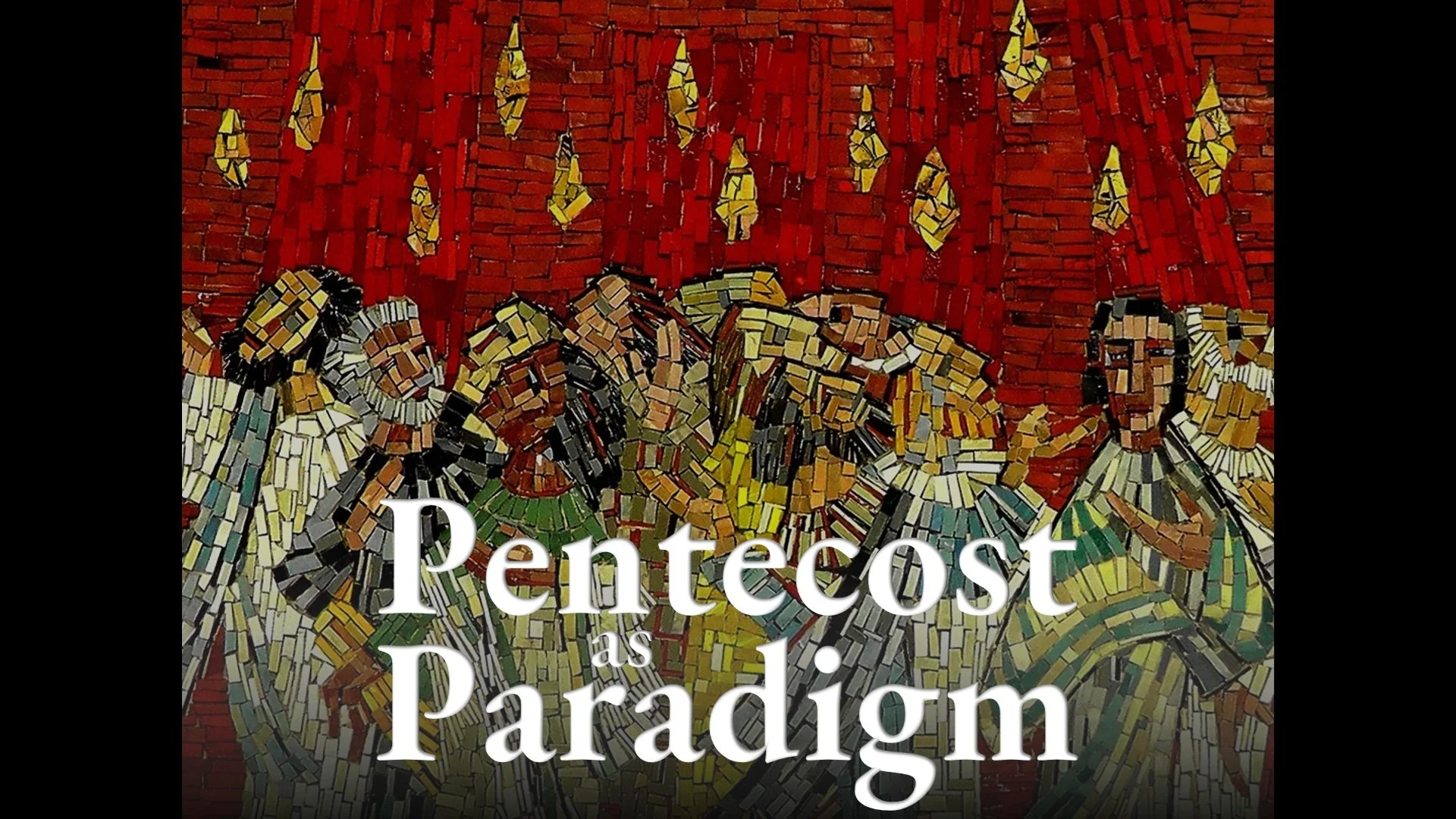
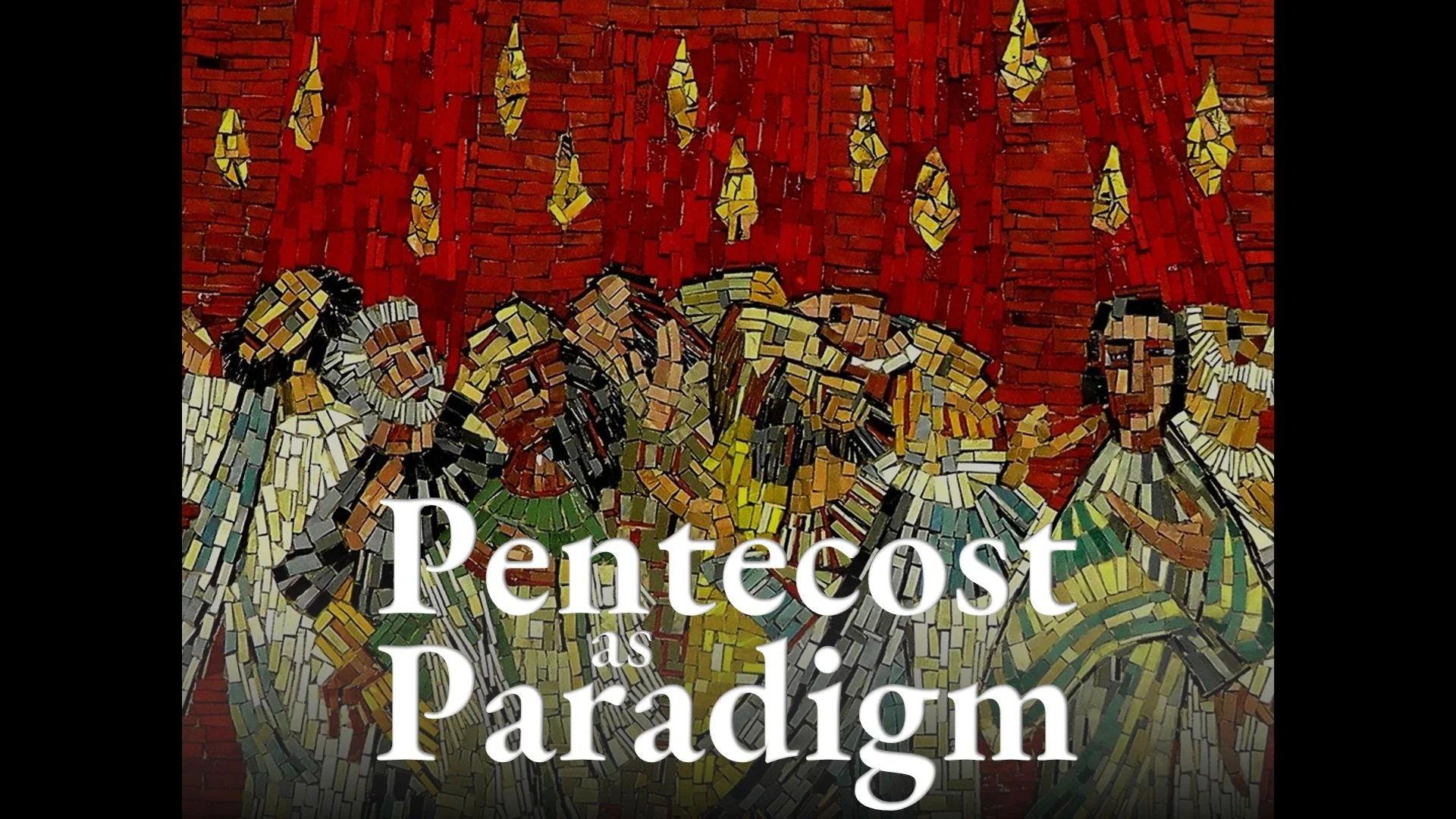
Photograph: A mosaic of Pentecost, the event in Acts 2 when the Lord Jesus sent his Spirit, and caused his disciples to speak in the tongues of the world. Photo credit: music4life, Pixabay.
Introduction: Why Study Pentecost?
Pentecost sets a paradigm for Christian engagement with language, culture, and political toleration.
The selection of perspectives on church history in this section — Church and Empire — has been guided by three factors: (1) to demonstrate that Christianity has not been a “white man’s religion”; (2) the study of empire as a recurring motif in Scripture by recent biblical studies scholars; and (3) explorations of biblical Christian ethics on issues of power and polity, to understand how Christians were faithful to Christ or not. Christian relational ethics continues a Christian theological anthropology that began with reflection on the human nature of Jesus, and the human experience of biblical Israel.
Messages and Resources
Video of a message given at Neighborhood Church of Dorchester, Aug 16, 2020. Pentecost in Acts 2:1 - 11 is the expression of Jesus’ new humanity for all humanity. It is outward, self-giving, missional, and embracing of other languages and cultures. It is not monocultural, monolingual, self-protective, and fearful. Explains why Christian nationalism in the U.S. is such a problem, and wrong. See also text in pdf format. This message is part of a series on our website in the Christ vs. Empire section, which is also available on our YouTube channel.
God as the Foundation of Human Rights
Text of a message on Genesis 1 - 11. Genesis 1 - 11 was aware of other Ancient Near Eastern and Mediterranean creation stories, and argued against them, as shown by the literary analysis of these literatures. Topics of disagreement include: the value of every human being; the relations of humans and God/gods; the reason for catastrophes like the Flood; the resolution or movement.
Why Did God Choose a "Chosen People"? Why Not Just Skip Right to Jesus?
Why Israel was a multi-ethnic faith community, and what implications that has, addressed in Part 1. Accusations abound of God being racist by selecting a "chosen people," or expressing favoritism by defending Israel against Egyptians, Canaanites, and others. This is why a loving God had to have an Israel as a covenant partner as a precursor to Jesus.
Hebrew Messianic Hope as Anti-Imperial Declaration (TBD)
This paper will trace the theme of empire through the Old Testament.
Human Dignity: Does Every Individual Matter?
Science, philosophy, existentialism, other religions, and double-predestination based theologies mean that some human beings do not matter. Only a fully Trinitarian theology with a medical substitutionary atonement can provide an adequate foundation.
Why Question Atheism from a Political and Moral Perspective?
A presentation on how the Enlightenment tradition gave birth to racist liberal democracies on the one hand, and Marxist communism/state-capitalism on the other. The Enlightenment tried to dethrone Christian faith from political theory and the Christian church from political power. Thus, the ideology of the individual and the nation-state went to these two extremes, colored by the presumption of cultural, intellectual, and spiritual superiority that Europeans had about themselves. Protestant heresies, fed by self-imposed Protestant ignorance about the church prior to Luther, and combined with a growing nationalism, accelerated the problem. Race became the badge of membership in Empire or the token of citizenship in the Nation-State. Authentic Christianity, therefore, must stress Pentecost (a principled cultural diversity) as the expression of Jesus' new humanity for all humanity.
The Role of Jesus in Revolution and the Pursuit of Justice
This is an evangelistic message that highlights the Christian-led and Christian-influenced non-violent resistance movements throughout the world in the 20th century. They show the connections and spiritual vitality of Christian faith under empire or empire-like oppression.
White American Evangelical Political Attitudes and Behavior: Explanation and Correctives
White American evangelical political attitudes can be characterized by the debate between John Winthrop and Roger Williams, and their respective attitudes towards Native Americans, slavery, fairness, and faith in the civic space. This is a presentation also explores Scripture and church history to argue that Roger Williams was correct. Given to the staff of Emmanuel Gospel Center, Apr 18, 2018, as a follow-up to how Christian restorative justice impacts ministry; audio file here
Reflection on the Presidential Election of 2016
Text of a reflection written on November 30, 2016. The reflection voiced a concern about how white American evangelicals are turning towards Vladimir Putin and the Russian Orthodox Church as a model of a state-church partnership, in order to politically oppose Muslims and pro-gay voices. This continues to unfold. See "The Fellowship Foundation" aka "The Family" in Washington DC and the National Prayer Breakfast being a way to work around the State Department.
-
Global Ethnodoxology Network (website) ethnodoxology means “people” and “praise” including the arts. See this YouTube playlist with videos from GEN's global leaders as they describe their ministries in various countries. The series is called, "I am an ethnodoxologist."
Epistle to Diognetus (1st - 2nd century), New Advent. Chapter 5 displays the early Christian approach to culture, language, and political identity:
"For the Christians are distinguished from other men neither by country, nor language, nor the customs which they observe. For they neither inhabit cities of their own, nor employ a peculiar form of speech, nor lead a life which is marked out by any singularity. The course of conduct which they follow has not been devised by any speculation or deliberation of inquisitive men; nor do they, like some, proclaim themselves the advocates of any merely human doctrines. But, inhabiting Greek as well as barbarian cities, according as the lot of each of them has determined, and following the customs of the natives in respect to clothing, food, and the rest of their ordinary conduct, they display to us their wonderful and confessedly striking method of life. They dwell in their own countries, but simply as sojourners. As citizens, they share in all things with others, and yet endure all things as if foreigners. Every foreign land is to them as their native country, and every land of their birth as a land of strangers."
See also Chris Gehrz, In American Culture, But Not of It. The Pietist Schoolman | Substack, Jan 11, 2024. “What would the Letter to Diognetus say today?”
Alan F. Segal, Rebecca's Children: Judaism and Christianity in the Roman World. Harvard University Press | Amazon page, 1986. An intriguing reinterpretation.
Dr. Anthony Fauci, A Goal of Service to Humankind. NPR, Jul 25, 2005. Although this is not a statement explicitly about political theology per se, Dr. Fauci’s recognition that public health is a global health issue, rooted in principles from his Jesuit education, is impressive and corresponds with biological reality over political dynamics.
Randall Nolan, A Mediating Tradition: The Anglican Vocation in Australian Society. Griffith University Ph.D. dissertation, May 2007. Nolan gives helpful examples of cultural contextualization and undoing the injustices of colonialism.
Akilah Johnson, Chapel Services Test Gordon College's Values. Boston Globe, Feb 24, 2014. Johnson gives a case study of white American resistance to multi-cultural Christianity and mission.
Kay Higuera Smith, Jayachitra Lalitha, L. Daniel Hawk, Evangelical Postcolonial Conversations: Global Awakenings in Theology and Praxis. InterVarsity Press | Amazon book, Jul 2014.
Andy Crouch, Gabe Lyons, Culture, Power, and Institutions. Q Ideas video, 2014.
Ched Myers, Pentecost: Divine Polyculture vs. Imperial Monoculture (Genesis 11 and Acts 2). Radical Discipleship, May 21, 2015. Myers gives a helpful theology of culture, although historically, empires have a better track record at managing cultural diversity because they tend to be pluralistic, whereas nation-states are more prone towards monoculture.
Geoffrey Holsclaw, Is Babel Reversed at Pentecost? Northern Seminary blog, May 26, 2015. Holsclaw provides a helpful theology of culture.
Joseph Pearce, Turning Multiculturalism on its Head. The Imaginative Conservative, Jul 17, 2016. Pearce offers a subsidiarist, localist view of culture which is thoughtful, but still not a Pentecost-driven multiculturalism fueled by a Christ-centered vision of a new humanity for all humanity
Lizzie Stromme, Multiculturalism Creates Divisions and Has No Future in Europe, Blasts Church Leader. Express, Nov 21, 2016. Russian Orthodox Patriarch Kirill referring to decentered, or unprincipled multiculturalism. It is unclear, however, whether the Russian Orthodox Church leadership is being faithful to the vision of Pentecost or being obedient to the lure of mono-cultural nation-building. See Sergei Chapnin, A Church of Empire: Why the Russian Church Chose to Bless Empire. First Things, Nov 2015 and Ryan P. Hunter, Analyzing the Transformation of Church-State Relations in Russia from 1987 to 2008. Ryan P. Hunter blog, Dec 1, 2015.
Charles C. Chaput, (Re)Building the Kingdom: Secularism, Christianity, and Cultural Renewal. Witherspoon Institute, May 5, 2017.
Camille Paglia, Hillary Wants Trump to Win Again. The Spectator, Dec 4, 2018. Paglia argues, "comparative religion is the true multiculturalism and should be installed as the core curriculum in every undergraduate program. From my perspective as an atheist as well as a career college teacher, secular humanism has been a disastrous failure.” This is not a Christian article or perspective per se, but shows that leftist secularists sometimes blur the distinctions between religious communities, and what the negative consequences might be.
Chase Padusniak, Christianity and Christchurch. Jappers & Janglers | Patheos, Mar 19, 2019. Padusniak gives helpful commentary on political discourse outside the U.S.
Ari Lamm, Israel’s Political Mythology. First Things, Oct 10, 2019. Lamm examines the political and cultural role played by the Idumeans among the Jews at the time of Jesus; suggests that “Jewishness” is more complicated and permeable than simply “ethnicity,” and/or that the State of Israel has the potential of being more tolerant towards people who do not identify as “ethnic Jews”
Tim Mackie, God’s Global Family. The Bible Project, 2020. “Jesus unites his followers across cultural and ethnic lines as members of his global family. But that doesn’t mean cultural differences disappear. In fact, Jesus resurrects and glorifies what is unique and beautiful about every culture. In this episode, listen in as Tim and Jon discuss what it means to be part of the family of God.” A helpful, personal one hour discussion.
Bjorn Krondorfer, It’s 1933, and Franklin Graham is German Theologian Paul Althaus. The Christian Century, Nov 4, 2020. The opposite of what Pentecost entails.
“Paul Althaus was not a radical Nazi, but his theology was thoroughly infected by völkisch ideology: the belief in the purity and unity of a peoplehood. Althaus defined this imagined peoplehood not by blood (as Nazi racial laws did) but by a shared history, soul-spirit, customs, values, and ethnicity—similar to the way some Americans speak today of Whiteness as a heritage of pride. Althaus fervently spoke in favor of God’s mission for a German nation in which Jews had no place. He did not argue for the elimination of Jews. Rather, he wanted them to live in isolated enclaves in Germany, separate from ethnic Germans.”
Terence Donaldson, Gentile Christian Identity from Cornelius to Constantine: The Nations, the Parting of the Ways, and Roman Imperial Ideology. Eerdmans | Amazon book, Nov 5, 2020. Donaldson argues that “not Jewish” played a pivotal role in the consciousness of Gentile empire building
Andrew Mark Henry, The Origins of Hebrew. Religion for Breakfast, Apr 14, 2021. Henry details the archaeological evidence and dominant theories of linguistic development. While the timeline might be shifted earlier because it is based on stonework and ceramic materials, and not papyri, the overall impression is important. From an archaeological perspective, Hebrew appears to be a development taking place between 1000 - 587 BCE in a region with many different linguistic and scribal traditions. It may be a blend of those traditions, reinforcing the biblical portrait of Israel being a multi-ethnic faith community that was designed to be a good neighbor to others.
Kavitha Cardoza and Rebecca Griesbach, An Alabama Superintendent Made Big Gains. He Was Shown the Door. Hetchinger Report | Alabama.com, Aug 6, 2024. A touching story involving funding of English learners programs for mostly Latino immigrants. Superintendent Heath Grimes said, “Jesus loved the people that everybody else didn’t. And that was part of his message — you love your enemies, you love your neighbors, you love the foreigners, you love the sinner,” he said. “I see God in those children.”
Paul Kingsnorth, Against Christian Civilization | 2024 Erasmus Lecture. First Things, Oct 28, 2024.
“When I hear Steve Bannon talking about Christian nationalism as the spear point of his holy war against the globalists, I hear a faint echo of what is coming. Civilizational Christianity puts civilization first and Christianity second. Its proponents are less interested in whether the faith is actually true or transformative, then in what use it can be to them in their ongoing culture war. The best known current proponent of civilizational Christianity is the psychologist and pundit, professor Jordan Peterson.”
Richard Beck, The Politicization of Enchantment. Experimental Theology with Richard Beck | Substack, Nov 18, 2024.
“I bring this up because there's more and more conversation happening about enchantment and re-enchantment, and some of this discussion is being politicized and mobilized for the culture wars. If not directly, than indirectly. Enchantment is a huge topic right now, and much of that conversation is taking place in right-wing or right-wing adjacent spaces. Enchantment is being used as an argument for the West to return to Christendom. Enchantment as means to restore Christian "civilization." To put it plainly, a lot of those who write or talk about enchantment seem more in love with Christianity than with Christ. Just follow the talk about enchantment on outlets like The Daily Wire. Or observe the politics and political sympathies of prominent writers and thinkers discussing enchantment.”
Pat Kahnke, I Got Dozens of Bigoted Comments from "Christians" When I Dared To Defend Immigrants. Culture, Faith, and Politics, Dec 8, 2025. Pat Kahnke is a former pastor who spoke out against Trump’s verbal insults of the Somali community in Minnesota. Kahnke was mentored by John Piper in Minneapolis.
Rabbi Haim Sofer, Can Judaism Exist Without Zionism? Al Jazeera, Sep 20, 2026. A fascinating account from the perspective of Babylonian Jewry durng the exile. Rabbi Sofer narrates history: Christian Byzantine Empire fought the Persian Empire and almost won, which also threatened Jews. But in his view, God raised up Islam among the Arab people to push back the Byzantine Christians and protect Jews. Then came the Golden Age in Spain from 711-1492, when the Muslim Caliphate welcomed Jews into governance, and helped general flourishing and Jewish flourishing in particular. When Christian Spaniards won the reconquest, 300,000 Jews left Spain with the Muslims, or faced the Inquisition. Rabbi Sofer is very critical of Zionism as a terrorist movement. This is a fascinating and very important perspective from Diaspora Judaism.
Church: Topics:


Church and Empire: Topics: