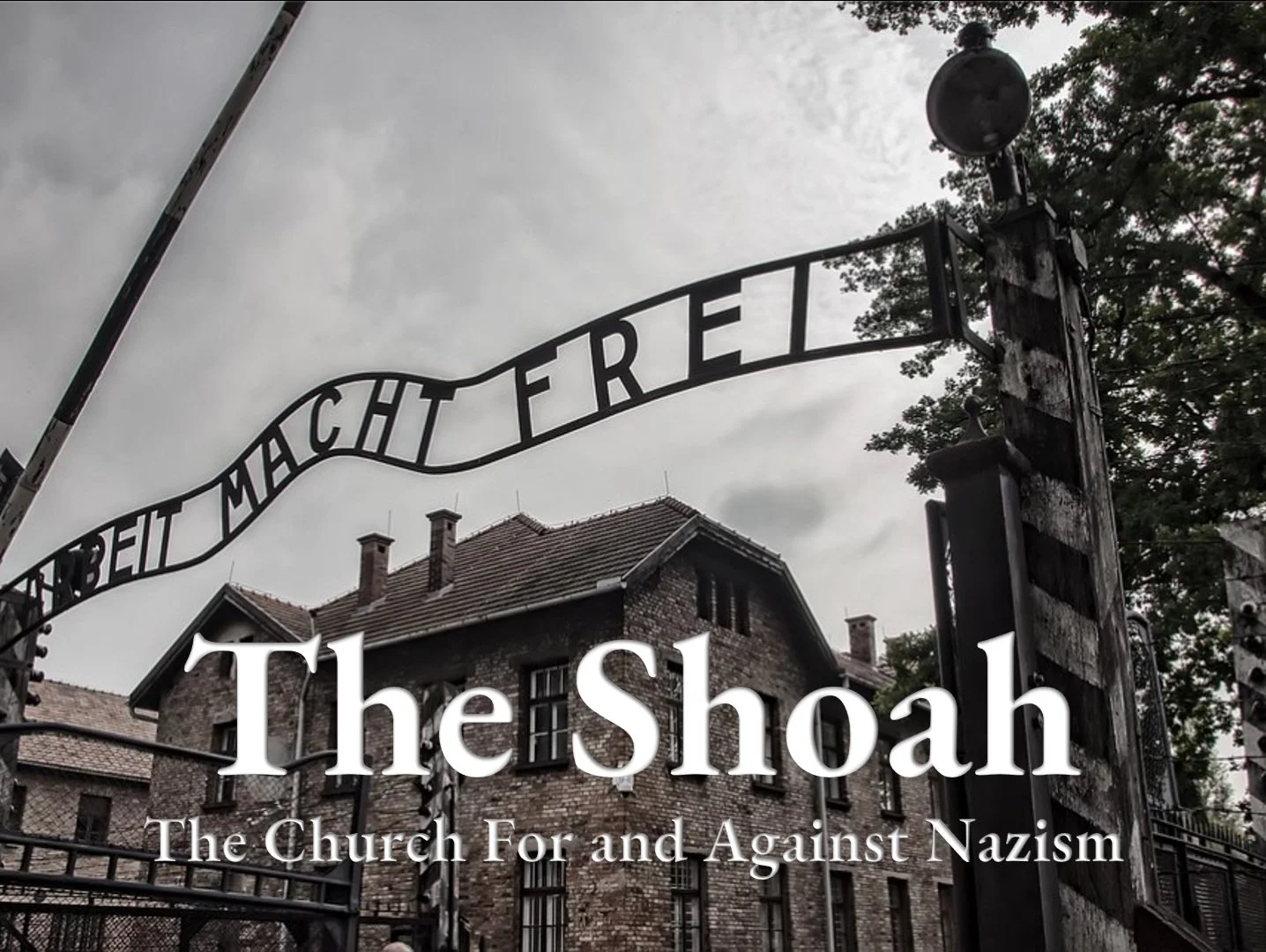
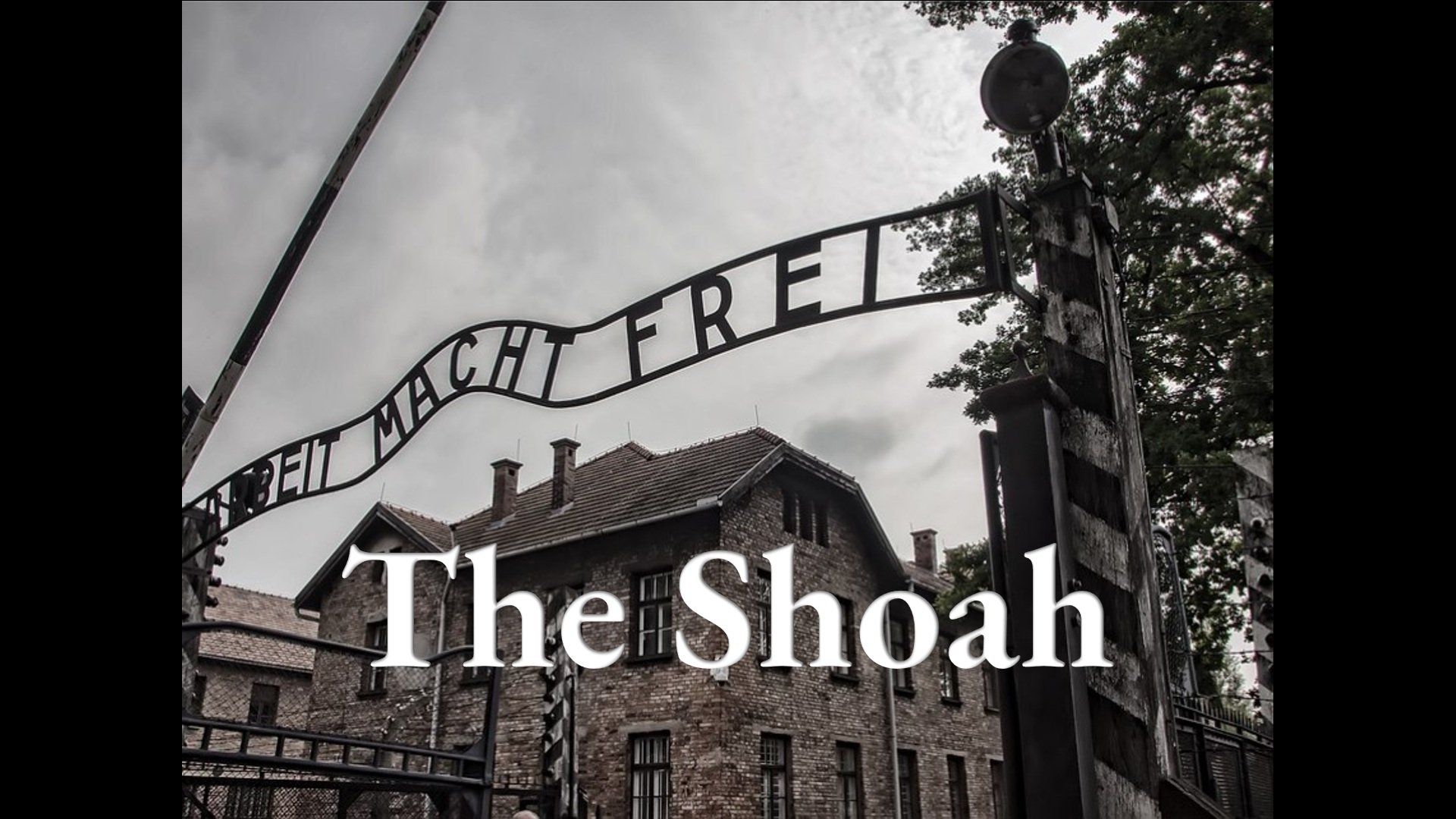
Photograph: Auschwitz, Poland. Photo credit: peter89ba | Public Domain, Pixabay. In Hebrew, “shoah” means “calamity.” This term is preferable to “the Holocaust” because “holocaust” is the English translation of the Hebrew word for “burnt offering.” Ironically and sadly, “burnt offerings” in the Hebrew Scriptures were honorable ways to express devotion to God. Therefore, we prefer to use the term “shoah.”
Introduction
This section explores the experience and activities of Christians under the Nazi regime. Resources highlighting the church’s resistance to Nazism are listed in the first part of this page. Resources highlighting the church’s complicity with Nazism are listed in the second half.
Resources on Christianity and Anti-Semitism
See the slides to this presentation. The presentation examines the relationship between the Church and Israel. We begin with the Dead Sea Scrolls and the Qumran Community, who saw themselves as a fulfillment of Israel inviting the rest of Israel to join them. This hinges on a view of the Sinai covenant as an analogy to medical treatment, where God’s role in the sanctuary played the role of a dialysis machine.
The Chiastic Structure of the Pentateuch
Notes on how the Pentateuch possesses a chiastic literary structure. This structure is vital to observe when studying and teaching the Pentateuch. The center of the Pentateuch is the story of Moses ascending Mount Sinai, stabilizing the covenant, and returning with his face shining with divine light. Moses stabilized the Sinai covenant. Yet the Pentateuch already saw the need for a "new Moses" who would not simply stabilize the Sinai covenant, but circumcise the human heart, and invest God's glory into the human face -- in fact, all of human nature.
A paper written for Dr. Bruce Beck, at Holy Cross Greek Orthodox Seminary, for his class on the Gospel of Matthew. Establishes that Jesus and Matthew were using the distinction between parents and children from the exodus, and applying it to the parents and children of Jesus’ day. This has significance for the accusation that Matthew is anti-Semitic.
-
Wikipedia, Individuals and Groups Assisting Jews During the Holocaust (Wikipedia article)
Wikipedia, Archbishop Damaskinos of Athens (Wikipedia article) whose actions and advocacy saved thousands of Jews during WW2
Wikipedia, Council of Jews and Christians (Wikipedia article) a voluntary organization in Britain working against anti-Semitism
Sir Nicholas Winton, Man Who Rescued Nearly 700 Holocaust Victims Finds Himself in an Audience Comprised Entirely by Those He Saved. BBC, 1988. Winton was not a professing Christian but his is a noteworthy story.
Father Arthur B. Klyber, The Chief Rabbi’s Conversion. Catholic Answers, Apr 1, 1992. Pope Pius XII, who was called “Hitler’s Pope,” baptized Rabbi Israel Zolli. In part, this conversion attests to Pius’ leadership of an “underground railroad” through the Catholic network in Germany to help Jews escape the Nazis.
“On February 17, 1945, Israel Zolli, the Chief Rabbi of Rome, and his wife were baptized in the Basilica of St. Mary of the Angels by Msgr. Luigi Tralia. Zolli was the Chief Rabbi of Trieste for 35 years before coming to Rome. His deep learning in the Scriptures and Semitic literature may be seen in the many books he published. Catholic scholars publicly recognized this learning years before his conversion, when they invited him to assist in the work of the Pontifical Biblical Commission, and in the compiling of the Italian Catholic Encyclopedia.”
However, one Jewish source condemns Rabbi Zolli for simply being a beneficiary of the Vatican. See Tovia Singer, Why Did the Chief Rabbi of Rome Convert to Catholicism? Outreach Judaism, Apr 28, 2014.
International Raoul Wallenberg Foundation, Research on Angelo Roncalli’s Humanitarian Actions. International Raoul Wallenberg Foundation, 2000 and 2001. Three reports detailing the activities of then Papal Nuncio Angelo Roncalli, the future Pope John XXIII.
Rabbi David G. Dalin, The Myth of Hitler's Pope: Pope Pius XII And His Secret War Against Nazi Germany. Regency History | Amazon page, Jun 2005. "How Pope Pius XII rescued Jews from the Nazis" and review by Wikipedia, The Myth of Hitler's Pope (Wikipedia article)
Francis R. Nicosia, Germans against Nazism: Nonconformity, Opposition and Resistance in the Third Reich. Bloomsbury Academic | Amazon page, Jan 1992.
Brian Rosner, Bonhoeffer: Pastor, Martyr, Prophet, Spy - A Righteous Gentile vs. the Third Reich. Centre for Public Christianity, May 12, 2011.
Michael Ignatieff, One Country Saved Its Jews. Were They Just Better People? The Surprising Truth about Denmark in the Holocaust. New Republic, Dec 14, 2013.
Tim Townsend, Mission at Nuremburg: An Army Chaplain and the Trial of the Nazis. Religion and Politics, Apr 23, 2014.
Madison Park, How the Philippines Saved 1,200 Jews During the Holocaust. CNN, Feb 3, 2015.
Stephen Yolland, Sophie Scholl: The Final Days. blog, Feb 23, 2015. German Christian students resisting Hitler and Nazism, getting caught, and executed
Irene Archos, Mother Maria of Paris Says "Oxi!" to the Nazi Mass Murder Machine. Pravoslavie, Mar 11, 2015.
David Gelernter, Why Should a Jew Care Whether Christianity Lives or Dies? First Things, Mar 24, 2015.
Andrew Higgins, WWII Hero Credits Luck and Chance in Foiling Hitler’s Nuclear Ambitions. New York Times, Nov 20, 2015.
Robert D. McFadden, Nicholas Winton, Rescuer of 669 Children From Holocaust, Dies at 106. New York Times, Jul 1, 2015.
Catholic News Agency, Heroic Virtue of Ukrainian Bishop Who Sheltered Hundreds of Jews Recognized. Catholic News Agency, Jul 17, 2015.
John Sandinopoulos, The NO of Greek Clergy in 1940. Mystagogy blog, Oct 28, 2015.
Ishaan Tharoor, What Americans Thought of Jewish Refugees on the Eve of World War II. Washington Post, Nov 17, 2015. A sad counterexample.
Daniel A. Gross, The U.S. Government Turned Away Thousands of Jewish Refugees, Fearing That They Were Nazi Spies. Smithsonian Magazine, Nov 18, 2015. A sad counterexample.
Carol Kuruvilla, Japanese Schindler Who Saved 6,000 Lives During World War II Finally Gets a Movie. Huffington Post, Jan 19, 2016. Re: Chiune Sugihara who converted to Russian Orthodox Christianity in the 1920's and took the baptismal name Sergei Pavelovich.
David Swanson, Top 12 Reasons the Good War Was Bad: Hiroshima in Context. Washingtons blog, May 24, 2016.
Newsner, Woman Hides Thousands of Children in Coffins - Then She's Arrested and Her Dark Secret Emerges. Newsner, Dec 17, 2016.
BBC Select, Rise Of The Nazis | Episode 1. BBC Select, Oct 14, 2021. Mentions the human rights lawyer Hans Litten, who was born Jewish but was baptized Lutheran, questioned Hitler for three hours to tie him and the Nazis to organized violence, and later found a conspiracy between the Nazi stormtroopers and local police.
Menachem Z. Rosensaft, The Ambiguity of Evil and Good: A Tale of Holocaust Rescue and Deportation in Bulgaria. Just Security, May 23, 2023. Rosensaft evaluates King Boris III’s narrative and remarks to show that he was indeed an antisemite. The King bowed to public outcries and pressure by Catholic and Orthodox and civil society leaders to not deport 48,000 Jews from “Old” Bulgaria. Notably:
“Meanwhile, two metropolitans of the Bulgarian Orthodox Church, Stefan of Sofia and Kiril of Plovdiv, also got wind of the impending deportations and spoke out forcefully, both publicly and privately, against them. Kiril went so far as to threaten in a telegram to Boris that he would lie on the railroad tracks to prevent the trains from leaving.”
Chris Gehrz, The Bishop of the Resistance. The Pietist Schoolman, Oct 10, 2023. Norway’s Lutheran bishop Eivind Berggrav during World War II.
-
Hermann Göring, “God gave the savior to the German people. We have faith, deep and unshakable faith, that he [Hitler] was sent to us by God to save Germany. How shall I give expression, O my Führer, to what is in our hearts? How shall I find words to express your deeds? Has there ever been a mortal as beloved as you, my Führer? Was there ever belief as strong as the belief in your mission. You were sent to us by God for Germany!” (Wikiquote, Hermann Göring, 1934)
Robert P. Ericksen, Theologians Under Hitler: Gerhard Kittel, Paul Althaus, and Emanuel Hirsch. Yale University Press | Amazon page, Jan 1985.
“What led so many German Protestant theologians to welcome the Nazi regime and its policies of racism and anti-Semitism? In this provocative book, Robert P. Ericksen examines the work and attitudes of three distinguished, scholarly, and influential theologians who greeted the rise of Hitler with enthusiasm and support. In so doing, he shows how National Socialism could appeal to well-meaning and intelligent people in Germany and why the German university and church were so silent about the excesses and evil that confronted them. "This book is stimulating and thought-provoking....The issues it raises range well beyond the confines of the case-studies of the three theologians examined and have relevance outside the particular context of Hitler's Germany....That the book compels the reader to rethink some important questions about the susceptibility of intelligent human beings to as distasteful a phenomenon as fascism is an important achievement."-Ian Kershaw, History Today”
Doris L. Bergen, Twisted Cross: The German Christian Movement in the Third Reich. University of North Carolina Press | Amazon page, 1996. "Focusing on the 600,000 self-described 'German Christians,' who sought to expunge all Jewish elements from the Christian church. In a process that became more daring as Nazi plans for genocide unfolded, this group of Protestant lay people and clergy rejected the Old Testament, ousted people defined as non-Aryans from their congregations, denied the Jewish ancestry of Jesus, and removed Hebrew words like 'Hallelujah' from hymns. Bergen refutes the notion that the German Christians were a marginal group and demonstrates that members occupied key positions within the Protestant church even after their agenda was rejected by the Nazi leadership. Extending her analysis into the postwar period, Bergen shows how the German Christians were relatively easily reincorporated into mainstream church life after 1945. Throughout Twisted Cross, Bergen reveals the important role played by women and by the ideology of spiritual motherhood amid the German Christians' glorification of a 'manly' church."
Robert P. Erickson and Susannah Heschel, The Betrayal: German Churches and the Holocaust. Fortress Press | Amazon page, Jan 5, 1999. A collection of essays on the Christian responses to the Nazi regime and program of extermination of the Jews.
Gregory Paul, The Great Scandal: Christianity’s Role in the Rise of the Nazis. Church and State, Oct 11, 2003. An essential reading of the history between the Nazi party and both Catholic and Protestant groups within and without Germany. Meticulously footnoted. There are some stories of courageous resistance, but the overwhelming number of stories indicate complicity with, if not enthusiasm for, the Nazis.
Thomas Albert Howard, Protestant Theology and the Making of the Modern German University. Oxford University Press, 2006. Many German theologians were “liberal” in the sense of how they viewed Scripture. And they had replaced Christian ideas/principles with secularized versions, or reduced Christianity down to cultural advance. So the impact of Christianity on civilization (sanctification) was secularized to simply "German culture." The advance of Christian truth about humanity and the planet was secularized to simply "German science and technology." Politically, we would call them “conservatives” and "nationalists" even though they were “liberal” on Scripture.
Robert P. Ericksen, Christian Complicity? Changing Views on German Churches and the Holocaust. US Holocaust Memorial Museum, Nov 2007. After sixty years of assuming that the ordinary German opposed Hitler and Nazism and the extermination of the Jews, more evidence proves otherwise.
Susannah Heschel, The Aryan Jesus: Christian Theologians and the Bible in Nazi Germany. Princeton University Press | Amazon page, Oct 3, 2010. "During the Third Reich, German Protestant theologians, motivated by racism and tapping into traditional Christian anti-Semitism, redefined Jesus as an Aryan and Christianity as a religion at war with Judaism. In 1939, these theologians established the Institute for the Study and Eradication of Jewish Influence on German Religious Life. In The Aryan Jesus, Susannah Heschel shows that during the Third Reich, the Institute became the most important propaganda organ of German Protestantism, exerting a widespread influence and producing a nazified Christianity that placed anti-Semitism at its theological center."
Nicholson Baker, Why I'm a Pacifist: The Dangerous Myth of the Good War. Harper's Magazine, May 2011. Before we blame God for the Holocaust, we need to read this article about the U.S. refusing to admit Jewish refugees, which is tragic considering the Protestant influences and leadership in the U.S.
Rainer Bucher, Hitler's Theology: A Study in Political Religion. Continuum | Amazon page, Sep 2011.
Robert P. Ericksen, Complicity in the Holocaust: Churches and Universities in Nazi Germany. Cambridge University Press | Amazon, Feb 6, 2012. See pdf book of which Christopher R. Browning, professor of history at the University of North Carolina wrote, "Based on decades of his own research and complete mastery of both German- and English-language scholarship in the field, Robert Ericksen demonstrates convincingly how a critical mass of churchmen and academics in Germany enthusiastically embraced the Nazi regime and provided the rationalizations and adjustment of moral norms that permitted ordinary Germans to accept and even implement the regime’s brutal and murderous policies." Ericksen argues that enthusiasm for Hitler in churches and universities gave German statesmen permission to participate in the Nazi regime.
Omar S. Haque, Julian De Freitas, Ivana Viani, Bradley Niederschulte, Harold J Bursztajn, Why Did So Many German Doctors Join the Nazy Party Early? International Journal of Law and Psychiatry, Sep - Dec 2012. “During the Weimar Republic in the mid-twentieth century, more than half of all German physicians became early joiners of the Nazi Party, surpassing the party enrollments of all other professions. From early on, the German Medical Society played the most instrumental role in the Nazi medical program, beginning with the marginalization of Jewish physicians, proceeding to coerced "experimentation," "euthanization," and sterilization, and culminating in genocide via the medicalization of mass murder of Jews and others caricatured and demonized by Nazi ideology.”
Manfred Gailus, 1933 As a Protestant Experience and the “Day of Potsdam”. Contemporary Church History, Jun 2017. “The unique feature of the ecclesiastical and also highly politically symbolic ceremony of March 21, 1933, in the Potsdam Garrison Church was this: it was the only church in which Hitler himself gave a speech during the twelve-year Nazi regime.”
Susannah Heschel, The Aryan Jesus: Christian Theologians and the Bible in Nazi Germany. Princeton University Press | Amazon book, Oct 3, 2010. "During the Third Reich, German Protestant theologians, motivated by racism and tapping into traditional Christian anti-Semitism, redefined Jesus as an Aryan and Christianity as a religion at war with Judaism. In 1939, these theologians established the Institute for the Study and Eradication of Jewish Influence on German Religious Life. In The Aryan Jesus, Susannah Heschel shows that during the Third Reich, the Institute became the most important propaganda organ of German Protestantism, exerting a widespread influence and producing a nazified Christianity that placed anti-Semitism at its theological center."
Stephen Waldron, What Was a Nazi Church Service Like? Theology Corner, Jan 4, 2018. A fascinating historical overview.
Alan Bean, When Churches Fail: The Abiding Challenge of Dietrich Bonhoeffer. Friends of Justice, Nov 17, 2018. A Mennonite reflection on the rise of Nazi Germany and the capitulation of German Christians
America and the Holocaust: Deceit or Indifference. Shoah - The Memory of a Holocaust, Mar 24, 2019. A documentary movie, 85 minutes
Jason Stanley, How Fascism Works: The Politics of Us and Them. Random House | Amazon page, May 2020.
Mike Corder, Dutch Protestant Church Admits Failing Jews During World War II. Associated Press and Christianity Today, Nov 9, 2020. “Ceremony recalls “sinful history” during Nazi occupation and beyond.” This article links to Suzanne Burden, Meet the Dutch Christians Who Saved Their Jewish Neighbors from the Nazis. Christianity Today, Nov 23, 2015. “Diet Eman endured Hitler’s occupation separated from her fiance, Hein Sietsma. But apart, they served in the Dutch Underground—saving at least 60 Jews from certain death.”
D.L. Mayfield, The Good White Christian Women of Nazi Germany. The Christian Century, Mar 25, 2021.
Henry Abramson, Jews and Finance in the Medieval Period (Jewish History Lab). Henry Abramson, May 2, 2021. Abramson highlights very important and sobering and regrettable dynamics of how Western European Christendom assigned Jews the role of moneylender with interest. This made the credit market possible but the backlash was focused against the Jews. This is one reason why community, public banking as opposed to private banking, is so important to a community. See also Cultural Origins, Why King Edward I Expelled the Jews from England in 1290. Cultural Origins, Oct 24, 2021. Sadly, only the royal power protected the Jews in England while also exploiting them; when Parliament gained power, Parliament expelled the Jews. See also Sam Aronow, Jews in Medieval England (1070 - 1290). Sam Aronow, Mar 19, 2021. Aronow gives more detail and ties political events in England to those happening on the Continent.
Luisa Beck, Max Bearak, and Shinovene Immanuel, Germany Acknowledges Colonial Genocide in Namibia and Promises Development Projects. Washington Post, May 28, 2021. An important touch point, with historical context. See also Luisa Beck, Germany, A Model for Coming to Terms With Its Past, Still Struggles With Its Colonial Period. Washington Post, Jan 3, 2020.
“Germany’s government acknowledged Friday that it committed genocide during its colonial occupation of what is now Namibia and promised more than $1 billion in development projects in communities descended from victims… Germany refused direct reparations that victims’ descendants had lobbied for and said development projects would be carried out over the next 30 years. The acknowledgment came more than 100 years after the genocide — a stark contrast with the public recognition and deeply imbued sense of national shame around the Holocaust that has become part of Germany’s modern identity.”
BBC Select, Rise Of The Nazis | Episode 1. BBC Select, Oct 14, 2021. Picks up the story after the Nazi failed coup, and Hitler’s imprisonment. The Nazis nevertheless gained power because of their Stormtroopers’ street violence and intimidation. The political power-whisperers thought they could harness the Nazi Party in a coalition of rightward parties against the left (Social Democrats and Communists). The Nazis infiltrated institutions.
Samuel Loncar, Christianity’s Shadow Founder: Marcion, Anti-Judaism, and the Birth of Liberal Protestantism. Marginalia, Nov 19, 2021. Examines the characteristics of the second century anti-judaic heretic Marcion of Rome, and the Protestant liberalism that originated in Germany with Friedrich Schleiermacher and his heirs. This indirectly raises the problem of the stability of language and meaning: Amputating the Old Testament from the New means that Christian faith becomes deeply unstable. If allowed to continue, the especially Lutheran — and more general Protestant — presuppositions about human nature, personhood, divine justice, and atonement could no longer be checked.
David de Jong, Nazi Billionaires: The Dark History of Germany's Wealthiest Dynasties. Mariner Books | Amazon page, Apr 2022. “A provocative group portrait of five industrialists who expanded their fortunes by colluding with Hitler and then, after World War II, walked away with minimal punishment and barely a dent in their bottom lines... In this meticulously researched book, Mr. de Jong, an investigative journalist and former reporter at Bloomberg News, compels us to confront the current-day legacy of these Nazi ties." See review by David Smith, ‘People Should Be More Aware’: The Business Dynasties Who Benefited from Nazis. The Guardian UK, May 18, 2022.
Andrew Meier, ‘The God-Damnedest Thing’: The Antisemitic Plot to Thwart U.S. Aid to Europe’s Jews and the Man Who Exposed It. Politico, Sep 23, 2022. “Henry Morgenthau used his close ties with Roosevelt to expose rampant antisemitism in the State Department that thwarted America’s efforts to provide refuge for Jews imperiled by Hitler.”
Best Documentary, The Vatican and the Third Reich: An Unholy Alliance. Best Documentary, Jun 8, 2023. A one hour video. “In the midst of WWII, Catholics looked to the pope to guide them. Hitler had already begun secretly launching his plan to exterminate the Jews of Europe. Secretly, that is, to most- except Pope Pius XII. The pope remained silent whilst the rest of the world awaited any kind of grand gesture or speech condemning Hitler’s atrocities. He chose to keep quiet in the face of the crimes committed by the Nazis throughout Europe, crimes that even took place below the Pope’s own windows, like the 1943 liquidation of the Jewish Ghetto in Rome, to which the pope made no official reaction. At first glance, Nazism and Catholicism are diametrically opposed. The Vatican even seems an institution beyond all suspicion. The Church, however, faced in turn with the rise of Nazism, the Second World War and the extermination of Jews, will play an ambiguous – at times unholy – role. Several men of the Church, priests and bishops, being fervent admirers of Hitler, even fell into complicity…”
Timothy Rybeck,The Oligarchs Who Came to Regret Supporting Hitler. The Atlantic, Feb 6, 2025. They helped him in pursuit of profit. Many ended up in concentration camps.
“After cantankerous negotiation, a deal was reached: Hugenberg would deliver Hitler the chancellorship, in exchange for Hugenberg being given a cabinet post as head of a Superministerium that subsumed the ministries of economics, agriculture, and nutrition. Once in the cabinet, Hugenberg didn’t hesitate to meddle in foreign relations when it suited him. Reinhold Quaatz, a close Hugenberg associate, distilled Hugenberg’s calculus as follows: “Hitler will sit in the saddle but Hugenberg holds the whip.”
The New York Times expressed astonishment that Hugenberg, an “arch-capitalist” who stood “in strongest discord with economic doctrines of the Nazi movement,” was suddenly in charge of the country’s finances. Hitler’s “socialist mask” had fallen, the Communist daily Red Banner proclaimed, arguing that “Hugenberg is in charge, not Hitler!” The weekly journal Die Weltbühne dubbed the new government “Hitler, Hugenberg & Co.”
As self-proclaimed “economic dictator,” Hugenberg kept pace with Hitler in outraging political opponents and much of the public. He purged ministries. He dismantled workers’ rights. He lowered the wages of his own employees by 10 percent. “The real battle against unemployment lies singularly and alone in reestablishing profitability in economic life,” one of Hugenberg’s newspapers editorialized, arguing that the goal of economic policy should be to rescue “the professions, and those most negatively affected: the merchant middle class.” Hugenberg declared a temporary moratorium on foreclosures, canceled debts, and placed tariffs on several widely produced agricultural goods, violating trade agreements and inflating the cost of living. “It just won’t do,” Hitler objected in one cabinet meeting, “that the financial burdens of these rescue measures fall only on the poorest.” Let them suffer awhile, Hugenberg argued. “Then it will be possible to even out the hardships.” The economy fell into chaos. The press dubbed Hugenberg the Konfusionsrat —the “consultant of confusion.”
Thorsten Wagner, Clergy and Complicity: Religion in Nazi Germany. Center for Public Theology and Public Policy, Yale Divinity School, Dec 2, 2025.
“The ascent of Hitler to power went hand in hand with a sense of a long-awaited religious and moral revival. Nazism was – especially in Protestant milieus – not primarily seen as a threat, but often as a potential force for good, pushing back against godlessness, moral depravity, decadence, and decay. What can exploration of the complex interrelationship between religious leaders and the emergent authoritarian Nazi regime reveal about the precarious situation of organized religion in the modern world today?”
Church and Empire: Topics:
This page is part of our section on Church and Empire. These resources begin with a biblical exposition of Empire in Church and Empire and the meaning of Pentecost in Pentecost as Paradigm for Christianity and Cultures, then grouped by region.
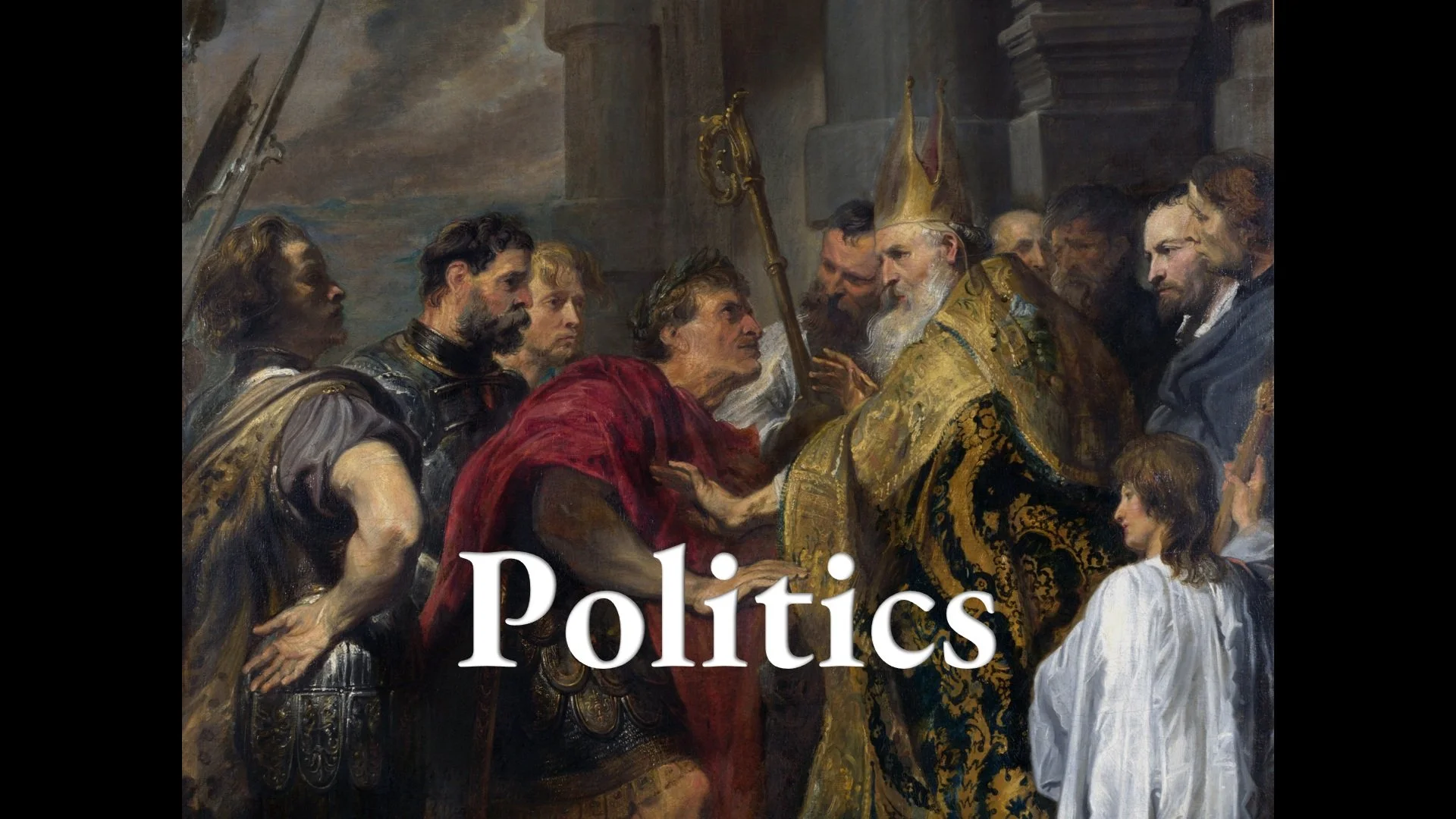
Suffering: Topics:
This section on Suffering is organized in the following way: Suffering and God explains why God is good despite human suffering. African American Faith connects to the deep, living Christian tradition of resistance to human evil and hope in Christ. Grieving collects resources for healthy grieving, both biblical and otherwise. Mental Health spotlights how Jesus and our experience of him intersect with various mental health needs. Church and Shoah is about Christians who were for and against Nazi Germany; it is drawn from our Church and Empire resources; we place it here because of how often people raise it as a question connected to human suffering. General Reflections highlights other resources that may not be Christian per se, but are thoughtful and helpful to consider.