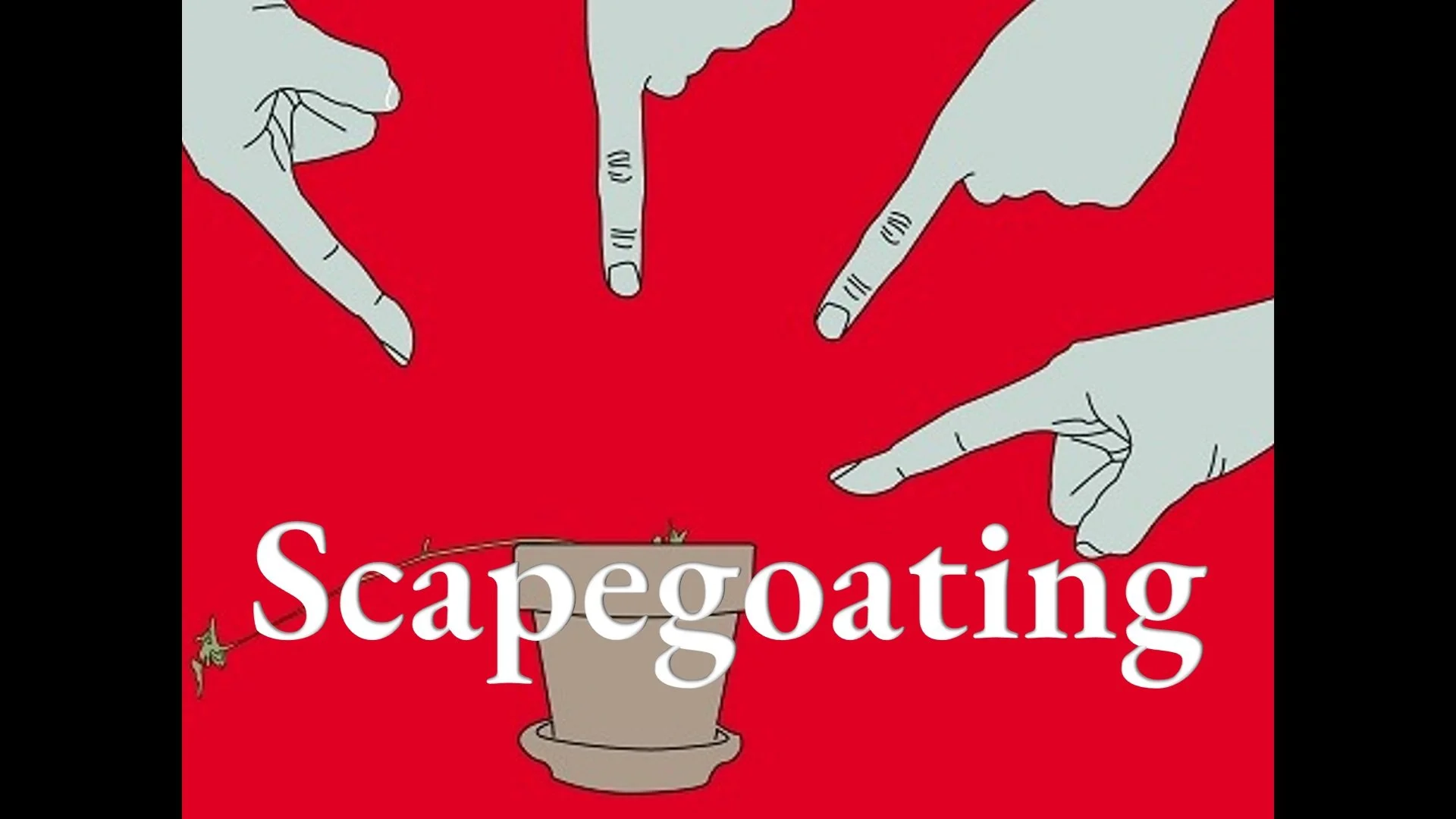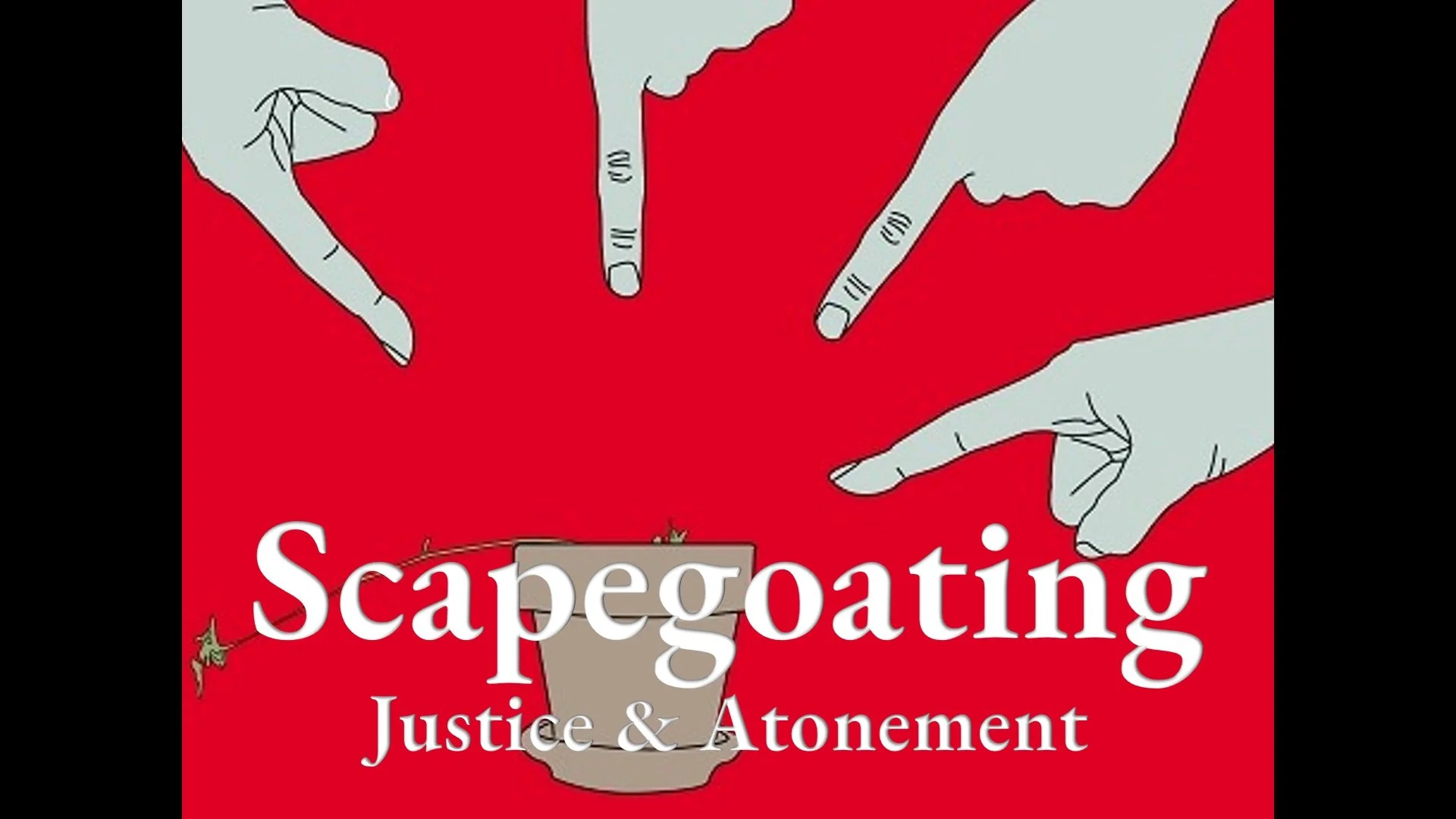
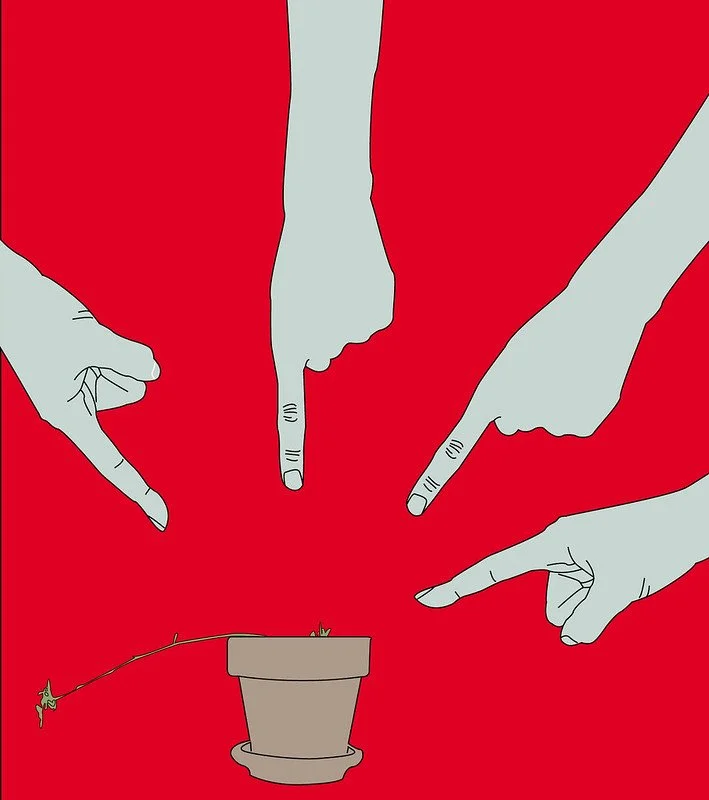
“Blame” by 周小逸 Ian. Creative Commons 2.0.
Introduction
This series relates to both the topics of Atonement and Desire because, like fallen Adam in the garden, we desire to deflect blame, and therefore we scapegoat others. On the political level, this builds group cohesion and creates a social outsider, who is blamed for the group’s woes, who the group must exile or kill or marginalize in order to maintain a hopeful lie. For recent troubling outcomes, see Racial Fascism and Immigration Policy.
This series explores what political scapegoating has looked like in the U.S. The blog posts illustrate what happens when you believe that the highest form of justice is retributive. Penal Substitutionary Atonement theology holds that divine justice is retributive, which is why white evangelical Americans have a unusual ability to scapegoat others. Compare this behavior to what Scripture actually calls Christians towards. See our Christian Restorative Justice Study Guide and general resources on Restorative Justice in the criminal justice system.
Start Here
Messages and Resources
This is our four week class, which incorporates some of the blog posts linked in the See Description section. Register through our Thinkific course site. In the Zoom class, we discuss some of blog posts below. This series focuses on atonement from the angle of American evangelical political behavior. This series is a long engagement with Rene Girard and his scapegoat theory. Girard had valuable insights into the anthropology of the cross of Christ. Penal substitution enshrines and exploits the principle of retributive justice – at times, even infinite retribution – into human relations. This contributes to false racial perceptions of criminality and the false belief that the poor are lazy. See whole series.






Reframing Good Friday: From Scapegoating to Restoration
The Allender Center Podcast, April 3, 2026
-
Reframing Good Friday: From Scapegoating to Restoration (link to Allender Center page)
We all know what it feels like to scapegoat—or to be scapegoated. To shift blame, protect ourselves, and make someone else carry what feels too heavy to hold. So what does that have to do with Good Friday, April 3, 2026?
In this episode of the Allender Center Podcast, Mako Nagasawa helps us see that what we call “scapegoating” today is actually a distortion of its original biblical meaning. Looking at Leviticus 16, he explains that the scapegoat was never about blaming or punishing a substitute, but about removing what didn’t belong. A way of naming that the problem isn’t who we are, but what has taken hold within us.
But over time, we’ve changed that meaning, looking for others to carry the blame instead of facing our own sin. This episode invites us to see the cross differently. Rather than reinforcing blame and punishment, Jesus steps into our cycle of scapegoating to break it, revealing a God who is not looking for someone to punish, but is committed to restoring what’s broken.
This is the hope of Good Friday: not a story of blame, but the beginning of restoration.
-
How Wicked Helps Us Understand the Beasts of Revelation, Empire, Trumpism & Our Political Moment (link to YouTube video)
Many Christians have criticized the two Wicked movies (2024, 2025). But we think the movies help us better understand the Bible and live in our political moment. Consider the biblical themes of Empire, deception, and accusation -- especially in the Book of Revelation, and the first and second beasts of Revelation 13. Consider that the Wicked movies show us something about Trumpism, the scapegoating of vulnerable people to deflect from the administration's own corruption, and the abuse of power.
9:05 Revelation 13: The Dragon and the Two Beasts
12:58 A Quick Survey of the Theme of Empire in the Bible
17:23 Empire and Propaganda in Revelation 13
22:07 The Wizard of Oz and the Scapegoating of the Animals
26:30 Propandist 1: Madame Morrible as Dean of Shiz, then Press Secretary
28:03 Trump's Press Secretaries
33:52 Trump's Attorney General Pam Bondi
36:31 Propandist 2: Nessa and Trump's GOP Congress
37:50 Progandist 3: Glinda
38:10 The Animals, the Dehumanization of Outsiders, and Real Examples
46:10 If You Feel Defensive
See our trailers below:
-
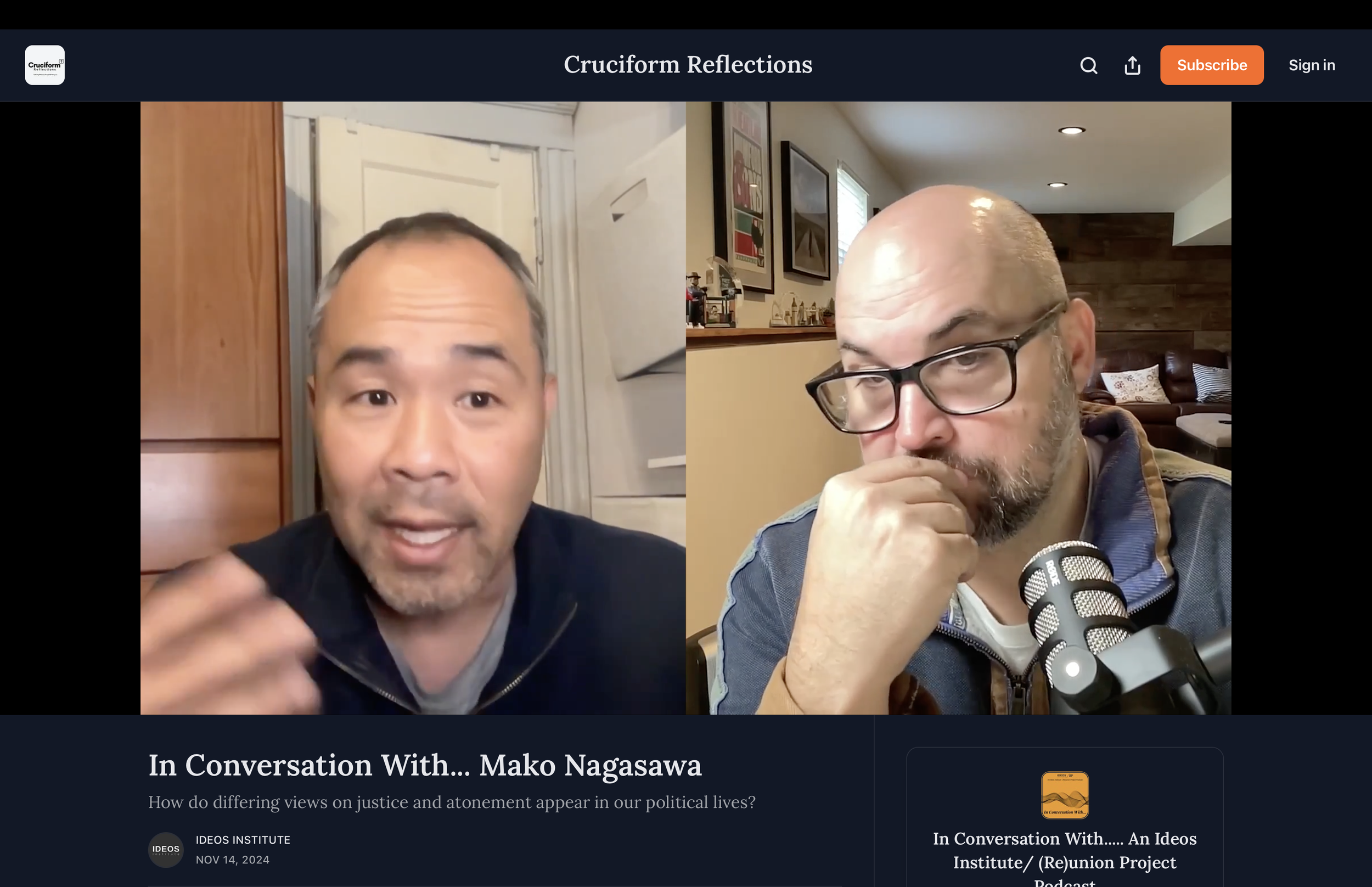
Greg Arthur, In Conversation With… Mako Nagasawa (link to Substack page)
Ideos Institute, Nov 14, 2024. At the 19:25 minute mark, Greg and Mako talk about the 2024 election. Mako talks about how Trump and Trump voters are drawn to the principle of retribution. Mako critiques this principle on theological grounds, and points out that White evangelicals, especially, are spiritually formed to exaggerate the principle of retribution and scapegoat people like immigrants, etc.
-
Rene Girard, Are the Gospels Mythical? First Things, Apr 1996.
Wayne Northey, Presentation on Spirituality of Penal Abolition. ICOPA IX, May 2000. a paper on Academia.edu, contains a concise summary of Christian history
Rene Girard, Interview with CBC, Part 1. Offensive Freedom, Jan 26, 2013. An excellent anthropology of scapegoating.
Rene Girard, Interview with CBC, Part 2. Offensive Freedom, Jan 26, 2013. Treats Leviticus 16 and the Jewish practice of the scapegoat and atonement; also says the Joseph story is the reversal of the Oedipus story, where Joseph is innocent (Oedipus as scapegoat is guilty) and brings reconciliation (not death and division). In addition, Joseph tests his brothers by making Benjamin a scapegoat, but Judah refuses it and offers himself. The Joseph and Judah story exposes the scapegoating myth. It is anti-myth.
Rene Girard, Interview with CBC, Part 3. Offensive Freedom, Jan 26, 2013. Explains why non-instinctual desires are imitative, or mimetic, and therefore competitive; explains the biblical story of the fall in Genesis and redemption in the Gospels; why imitating Jesus is non-violent and non-competitive
Richard Feloni, Peter Thiel Explains How an Esoteric Philosophy Book Shaped His Worldview. Business Insider, Nov 10, 2014. Thiel was influenced by Rene Girard
Dania Rodrigues, The Ancient Greeks Sacrificed Ugly People. Atlas Obscura, Oct 30, 2015. Part of the cultural backdrop which Christians rejected.
Adam Ericksen, Rene Girard and the Mechanisms of Violence. Christian Transhumanist Podcast, Nov 30, 2015.
Sarah Kaplan, The Darker Link Between Ancient Human Sacrifice and Our Modern World. Washington Post, Apr 5, 2016.
Paul Bloom, The Root of All Cruelty? The New Yorker, Nov 20, 2017. Perpetrators of violence, we’re told, dehumanize their victims. The truth is worse.
The Young Turks, Fear and Loathing in the Conservative Mind. The Young Turks, Feb 14, 2019. On the emotion of disgust, and its correlation to politically conservative instincts; how language triggering disgust is often used with religious ideology of a "pure community." References Kathleen McAuliffe, Fear This Is Your Brain on Parasites: How Tiny Creatures Manipulate Our Behavior and Shape Society. Houghton Mifflin Harcourt | Amazon page, Jun 2016. See also Kathleen McAuliffe, The Psychology (and Politics) of Disgust. Big Think, Sep 23, 2016. See also Bobby Azarian, A Complete Psychological Analysis of Trump's Support. Psychology Today, Dec 27, 2018. “Science can help us make sense of the president's political invincibility.”
Tyler Graham, Death to the Death Penalty? René Girard’s Challenge to Thomas Aquinas. The Imaginative Conservative, Nov 2018. An example of humility from conservatives.
Peter Wehner, Why Trump Supporters Can’t Admit Who He Really Is. The Atlantic, Sep 4, 2020. “Nothing bonds a group more tightly than a common enemy that is perceived as a mortal threat.”
Amy Goodman, The Intercept: New York Times Exposé Lacks Evidence to Claim Hamas Weaponized Sexual Violence Oct. 7. Democracy Now, Mar 1, 2024. “We speak with Jeremy Scahill and Ryan Grim of The Intercept about their exposé of a major New York Times piece into alleged mass rapes committed by Hamas militants on October 7 that raises serious questions about the accuracy of the story. The Times article was headlined "'Screams Without Words': How Hamas Weaponized Sexual Violence on Oct. 7," and its release in late December helped the Israeli government to justify the ongoing war on Gaza and to paint pro-Palestine supporters abroad as not caring about sexual violence. One of the reporters of the Times piece, Israeli freelancer Anat Schwartz, is being investigated by the Times for her social media activity, which included dehumanizing language and endorsements of violence against Palestinians in Gaza. "The New York Times has grave, grave mischaracterizations, sins of omission, reliance on people who have no forensic or criminology credentials to be asserting that there was a systematic rape campaign put in place here," says Scahill, who criticizes the newspaper for not issuing any corrections for their flawed reporting. We also hear from Ryan Grim about how the flawed Times article touched off "extremely intense debate" inside the newsroom. "They're used to external criticism, but the amount of internal criticism they're getting has them on the backfoot," he says.”
Richard Sanders and Al Jazeera Investigative Unit, October 7: Forensic Analysis Shows Hamas Abuses, Many False Israeli Claims. Al Jazeera, Mar 21, 2024. “After a thorough analysis of all available data, the I-Unit concluded that claims by the Israeli army that it found eight burned babies at a house in Kibbutz Be’eri were untrue. The analysis found that there were no babies in the house, and the 12 people inside were almost certainly killed by Israeli forces when they stormed the building… The I-Unit also examined claims that widespread sexual violence had occurred on October 7. It concluded that while isolated rapes may have taken place, there was insufficient evidence to support allegations that rape had been “widespread and systematic”.”
Tia Goldenberg and Julia Frankel, How 2 Debunked Accounts of Sexual Violence on Oct.7 Fueled a Global Dispute Over Israel-Hamas War. Associated Press | PBS, May 22, 2024.
Howard Mortman, Twitter, Mar 26, 2025. A British reporter asks Marjorie Taylor Greene a question about Defense Secretary Pete Hegseth using the commercial app Signal to discuss attack plans, which both included Jeffrey Goldberg, editor in chief of The Atlantic, by accident, and is illegal because it is a private app used to avoid FOIA requests. MTG responds by deflecting to “immigrants”. This is how scapegoating immigrants works.
Ashton, Why We Hate Welfare Freeloaders (But Shouldn't). Type Ashton, Apr 6, 2025. Ashton begins by citing a fascinating psychological experiment about people who choose a social system where they can punish freeloaders over a social system where they cannot. Most people choose the punishment system. She then cautions us against scapegoating immigrants or food stamp beneficiaries because of facts: immigrants contribute to the economy; food stamp beneficiaries are overwhelmingly children, elderly, disabled, and even employed at low-wage work. Why not require employers to pay a living wage and give better health benefits?
Radhika Desai and Michael Hudson, Trump’s Tariffs Are Part of a Class War on His Own Base. Geopolitical Economy Report, Apr 6, 2025. Desai and Hudson believe Trump’s tariff’s policy is part of another big lie that he sold to the American people. He couldn’t say that the US economy is fine, because too many people felt pain. But he also couldn’t say that it was the result of four decades of neoliberal policy that privileged finance. So he scapegoated other countries for developing their own economies and selling products back to the US. He also doesn’t understand dollar global dominance and foreign purchase of US debt and assets as the root cause of why corporations moved their manufacturing offshore. Trump’s tariff policy will therefore likely hurt his own base the most. He misdiagnosed the problem and has a more pro-corporate, laissez faire approach to managing capitalism. So Wall Street will continue to run the US government, not vice versa.
Rachel Maddow, Trump Exposed in Hot Mic Moment Planning Further Abuse of Power. The Rachel Maddow Show | MSNBC, Apr 15, 2025. Trump met with El Salvadoran President Nayib Bukele, self-dubbed “the world’s coolest dictator,” about his intention to deport American citizens to prison in El Salvador. Sherrilyn Ifill, civil rights lawyer and law professor, says that Trump will probably send people already incarcerated Americans to El Salvador. The Fifth Amendment requires due process for all persons, not just citizens. The Eighth Amendment prevents cruel and unusual punishment.
Emily Jashinsky and Ryan Grim, Breaking: El Salvador Caves, ICE Arrests US Citizen, Trump Attacks Fed. Breaking Points, Apr 18, 2025. At the 9 minute mark, U.S. Representative Tim Burchett (R-TN) on News Nation says that Trump/ICE is perfectly right to send “homegrown criminals” or U.S. citizens to El Salvador’s prison. “I don’t want Donald Trump teaching my daughter’s Sunday School class, but dag gum I like him in the White House because he understands the rule of law, I feel like. America is sick of this stuff.”
Tudor Tarita, This Study Finds a Chilling Link Between Personality Type and Trump Support. ZME Science, Jul 30, 2025. “Malevolent traits and reduced empathy go hand in hand.”
“A new study, published this month in the Journal of Research in Personality, suggests part of the answer may lie deep within the personalities of his supporters.
The research, led by psychologist Craig Neumann of the University of North Texas, examined whether certain personality traits—those associated with callousness, manipulation, and even enjoyment of others’ suffering—correlate with conservative ideology and support for Trump. The findings are striking: people who view Trump favorably are more likely to score higher on measures of malevolent traits and lower on empathy and compassion.
“People who view malevolent political figures favorably also report less empathy for others and enjoy the suffering of others,” Neumann told PsyPost.”
Will Gordh and Adrienne Larkin, They Regret Voting for Trump... Now What? Talking Politics with Mom, Aug 7, 2025. This 70 minute video is about politics/voting and not criminal justice, and for the secular audience and not the Christian audience. Nevertheless, given all the harm the Trump regime is causing, it is important for the anti-Trump coalition to basically adopt a restorative justice posture towards Trump regretters. We need to call for partnership while expressing the seriousness of taking accountability.
Evie, The Reason White Women Vote Trump Is Sicker Than We Thought. Channel 100 News with Evie, Oct 14, 2025. “Disgust was their tool. Obedience felt righteous.” “They weren’t necessarily voting for cruelty. They were voting for order. They just refused to see that those were the same thing.” This is the emotional contract with white patriarchy which claims to protect them. See also Evie, The Reason Poor People Vote Trump Is Sicker Than We Thought. Channel 100 News with Evie, Dec 17, 2025. Emotional politics, not material politics, about identity and recognition of how people see themselves.
Sophie Gilbert, No, Women Aren’t the Problem. The Atlantic, Nov 5, 2025. Devastatingly pointed at those who accuse women, but give Trump and other “bros” a pass. “America is rapidly becoming the manosphere, but sure, let’s go after the “feminization” of culture.”
Richard Beck, René Girard and Moral Influence, Part 1: Why Did Jesus Die. Experimental Theology with Richard Beck | Substack, Nov 18, 2025. Part 2: The Mechanism is Masked. Nov 19, 2025.
Keith Faber, Renee Good Wasn't an ‘Innocent.’ I Won't Tolerate Lawlessness as Ohio AG. The Columbus Dispatch, Jan 26, 2026. Today, the Republican running to be Ohio’s top lawyer said Renee Good deserved to die. Also, Kristi Noem, then Secretary of the Department of Homeland Security, said that Renee Good and Alex Pretty were engaging in domestic terrorism — again attempting to instill disgust, fear, and anger against them.
Robert Downen, He Remade the Southern Baptist Convention in His Image. Then Came the Abuse Allegations. Texas Monthly, May 2026. In the conservative takeover of the SBC, conservatives like Paul Pressler and Paige Patterson used disgust, fear, and anger against “liberals” to make their movement. It also goes to show that as they constructed an “enemy” menacing enough, their followers excused their own abuses and sins. See our saved copy.
Scott Warren, Sophia Winner, Katy Osborn, Morgan Ramsey-Elliot, Cameron Wu, Tariq Rahman, Julian Petri, Faith, Family, Freedom, Place: An Ethnographic Study of Conservative Americans’ Relationships to Democracy. SNF Agora Institute @ Johns Hopkins University, May 14, 2026.
“In February 2026, the SNF Agora Institute at Johns Hopkins University and ReD Associates spent three weeks conducting ethnographic research with 21 conservatives and their friends and families across three counties in Wyoming, Michigan, and South Carolina. The goal was to understand the underlying social and cultural drivers of support for democratic norm deviation. What we found challenges the dominant framing that conservatives harbor anti-democratic sentiment. This study examines how conservative Americans in three counties — Campbell County, Wyoming; Ottawa County, Michigan; and Greenville County, South Carolina – experience and evaluate democracy.”
It’s important to note that the study’s participants believe their children are abandoning Christian faith because of liberals, Democrats, coastal elites, and perhaps immigrants and immigrant-friendly postures. See more concerned and arguably more accurate responses by Jonathan V. Last, What Cletus Thinks About Democracy. The Bulwark, Jun 25, 2026. Subtitled, "They Are Who We Thought They Were and We Let Them Off the Hook." See also Hawk, Study Confirms MAGA Voters Are Exactly Who We Thought They Were. Hawk’s Podcasts, Jun 30, 2026.
“The headline finding: fourteen of twenty-one study participants, two thirds, had an immediate negative reaction when asked about democracy. Hawk reads quotes from participants by name throughout the study, including a Wyoming homeschooling mother who says she does not like the word democracy, a Michigan retiree who says if they had a democracy it would be a problem, a Wyoming delivery driver who says every small town would be outvoted by cities, and a South Carolina woman who calls democracy two wolves and one sheep deciding who is for dinner. Hawk also addresses JVL's core thesis, that these voters respond to Trump's illiberalism not in spite of it but because of it, alongside Sarah Longwell's more sympathetic read of the same voters. He engages with his brother's argument that MAGA voters who reject Trump would lose their family systems, friendships, and community standing in doing so, and explains why that argument moves him somewhat but does not change his position. He closes with JVL's conclusion that domination of the political system is not enough for these voters, who want the people who disgust them to simply disappear.” Disgust is Hawk’s word, and notable.
-
Kaya Van Roost, Miranda Horn, and Alissa Koski, Child Marriage or Statutory Rape? A Comparison of Law and Practice Across the United States. Journal of Adolescent Health, Mar 2022.
“Purpose: In many U.S. states, children can legally marry at an earlier age than they can legally consent to sex, leading to situations in which sex between spouses may be a criminal act. Some states exempt sex between married persons from their definition of statutory rape, which may create perverse incentives for child marriage. We estimated the number of child marriages that violated statutory rape laws across the United States since January 1, 2000.
Methods: We created a longitudinal database of statutory rape laws in place from 2000 to 2020 in each state. Using data from marriage certificates filed in 44 states and Washington, DC, we compared the age of married spouses with the text of state-specific statutory rape laws in place at the time the marriages occurred.
Results: Child marriages violated statutory rape laws in 14 states. The proportion of child marriages that violated statutory rape laws varied from 1% to over 50%. In 33 states, some or all statutory rape laws exempted sex between married couples from the definition of crimes. In these states, the proportion of child marriages that would have been crimes, without these exemptions, varied from less than 1% to over 80%.
Conclusions: Our results highlight the blurred legal and conceptual boundaries between child marriage and sexual violence. The simultaneous legality of child marriage and marital exemptions to statutory rape laws provide legal loopholes for sexual acts with children that would otherwise be considered crimes. Marital exemptions to statutory rape laws may also incentivize a substantial portion of child marriages.”
Alaina Democopoulos, ‘I Was Handed to a Complete Stranger’: The Survivors Fighting to End Child Marriage in 37 States — and the People Who Want to Keep It Legal. The Guardian, Jul 9, 2024. Suggests that marriage is viewed as a semi-punitive consequence for having sex and conceiving a baby.
“Republicans have likewise latched on to the idea that allowing child marriage will decrease the frequency of abortions. That’s the reason a ban on the practice has stalled in Missouri. The state representative Hardy Billington, an opponent of the ban, told the Kansas City Star: “My opinion is that if someone [wants to] get married at 17, and they’re going to have a baby, and they cannot get married, then … chances of abortion are extremely high.” The state representative Jess Edwards of New Hampshire, who voted against the ultimately successful ban in that state, argued that teens are of “ripe, fertile age” and marriage could be an alternative for abortion. He asked: “Are we not in fact making abortion a much more desirable alternative, when marriage might be the right solution for some freedom-loving couple?””
Department of Data, Are Federal Workers Lazy? Let’s Look at the Data. Washington Post, Feb 21, 2025. Helpful for when the government lies to its own people. “As Elon Musk’s U.S. DOGE Service targets federal workers, we investigate how hard those folks have been working for their government paychecks.”
Tad Stoermer, George III Didn’t Do the Things the Declaration of Independence Says He Did. Tad Stoermer, Apr 29, 2026.
Nick Turse, Trump Administration Tries to Shift Blame for Ebola Response. The Intercept, Jun 4, 2026. “After cutting its support for front-line healthcare workers in Central Africa, the Trump administration is pointing fingers.”
Owen Scott, Trump Administration Blames Obama After ‘Blue’ Reflecting Pool Turns Green After $14M Refurb. U.K. Independent, Jun 16, 2026. “President Trump previously vowed to paint the Reflecting Pool an ‘American flag blue’”
Greg Sargent, Trump Rages Over Reflecting Pool Fiasco—and Arrests Over It Get Darker. The New Republic, Jun 23, 2026. The green algae continues to outsmart Trump. Meanwhile, Trump raged at journalists covering the story, detained a 67 year old former Olympic medalist who just wanted to examine the water, and detained a woman who said she was merely pulling peeled paint out of the water. Importantly, the Reflecting Pool belongs to “We the People” and was never off limits before.
-
Wayne Northey, Presentation on Spirituality of Penal Abolition. ICOPA IX, May 2000. A paper on Academia.edu, contains a concise summary of Christian history.
Dominique J.-F. De Quervan, Urs Fischbacher, Valerie Treyer, Melanie Schellhammer, Ulrich Schnyder, Alfred Buck, and Ernst Fehr, The Neural Basis of Altruistic Punishment. Science, Aug 27, 2004.
“Many people voluntarily incur costs to punish violations of social norms. Evolutionary models and empirical evidence indicate that such altruistic punishment has been a decisive force in the evolution of human cooperation… Our findings support the hypothesis that people derive satisfaction from punishing norm violations and that the activation in the dorsal striatum reflects the anticipated satisfaction from punishing defectors.”
Paula J. Giddings, Ida: A Sword Among Lions: Ida B. Wells and the Campaign Against Lynching. Amistad | Amazon page, Mar 3, 2009.
Dominique Gilliard, Sunday Lynchings: The Church's Role in Our Nation's Legacy of Racism. Converge Oakland, Feb 27, 2013.
Jamelle Bouie, Christian Soldiers: Lynching and Torture in the Jim Crow South Weren't Just Acts of Racism, but Religious Rituals. Slate, Feb 10, 2015.
Kaia Stern, Voices from American Prisons: Faith, Education, and Healing. Routledge | Amazon page, Jun 10, 2015. Ch.2 is about the impact of Augustine, Calvin, and penal substitution.
Tim Molloy, Der Sturmer: Why There Are So Many Pictures of the Nazi Tabloid Today. The Wrap, Mar 1, 2017. Trump’s plan to publicize crimes by illegal immigrants draws comparison to a tactic used by the Nazis. Stoking fear and then a desire for retribution is the authoritarian populist playbook.
Julie Zauzmer, Christians Are More Than Twice as Likely to Blame a Person's Poverty on Lack of Effort. Washington Post, Aug 3, 2017. Because white evangelicals believe in penal substitution and therefore believe that God's highest justice is meritocratic-retributive; something Mako commented on in a blog post, Why Penal Substitution is a Gateway Drug to Right Wing Extremism
Julie Perkins, The Most Dangerous Sermon Ever Preached. Relevant Magazine, Feb 6, 2018. An interview with Brian Zahnd critiquing Jonathan Edwards, Puritan Christianity, and retributive justice.
Stephen Waldron, Christianity, Cruelty, and Lies. Moralizing God | Substack, Feb 19, 2025.
“Cruelty and the pleasure that some people take in it is dangerously empty. In the Christian story, along with the prophets and martyrs, Jesus is the victim of cruelty that was based on lies. We might think that this is a clear foundation for Christian rejection of cruelty. But the emptiness of this cruelty means that it can also be used to inspire cruelty and lies.
Such cruelty and lies were quickly and consistently turned against another scapegoat. In the earliest centuries of Christianity, prominent Christian leaders consistently engaged in anti-Judaism. Building on the twisted myths of medieval antisemitism, Martin Luther called for Jewish synagogues and schools to be burned and for Jews to be subjected to manual labor. (The oddest justifications of Luther’s antisemitism point out that he was upset at the time he was writing. Thing is, antisemites are often unhappy while spouting their antisemitism.)
By the 20th century, Christians performing “passion plays” at Oberammergau in Germany and at Eureka Springs in the United States did so as an exercise in violent antisemitism. (Gerald L. K. Smith, the key founder of the popular passion play in Arkansas, was one of the foremost promoters of white supremacism and antisemitism in the United States during his lifetime.) Even the director of a widely-viewed 21st century passion play on film, The Passion of the Christ, is known to have been a virulent antisemite.”
Jonah Goldberg, A Unified Field Theory of Trump. The Dispatch, Mar 8, 2025. Goldberg turns to Trump’s pattern of scapegoating.
ABC 13 News, Economic Experts Weigh In on the Trade War Impact on the Stock Market. ABC 13 News, Mar 11, 2025. Dave Brat, an economist, former Congressman, and now a Senior VP at Liberty University, a flagship school for White evangelicals, especially Southerners, said on a video interview that Trump’s tariffs are following “reciprocity,” which he said is the Golden Rule: “whatever you do to us, we’re gonna do to you.” Surely this is evidence that Penal Substitution and the theory of divine retributive justice has broken the minds of White evangelicals. The Golden Rule is aspirational, not retributive. See the 59:32 minute mark of Tim Miller, Trump Admits He’s Violating the Constitution (w/ David French). The Bulwark, Mar 14, 2025.
Jonathan V. Last, The Faces of Trump’s Anti-Immigrant Crusade. The Bulwark, Mar 18, 2025. The government deported a 10-year-old American citizen with brain cancer.
“Do you know what a “lynching postcard” is?1 In post-Civil War America people would take photos of the lynchings of African Americans and print them up as postcards. That’s right. Pictures of smiling white people next to a dead black person they had just murdered. Americans would trade these postcards and collect them. They’d even use them as actual postcards and send them through through the mail.2Hey Uncle Jedidiah! We’re having a great time in Alabama. Wish you were here. This practice persisted through the 1940s. Don’t look away from this, because it’s the truth: There are Americans—lots of them—who get off on dominating the people they hate. The Hemingway line is terrifyingly true: “There are many who do not know they are fascists but will find it out when the time comes.”
Peter Zeihan, The Russian Reach: Christian Ultranationalism. Zeihan on Geopolitics, Mar 20, 2025. Very important topic. There are connections between the Russian Orthodox nationalism and White American Evangelical-Catholic nationalism, including via the “National Prayer Breakfast.” The Russian popular consciousness includes its suffering at the hands of others, but not their own oligarchs.
Peter Wehner, Trump’s Appetite for Revenge Is Insatiable. The Atlantic, Mar 20, 2025. This pattern of behavior, kicked off with Trump’s campaign promise, “I am your retribution”, shows how much people are being drawn by anger and fear into Trump’s pathologies. For Evangelicals, one major channel is theological: Penal Substitutionary Atonement and the theory of divine retributive justice.
Jon Evans, Prof G on AI Eating Itself, Social Media Rage & the End of the CMO. Uncensored CMO, Apr 2, 2025. At the 9 minute mark, Scott Galloway points out that social media has shown us that rage sells even better than sex.
Decoding Fox News, X/Twitter, Jun 30, 2025. Re: Alligator Alcatraz. “Cruelty is the point - several Fox News hosts seemed gleeful at the notion that a detained migrant might be attacked and eaten by a crocodile or killed by a python. Good Christian folks laughing about animals eating prisoners. Jesse Watters seems to think they are all named Jose.”
Pat Kahnke, Is Our Understanding of Hell Making Evangelical Christians Cruel? Culture, Faith, and Politics, Jun 29, 2026. Interview with Pastor Brian Zahnd. Zahnd does not consider the possibility of eternal conscious resentment, and oversimplifies Scripture and church history on the topic. However, he accurately expresses concern about the impact of eternal conscious torment on Christians today: “When you believe billions of your neighbors are already destined for an eternal torture chamber, does it become easier to stop seeing them as fully human? Drawing on his book "Sinners in the Hands of a Loving God," Zahnd argues the traditional view turns the gospel inside out — and reveals a chapter his own publisher refused to print.”
-
Sterling Sherrill, The Teaching That Makes Trump Untouchable. Flannel Board Faith | Substack, Jun 1, 2026.
“How a theological framework eliminated the concept of accountability from Christianity and handed it to the most powerful man in the world.”
“The teacher was Danny Silk. The institution was Bethel School of Supernatural Ministry. The book he wrote from that teaching, Unpunishable: Ending Our Love Affair with Punishment, became a Christian bestseller. And somewhere along the way it stopped being a theology lesson. It became a shield.”
Andy Mannix and Jeremy Kohler, In This Church, Child Sexual Abuse Has Gone Unchecked for So Long That It Spans Generations. ProPublica, Jun 4, 2026. Part of a series on this particular church called Forgive and Forget.
”The church teaches that once a perpetrator is forgiven, anyone who speaks about the wrongdoing — including the victim — can be accused of harboring an unforgiving heart. Those who have left the church, as well as some who are still with it, say this means the burden of sin shifts from the person who committed the act to the person who refuses to let the matter rest.”
-
Dominique J.-F. De Quervan, Urs Fischbacher, Valerie Treyer, Melanie Schellhammer, Ulrich Schnyder, Alfred Buck, and Ernst Fehr, The Neural Basis of Altruistic Punishment. Science, Aug 27, 2004.
“Many people voluntarily incur costs to punish violations of social norms. Evolutionary models and empirical evidence indicate that such altruistic punishment has been a decisive force in the evolution of human cooperation… Our findings support the hypothesis that people derive satisfaction from punishing norm violations and that the activation in the dorsal striatum reflects the anticipated satisfaction from punishing defectors.”
John Taylor, The Neuroscience of Encountering God. Relevant Magazine, Jun 3, 2026.
“[Andrew] Newberg’s research found that beliefs don’t just shape how people think — they alter the way the brain processes reality itself. In a study on religious symbols, his team found that a person’s prevailing beliefs changed activity in the primary visual cortex, meaning the brain was literally perceiving the world differently based on what the person believed about God.
“A person who has a fear-based perspective is likely to see fear in everything resulting in strong anxiety and distress in the brain,” Newberg said. “A person who has a more compassion or love-based perspective is more likely to see connections between things and be open to other people and ideas.”
A faith organized around punishment keeps the brain’s fear and survival circuitry — the limbic system — in a state of chronic alert. The neurological cost is higher stress, greater emotional rigidity and a diminished capacity for the kind of openness spiritual traditions tend to say they’re building toward. A faith organized around love produces measurably different outcomes.”
Desire: Topics: