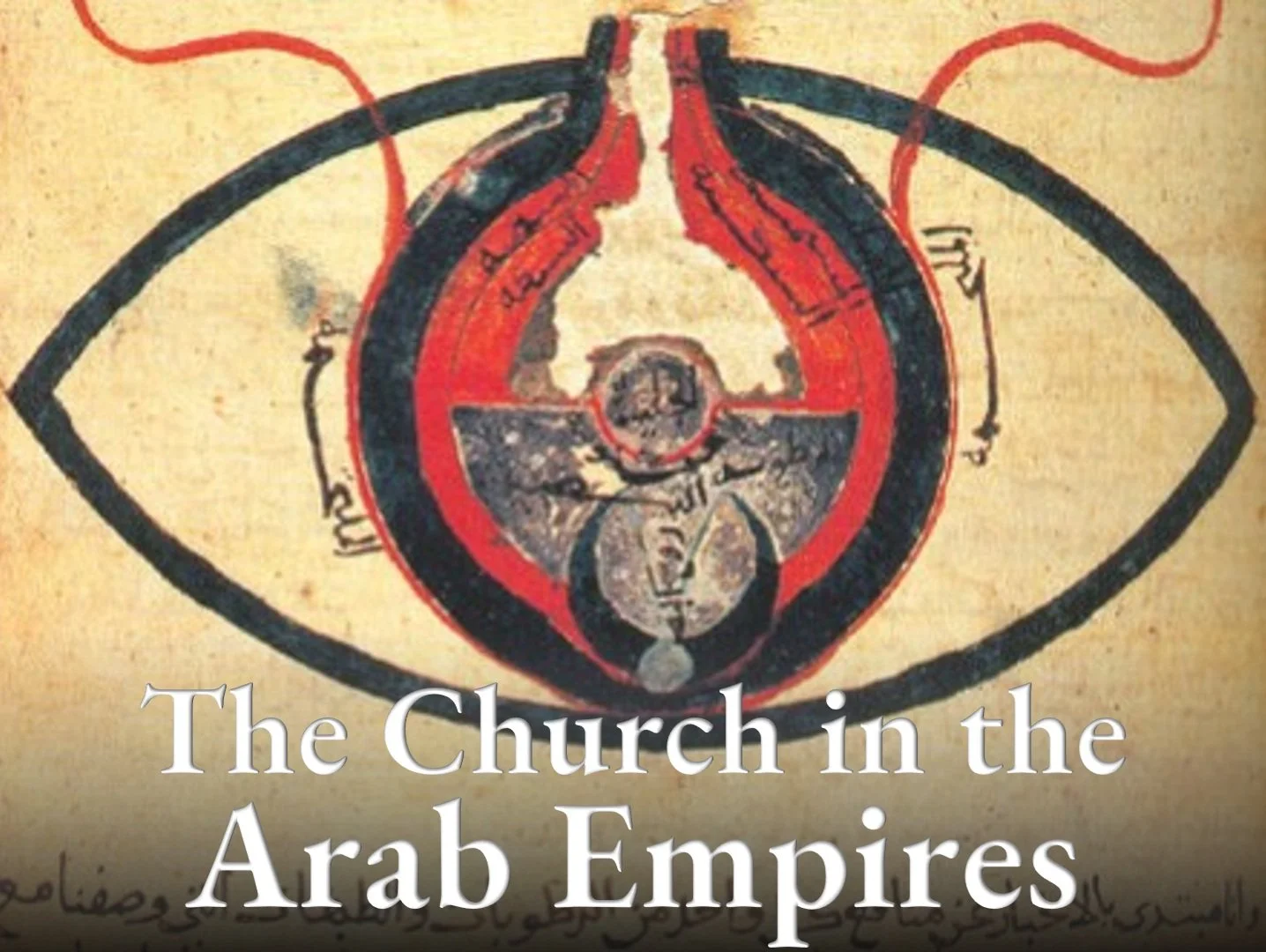
Photograph: Manuscript from the 1200's, copied from an older medical work by Hunain Ibn Ishaq (809 - 873 AD). Ishaq was an Arab Christian of Nestorian persuasion. Photo credit: Unknown | Public Domain, Wikimedia Commons. The Arab Christian Hunain Ibn Ishaq was a translator, physician, scientist, and scholar at the height of the Islamic Abbasid Caliphate. His research into the human eye is called Ten Treatises on Ophthalmology. His story is remarkable and inspiring, and an important part of the story of Christians living under Arab rule.

Introduction
The selection of perspectives on church history in this section — Church and Empire — has been guided by three factors: (1) to demonstrate that Christianity has not been a “white man’s religion”; (2) the study of empire as a recurring motif in Scripture by recent biblical studies scholars; and (3) explorations of biblical Christian ethics on issues of power and polity, to understand how Christians were faithful to Christ or not. Christian relational ethics continues a Christian theological anthropology that began with reflection on the human nature of Jesus, and the human experience of biblical Israel.
This page explores the experience and activities of Christians under various Arab regimes.
-
The Church of the East 431 AD resources exploring the Syriac-speaking church that is sometimes seen through the lens of Nestorius, a characterization which has been recently challenged
The Oriental Orthodox Church 451 AD resources exploring the churches which upheld the Miaphysite language of Jesus’ one “physis” while the pro-Chalcedonian Churches (Constantinople and Rome) upheld two “physeis.” The selections below are guided by the attempt to understand the schism that occurred at the Council of Chalcedon in 451 AD. This includes the Egyptian Coptic, Armenian, Syrian, Ethiopian, Eritrean, and Indian Malankaran Churches.
George Khoury, The Arabic Christian Literature. Al-Bushra, date unknown. a helpful summary of the extant literature, grouped by Melkite, Jacobite, Nestorian, Coptic, and Maronite
Peter Theodore Farrington, The Orthodox Christology of St. Severus of Antioch. Orthodox Wiki article. Severus (c.459 - 538 AD) offers an insight into the Chalcedonian vs. non-Chalcedonian Christology of the Syriac and Arabic speaking Christians. See also Father Antony Paul, Chalcedonian and Coptic Orthodox: History, Similiarities, and Differences. Holy Transfiguration American Coptic American Church, Nov 20, 2016. This is a 50 minute Youtube video; helpful summary of the history of the 5th century; helpful comments about the term "monophysite" and why the Copts do not use the term "theosis," as the Eastern Orthodox do, because of their context in Islam
Laurence E. Brown, The Eclipse of Christianity in Asia From the Time of Muhammad Till the Fourteenth Century. Cambridge at the University Press | Amazon book, 1933.
Bat Ye’or, The Dhimmi: Jews and Christians Under Islam. UNKNO | Amazon book, 1985.
Bat Ye’or, The Decline of Eastern Christianity Under Islam: From Jihad to Dhimmitude: Seventh-Twentieth Century. Fairleigh Dickinson University Press | Amazon book, 1996.
Michael Luo, Iraqi Christians Flee as Extremist Threat Worsens. New York Times, Oct 17, 2006.
Robert Miller, Syriac and Antiochian Exegesis and Biblical Theology for the 3rd Millennium. Gorgias Press | Amazon book, Dec 1, 2008.
Philip Jenkins, The Lost History of Christianity: The Thousand-Year Golden Age of the Church in the Middle East, Africa, and Asia-and How It Died. HarperOne | Amazon book, Nov 3, 2009.
Sidney Griffith, The Church in the Shadow of the Mosque: Christians and Muslims in the World of Islam. Princeton University Press | Amazon book, Apr 2010.
Aziz Atiya, History of Eastern Christianity. Gorgias Press | Amazon book, Jan 1, 2010. Atiya is a Coptic Christian, surveys Copts and Ethiopians, along with other Oriental Orthodox Churches in Asia: Syrians, Nestorians, Armenians, and Indians.
C. Fotescu Tauwinkl, R.B. ten Haar Romeny, HGB Teule, and J.J. Van Ginkel, The Syriac Renaissance. Peeters Publishers | Amazon book, Dec 31, 2010. This book is a compilation of papers about the Syriac Renaissance of the 11th - 13th centuries
John L. Allen, Jr., Catholicism Growing in Heart of Muslim World. Boston Globe, Mar 8, 2014.
Samuel Noble and Alexander Treiger, The Orthodox Church in the Arab World, 700 - 1700: An Anthology of Sources. Northern Illinois University Press | Amazon book, Mar 15, 2014. This is an outstanding anthology of Arab Christian literature from the 8th to 18th centuries
Azam Ahmed, A Christian Convert, on the Run in Afghanistan. New York Times, Jun 21, 2014.
Tim Arango, Concern and Support for Iraqi Christians Forced by Militants to Flee Mosul. New York Times, Jul 20, 2014. and Tim Stanley, Iraqi Christians Are Raped, Murdered, and Driven From Their Homes - and the West is Silent. The Telegraph, Jul 21, 2014.
Loveday Morris, As Christmas Approaches, Baghdad Christians Lament Empty Pews. Washington Post, Dec 22, 2014.
George Richards, Fleeing ISIS Into Exile, Syriac Christians Sing the Oldest Music on Earth. Newsweek, Apr 16, 2015.
Princeton University, Christianity in the Near East: Past, Present, and Future? Arab Orthodoxy blog, May 15, 2015. See especially Samir Khalil Samir, The Role of Christians Within the Arab-Islamic Society of the Middle East
Isabel Malsang, How an Iraqi Friar Saved Ancient Christian Manuscripts from IS. Yahoo News, May 22, 2015.
Leah Marieann Klett, Thousands of Muslims In Northern Iraq Converting to Christianity After Witnessing ISIS Horror, Ministry Reveals: 'They're Just Sick of Islam.' Gospel Herald, Oct 30, 2015.
Andrew Doran, When Christianities Collide: Persecuted Churches of the East Need Dialogue With the West. The American Conservative, Jun 9, 2016.
Amr Emam, First Christian Mass Held in Saudi Arabia. The Arab Weekly, Sep 12, 2018. “There are approximately 1.8 million Christians in Saudi Arabia, the Coptic Orthodox Church said.”
Kristian Girling, The Chaldean Catholic Church: Modern History, Ecclesiology and Church-State Relations. Routledge | Amazon book, 2018. This is a modern study of the Chaldean Catholic Church in Iraq from 2003 - 2013.
Emma Green, The Impossible Future of Christians in the Middle East. The Atlantic, May 23, 2019. “An ancient faith is disappearing from the lands in which it first took root. At stake is not just a religious community, but the fate of pluralism in the region.”
Milton Quintanilla, ‘Lord God, Please Protect Us:’ Afghan Christians Ask for Prayers Amid Persecution from the Taliban. Christian Headlines, Oct 1, 2021.
The Church in the Middle East: Topics:
This page is part of our section of Church and Empire which explores the experience and activities of Christians under various regimes in the Middle East: Persian, Arab, Turkish, and the State of Israel.
Church and Empire: Topics:
This page is part of our section on Church and Empire. These resources begin with a biblical exposition of Empire in Church and Empire and the meaning of Pentecost in Pentecost as Paradigm for Christianity and Cultures, then grouped by region.