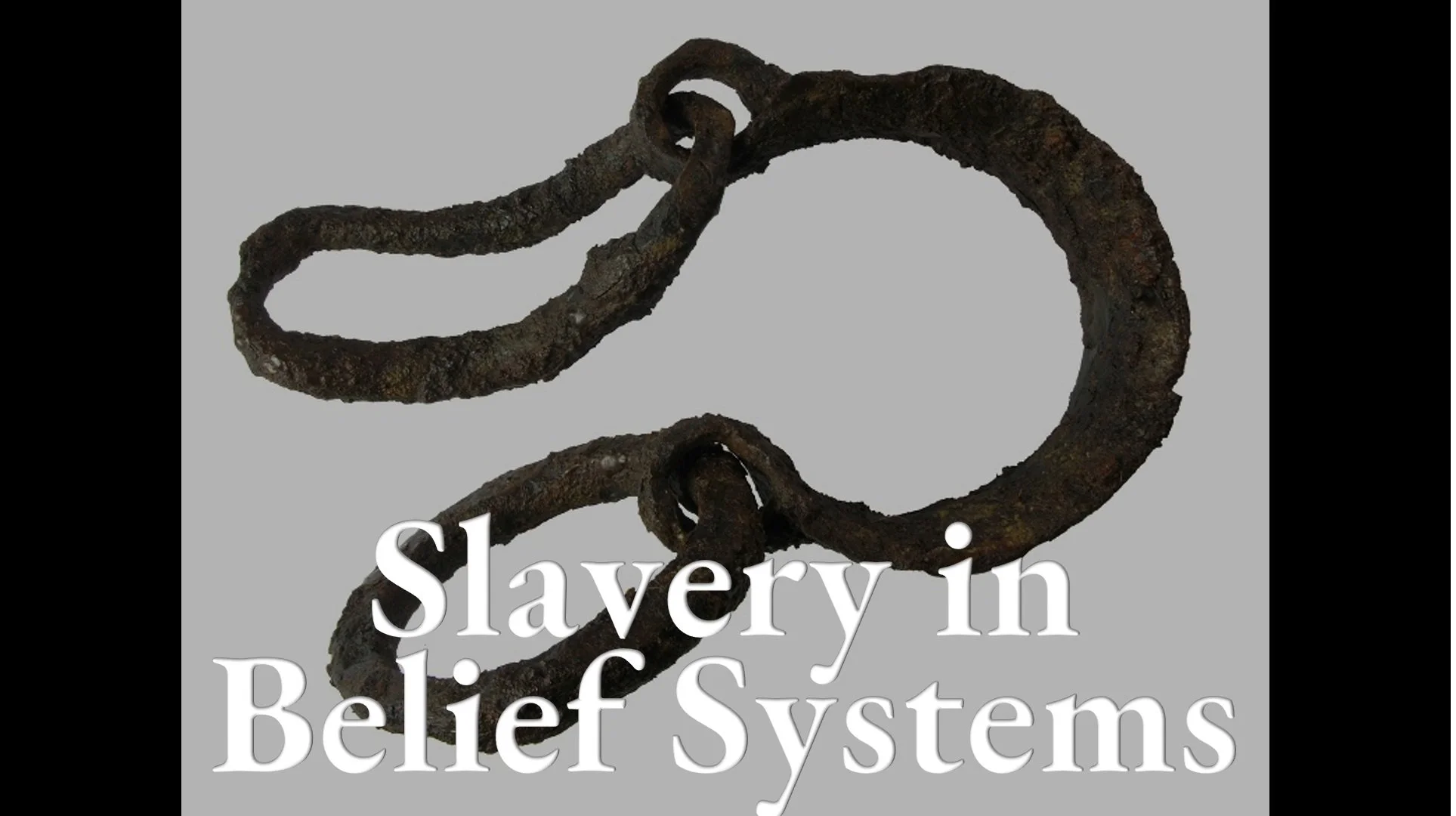
Photograph: Ancient slave manacles found in Britain used by the Roman Empire. Photo credit: Portable Antiquities Scheme | CC2.0, Flickr.
Introduction
The following resources look at how various belief systems approach slavery, define it, regulate it, or seek to abolish or advance or limit it.
Christianity and Slavery
See also the slides to this presentation. Explores early Christian emancipation and abolition. While Christians did not eliminate all forms of servitude, since servitude for civic penalties, indebtedness, war captivity, and self-indenture persisted, Christians eventually did eliminate what we know as chattel slavery. The presentation examines the Old Testament institution of the Hebrew ebed servant, and the New Testament approach to Greco-Roman modes of servitude. We glance at how colonialism and Trans-Atlantic slavery deformed traditional Christian teaching, mindful that more slavery exists today across the globe than every before, and that in the U.S., indebtedness and incarceration show that we have greatly exaggerated the claims that the U.S. has done better than the Bible on “slavery” and its constellation of challenges.
Slavery in Christianity, Part 1: Slavery in the Bible, Slavery Today
Research and slides which explores the Old Testament, then the New Testament. It looks at what the Hebrew "ebed" service meant in context, and then what Greek "duolos" meant and how the New Testament understood the various ways people could enter servitude. It uses a sociological approach, exploring different ways in to becoming an “ebed” or “duolos,” what rights and responsibilities those roles had, and how one could leave and/or escape.
Slavery in Christianity, Part 2: Abolitionism from the First to Fifteenth Century
Research that demonstrates that, although “slavery” was a complex phenomenon and varied across cultural groups and time periods, Christians understood the Bible as being against chattel slavery, and most other forms as well, and that Christian faith began to abolish slavery immediately, eventually formally abolishing it in northwestern and northern Europe by the 1300’s, despite the political upheavals and rising and falling of various political regimes. I am aware of ups and downs, because kingdoms rose and fell, regimes changed, and governments were not always consistent. Nevertheless, this historical record challenges the narrative that Christianity is ambiguous at best on slavery. Rather, Christianity is the only belief system that has generated abolitionist and anti-trafficking movements. See also Slavery in Islam: From the Seventh to Twenty First Century, which raises serious questions for both Muslims and also secularists who might want to argue that all belief systems are the same, etc.
The Rights of Women in the Bible: The Beauty of God’s Restorative Story
Slides of a presentation given to the ICAP Global Conference in Springfield, Missouri in May, 2019. It discusses protections for women in the Old and New Testaments, and opportunities for women in the Old and New Testaments as well. It is an egalitarian position on the question of women in church leadership. It highlights how Jewish faith led to the understanding that a husband must not rape his own wife (contrary to both English and American law until the 1970’s-80’s), how Christian faith impacted policies and laws about women, including the Council of Elvira (circa 300 AD) naming pimping and procuring sex as personal sins, but prostitution as a social sin (and thus not blaming the woman), Emperor Justinian and Empress Theodora creating the first “safe house” for ex-prostitutes, etc.
The Role of Jesus in Revolution and the Pursuit of Justice
A written message, graphics included, on how Jesus inspired twentieth-century non-violent resistance movements around the world, and why. Spotlights Tolstoy in Russia; Gandhi in South Africa and India; Ahn Chang-ho in Korea; the Civil Rights Movement in the U.S.; the Filipino People Power Revolution; Solidarity in Poland; the Velvet Revolution in Czechoslovakia; the Truth and Reconciliation Commission in South Africa; the Women’s Movement and Liberia’s Civil War. This is a shining thread of moral clarity, courage, and hope during humanity’s bloodiest century. A 15 - 20 minute read.
Human Dignity: Does Every Individual Matter?
An essay on how science, philosophy, existentialism, other religions, and double-predestination based theologies mean that some human beings do not matter. Only a fully Trinitarian theology with a medical substitutionary atonement can provide an adequate foundation for the dignity of each human person.
God as the Foundation of Human Rights
Text of a message on Genesis 1 - 11, which was aware of other Ancient Near Eastern and Mediterranean creation stories, and argued against them, as shown by literary analysis. Topics of disagreement include: the value of every human being; the relations of humans and God/gods; the reason for catastrophes like the Flood; the resolution or movement.
-
Mark Brumley, Let My People Go: The Catholic Church and Slavery. Catholic Education Resource Center, Jul-Aug 1999. See also ibookworm, Pope Pius IX and the Southern Confederacy in the Civil War. Reddit, 2016. See also The Armchair Historian, American Civil War from The European Perspective | Animated History. Armchair Historian, Aug 14, 2020. Points out that Pope Piux IX did not acknowledge the legitimacy of the Confederacy, and told the ambassador to the Vatican that the Confederacy should set out on a path of gradual abolition; also says that Europe was persuaded to support the Union because Abraham Lincoln claimed higher moral ground through the Emancipation Proclamation, as Europe was against slavery.
Peter Brown, Celtic Christianity. Samuel Weddington, Oct 3, 2019. four lectures given 2003 Feb 16, 23 and Mar 2, 9. Lecture 1 examines with humor the story of Patrick and his significance, as a writer the first Latin prose written from outside the Roman Empire — a third world church. Roman Britain did not like the Irish and questioned Patrick. Ireland was rural, warlike, ruled in small fiefdoms, and particularly harsh on women via slavery and concubinage. Important background to Patrick’s letter to Coroticus, who was Roman and thought of himself as superior to the “barbaric” Irish whom he enslaved.
Mark A. Noll, The Civil War as a Theological Crisis. The University of North Carolina Press | Amazon page, 2006. A very important, readable, and concise study of why American evangelicalism must be considered a heretical aberration from English-speaking Christians outside the US, and also American Catholics, who retained a rich memory of the church's abolitionist posture from its earliest times.
John Coffey, The Abolition of the Slave Trade: Christian Conscience and Political Action. Jubilee Centre, 2007.
Kimberly Flint-Hamilton, Gregory of Nyssa and the Culture of Oppression. Center for Christian Ethics at Baylor University, 2010.
Kevin Knight, Influence of the Church on Civil Law. New Advent, 2012. See section on slavery.
Kyle Harper, Robert Woodberry, Donald Miller, and Daniel Philpott, Christian Views on Dignity, Slavery, Proselytism, and Democracy. Berkley Center at Georgetown University, Jan 28, 2014.
Kyle Harper, Christianity and the Roots of Human Dignity, argues that public Christianity began after Constantine. Harper discusses slavery, sexual coercion, and poverty. On slavery, he argues that Gregory of Nyssa is significant because of his critique of slavery, though he favors literary, intellectual history and not the embodied, practiced history of the Christian community prior to that. On sexual coercion, Harper notes that bishops take the victim’s point of view and preach that human freedom is essential to the definition of sin, exonerating those who lack freedom. Emperors Theodosius then Justinian ban sexual coercion. On poverty, Christians argue that human beings have certain entitlements that demand a material response to poverty.
Robert Woodberry argues that many positive social outcomes attributed to the Enlightenment really are due to Christian missionaries. The major contributions are literacy, printing, and religious freedom. Freedom for conversion and religious liberty is a major factor for elites to give up power and wealth in the long term. East Asia had movable font metal type before Europe, but book publishing didn’t spread beyond Mahayana Buddhist circles; Jews and Catholics were present and printed works in Asia, but no one copied them because religious motivations made the difference. Woodberry focuses on colonial history and missions, studying concrete examples of missionaries’ legacy from a sociological perspective.
Donald Miller studies Pentecostals, and argues the Pentecostal movement increases religious vitality. They are not disproportionately poor, and just as politically progressive. It has a democratizing effect on churches focusing on the experience of the laity and appeal to youth.
Daniel Philpott argues that Christians from 1800 - 2000 favored liberal democracy; the stereotype that Christians were predominantly stragglers or reactionaries of liberal democracy must be revised.
Matthew Namee, Ecumenical Patriarch Opposes Slavery in 1862. Orthodox History, Apr 27, 2015.
Matthew Franklin Cooper, The Brightness of the ‘Dark Ages’. The Heavy Anglo-Orthodox Weblog, Oct 19, 2018.
“[T]he first categorical legal sanction against slavery was issued by the cousins of the Old English on the continent, the Old Saxons. (There had been legal sanctions against slavery and the slave trade prior to that, but they were almost always conditioned on the status of the enslaved as Christian or the status of the owner as non-Christian.) The Sachsenspiegel (‘Saxon Mirror’), or Sassen Speyghel in the original Middelsassisch language, was a systematic collection (often in verse) of earlier customary Saxon law, and indeed the first law code to outright forbid the ownership of a human being. Its compiler, Eike von Repgow, was apparently a well-educated lay-clerk with a formidable understanding of both Scripture and canon law. As such, he put forward a radical theological justification for this proscription. According to Roman Catholic ‘solidarist’ œconomist Prof Dr Hans Frambach of the University of Wuppertal: “The total power of one man over another was first condemned in the Sachsenspiegel, whose author, Eike von Repkow, judged it a violation of God’s likeness in man.”
The theological instincts of Eike were correct, of course. And the Low Germans (some of my own forebears being, I presume, among them) can be justly proud of this particular mediæval contribution of theirs to jurisprudence. Still, East or West, the insistence on the inherent dignity of the human being has always had a theological basis. In the brightest flowering of the theological thought of the Middle Ages, as we can see with Eike von Repgow, the traditional Teutonic detestation of servility – that ‘noble Northern spirit’ which so moved Tolkien – combined with the Christian witness to produce a conviction that all slavery is wrong.
The infamous transatlantic slave trade represented, not a recapitulation or an outgrowth of European mediævalism, but instead a backsliding from it.”Matthew Franklin Cooper, Ideological History: The Fourth International Take on 1619. The Heavy Anglo-Orthodox Weblog, Dec 5, 2019. Cooper makes the very important Christian point:
“In Europe itself, the two institutions – the slavery of Antiquity, and the chattel slavery of the Age of Exploration – were separated by a good half millennium of gradual abolition and humane developments in law, like those undertaken by Adamnán of Iona in the British Isles and by Eike von Repgow on the Continent. This gradual abolition happened in large part because of the building reliance of the agrarian œconomies of the late-antique barbarian kingdoms on arable land and its produce rather than on labour. This œconomic structure, which was still largely in place on the continent during the capitalist revolution, was the source of a great deal of the early resistance to the new institution of modern chattel slavery, and made up a significant element of the abolition movement going forward. This is something I have laid great stress on over the course of my writing on this blog. The old feudal resistance to the new money-based, urban and mercantile œconomy provided an early basis for the proletarian resistance that was as yet in its germinal stage.”
Peter Williams, Does the Bible Support Slavery? fleetw, Dec 2, 2015. This lecture will examine the key Old Testament and New Testament texts said to support slavery and show how the Bible as a whole does not support slavery. To do this, we will look at the biblical words commonly associated with slavery and how their translation has changed over time. We will also look at the logic of the Old Testament world and the way ancient societies were structured quite differently from ours. Peter Williams is the Warden of Tyndale House in Cambridge and an affiliated lecturer at Cambridge University. This will be his third lecture at the Lanier Theological Library. Dr. Peter Williams is the Warden and CEO of Tyndale House Cambridge and a lecturer on the Hebrew language at the University of Cambridge. He earned his M.A., M.Phil., and Ph.D. at Cambridge University studying ancient languages related to the Bible.
Samuel Perry, Whitewashing Evangelical Scripture: The Case of Slavery and Antisemitism in the English Standard Version. Journal of the American Academy of Religion, Jun 23, 2021. “I show how the ESV editors, while modifying certain RSV renderings to establish transitivity for their text among complementarian/biblicist Christians, sought to establish intransitivity between the text and more pejorative social interpretations by progressively re-translating lexically ambiguous terms and introducing footnotes to obviate the Bible’s ostensible promotion of slavery and antisemitism. Findings elucidate how a conservative religious subculture, confronted with increasing pluralism, negotiates gaining legitimacy for their text within their sectarian subculture while also whitewashing “the Text” for public relations outside that subculture.”
Kings and Generals, How Europe Transitioned from Slavery to Serfdom - Middle Ages. Kings and Generals, Oct 28, 2021. A very useful 22 minute video documentary. Highlights the major theories — which do not differ much — on how slavery in the Roman Empire and post-Empire period in Western Europe overlapped with the coloni and transitioned later to serfdom. The video contains a few examples of church leaders preserving certain forms of slavery, but tends not to differentiate means of entrance and exit.
Our Daily Bread, Juneteenth: Faith and Freedom | A Documentary from Our Daily Bread Voices Collection. Our Daily Bread, Jun 7, 2022. This is an excellent 75 minute documentary, from the perspective of African American Christians. The interviews argue that the Black Church, not white Protestants, preserved the gospel faithfully in the face of white supremacy. One thought provoking observation was the Slave Bible excised Exodus and the Psalms, which suggests that Scripture at the very least has compelling material that leans towards abolition over slavery, and maximally condemns chattel slavery because it competes directly with Jesus’ assertion of lordship over each person.
Geo History, Slavery — Summary on a Map. Geo History, Oct 19, 2022. A 21 minute video using a map, focused on the Ancient Near East, Europe, Africa including the Arab Islamic slave trade, the Transatlantic trade, and modern day slavery.
Kings and Generals, Slavic Slave Trade. Kings and Generals, Sep 15, 2024. In Eastern Europe and the Middle East, Slavs were enslaved for religious reasons, as Christians did not enslave Christians and Muslims did not enslave Muslims.
-
These are the images used in artistic physical displays. They are survey questions and conversation starters that are topically and thematically organized. They demonstrate how Jesus is relevant to each topic or theme. You can also just view the images on your device. If you would like, see all our Conversation Stations; below are the ones that relate to the topic of Race.
Whose Justice? (and instructions and Christian Restorative Justice Study Guide)
Whose Justice? for Harvard Law School
Is a Good Friend Hard to Find? (and instructions and conversation tree)
What Can We Do About Evil? (and instructions and conversation tree) and smaller version and brochure version
Que Podemos Hacer Sobre La Maldad? for the Asociacion Dominicana de Estudiantes Evangelico, 2014
Does the Good Outweigh the Bad? (and instructions)
Race What's the Problem? (and instructions) and brochure version
Islam and Slavery
Slavery in Islam: From the Seventh to Twenty First Century
Research demonstrating a timeline of historical events and teaching. This raises serious questions for both Muslims and secularists who might want to argue that all belief systems are the same, etc.
-
The New York Public Library, The African Diaspora in the Indian Ocean World: The Arabian Peninsula. The New York Public Library. “Arabs dominated the slave trade in the Indian Ocean from the sixth century until the arrival, in the late 15th century, of the Portuguese, who initially worked within the largely Muslim-run maritime trading system before trying to control the major ports of the Indian Ocean” Other geographical locations include: East Africa (“during the 19th century Zanzibar became the principal port along the coast for the mass distribution of captive Africans from the interior”), Persian Gulf (“As early as the fifth century Arabs brought Africans to southern Iraq to work their date plantations and salt marshes”), South Asia, Outlying Areas.
BBC World Service, The Story of Africa: The East African Slave Trade (BBC)
Oman and Zanzibar Virtual Museum (website)
Murray Gordon, Slavery in the Arab World. New Amsterdam Press | Amazon page, 1989.
Ronald Segal, Islam's Black Slaves: The Other Black Diaspora. Farrar, Straus, and Giroux | Amazon book, 2001.
R. Davis, Christian Slaves, Muslim Masters: White Slavery in the Mediterranean, The Barbary Coast, and Italy, 1500-1800. Palgrave MacMillan | Amazon page, Nov 4, 2004.
A. Moore, Ten Facts About the Arab Enslavement of Black People Not Taught in Schools. Atlanta Black Star, Jun 2, 2014.
Tidiane N'Diaye, The Hidden History of Black Castration. The Real Hidden Colors of Slavery, Aug 28, 2014. re: the Arab Islamic slave trade of Africans
BBC, Slavery in Islam. BBC, last updated Sep 7, 2009.
Economist, Slavery in Islam: To Have and to Hold. Economist, Oct 18, 2014.
John Henrick Clarke, Arab Destruction of Africans. African Hall of Knowledge, Oct 30, 2014.
Daniel Pipes, Slavery in Muslim-Majority Countries: A Survey. Daniel Pipes blog, last updated Dec 11, 2014.
John Alembillah Azumah, Ghanaian Author Speaks On How The Arab Slave Trade Has Been Ignored And Romanticized. The Real Hidden Colors of Slavery, Jul 30, 2015.
Keeping It Real, Saudi Arabs Are Still Selling Castrated Black Slaves Today. The Real Hidden Colors of Slavery, Aug 16, 2015.
The Economist, The Persistence of History. The Economist, Aug 22, 2015. “Islamic State’s revival of slavery, extreme though it is, finds disquieting echoes across the Arab world.”
Geo History, Slavery — Summary on a Map. Geo History, Oct 19, 2022. A 21 minute video using a map, focused on the Ancient Near East, Europe, Africa including the Arab Islamic slave trade, the Transatlantic trade, and modern day slavery.
Race and Slavery: Topics:

Race: Topics:
This page is part of our section on Race, which contains the following:




Church and Empire: Topics:
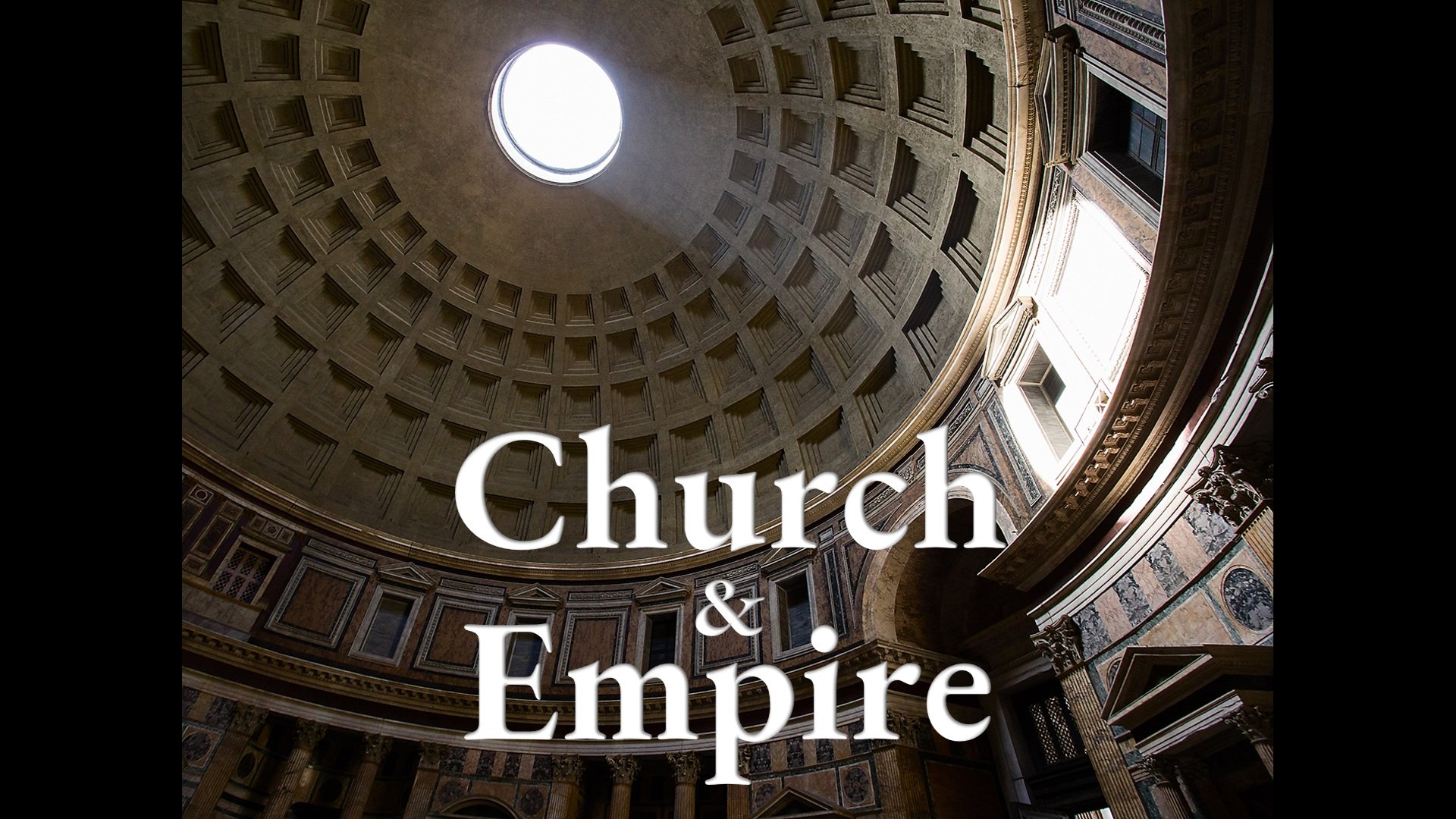
Race is a construct created by European colonialism. For more background, consider the Church and Empire section of our website. This section reminds us what Christian faith was like prior to colonialism, and in resistance to colonialism, to show that Christianity is not “a white man’s religion.”