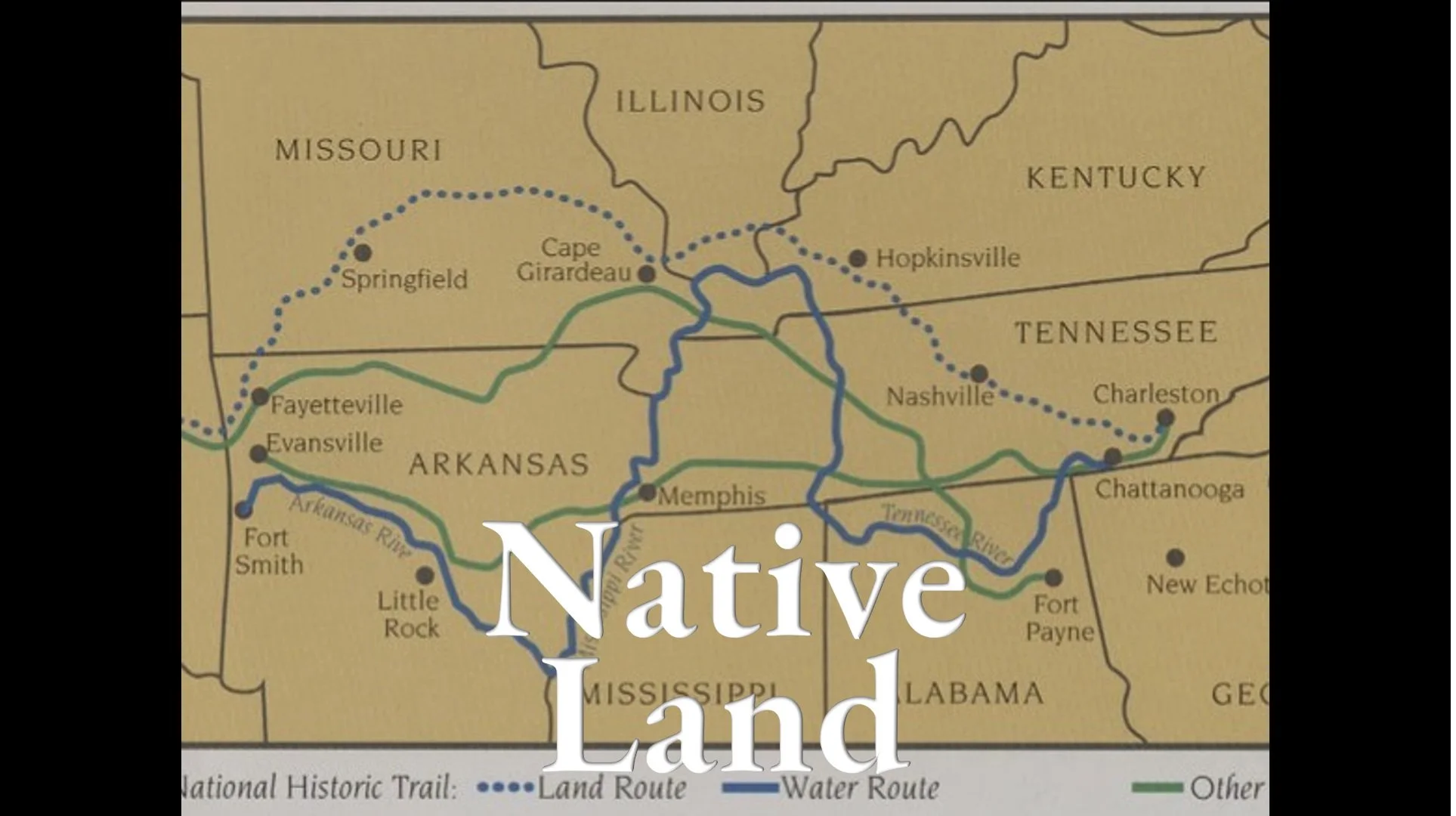
Photograph: The forced relocation march of the Cherokees on the Trail of Tears, in the 1830's. Photo credit: U.S. National Park Service, Wikimedia Commons.
Introduction
This page highlights resources on the various ways the U.S. dispossessed Native Americans from their lands, and how those lands were used afterwards.
Messages and Resources

Mako Nagasawa, John Locke’s Theology of Private Property, edited by Grace Tien and Maria Eugenia Funes, Religion and Racial Capitalism. Palgrave MacMillan, 2025.
American libertarians and private property absolutists appeal to John Locke, remembered as an English political philosopher. Locke originally positioned himself, however, as a biblical scholar and theologian. As such, Locke departed from Christian tradition. I argue the relationship between Locke’s political philosophy and the Bible is that of a parasite and its host. Christian leaders prior to Locke believed that the earth is the Lord’s, the fruit of the earth belongs to all, and the political community could modify property in various ways because it was ethically and chronologically prior to private property. Locke, however, argued that individuals first create private property by enclosing land and laboring on it, then bring their private properties into political society, which was meant by God to defend individual property rights. He thereby defended both the English Revolution of 1688 and also English colonialism in the Americas.
Politics, the Church, and Jesus’ Restorative Justice
Slides of a presentation given to the 2022 Reconstruction class. The introduction features John Winthrop vs. Roger Williams to highlight the debate over freedom of religious Conscience vs. Christendom, as well as viewing Native Americans as “savages” (Winthrop) vs. highly culturally sophisticated (Williams), and also viewing the land of the Native Americans as a gift from God to the Europeans vs. given by God to the Native Americans. The presentation also highlights Christian accomplishments in health and hospitals, education and schools, land ownership and economic justice, and criminal justice reform.
This video, the tenth in our video series on Tolkien found on our Arts and Theology page and our YouTube channel, looks at lessons about power and leadership from those three contexts. The Scouring of the Shire teaches us why we should resist "plantation capitalism." Rohan has lessons about migration, conflict, treaties with indigenous peoples and prior settlers, and peace. Gondor sifts its legacy from Numenor: an influential blessing at first, an imperial terror at the end. As usual, we look at Christian theology and ethics: the biblical theme of Empire, the question of women in power and leadership, and land, property, and hospitality.
00:10:36 The Shire
00:25:57 Rohan
00:38:14 Gondor
00:53:25 The Biblical Theme of Empire
01:07:08 Women Ruling and Leading
01:26:45 Land and Property
A series of blog posts where we explore many issues as Christian heresy, for which Christians must take responsibility in the frame of repentance. Blog posts 1 and 2 demonstrate how the proto-Christian nationalism of John Winthrop and the Puritans impacted Native Americans; the Puritan ethos justified taking Native lands and viewing Native cultures and inferior. Blog post 3 demonstrates the Doctrine of Discovery, which provided a Catholic justification for seizing Native lands, which passed into U.S. jurisprudence. Blog post 4 demonstrates how the construction of “race” as a category associated melanin with intelligence, falsely. Blog post 5 demonstrates how John Locke’s heretical theology of private property contributed to Native displacement. We have designed a study guide to accompany the blog posts. Please consider using it for personal reflection or discussion in your family, church, organization, etc.
White American Evangelical Political Attitudes and Behavior: Explanation and Correctives White American evangelical political attitudes can be characterized by the debate between John Winthrop and Roger Williams, and their respective attitudes towards Native Americans, slavery, fairness, and faith in civic space. This is a presentation also explores Scripture and church history to argue that Roger Williams was correct. Given to the staff of Emmanuel Gospel Center, Apr 18, 2018, as a follow-up to how Christian restorative justice impacts ministry; audio file here.
-
Linda Coombs, A Nation in Balance: Sovereignty, Earth and the Meaning of Right Relation. Partnership of Historic Bostons, Oct 26, 2024. This Native American approach to defining “freedom” is an important critique of all Western political philosophy. The West defines “freedom” only in terms of people not ruling arbitrarily over people. It does not refer to right relationship with the land.
“Aquinnah Wampanoag citizen, educator and author Linda Coombs on how Native people saw sovereignty as the right relationship to the earth. For English colonists, sovereignty meant control over land – and land meant property. For the Eastern Woodland's Native people, sovereignty meant something very different indeed. In this important and revelatory presentation, Aquinnah Wampanoag citizen, educator and author Linda Coombs delves into the true meaning of sovereignty as being in right relationship to the Earth. She reveals how the Wampanoag people did that for thousands of years before European contact, and recounts the cost of colonization, which caused, and continues to cause, the disruption of our intended lives.”
-
Landback (website) a movement arguing for Native American authority in decision making regarding the lands of North America
Native Lands (Native Land.ca) a map of First Nations peoples and their traditional boundaries, in North and South America, and Australia
Wikipedia, Dawes Act of 1887 (Wikipedia) was the legal device used to individualize and privatize land ownership among Native Americans, to be bought by whites
Wikipedia, Treaty of Guadalupe Hidalgo (Wikipedia) annexed land in the Southwest whereby Latinos lost their ejidos (community farms)
Danielle Romero, American Identity and Family Stories. NYTN | YouTube channel. “I'm Danielle Romero and my content is all about exploring the nuances of American identity and unearthing hidden historical narratives. My great grandmother Lola left her heritage behind in Louisiana when she moved to NY in the 1930s. Last year, I decided to uncover our family story and begin finding our roots. I'm still on the journey of hidden heritage, genealogy and finding out how our family history fits in the context of community history!”
William Cronon, Changes in the Land: Indians, Colonists, and the Ecology of New England. Hill and Wang | Amazon page, 1983. and pdf book
Morag Barbara Arneil, "All the World Was America": John Locke and the American Indian. University College London, 1992. in this doctoral dissertation shows how Locke, the foremost political theorist of English and American political liberal thought and property, relied very selectively on travel journals and books in his library for information about Native Americans to portray them unfavorably. Nagamitsu Miura, John Locke and the Native Americans: Early English Liberalism and Its Colonial Reality. Cambridge Scholars, 2013. writes a devastating and integrated analysis of Locke. John Quiggin, John Locke Against Freedom. Jacobin Magazine, Jun 28, 2015. argues even more strongly that Locke legitimized expropriation and enslavement. Quiggin notes that even SCOTUS case Keto v. City of New London, Connecticut (2005) relied on faulty Lockean assumptions. Matthew Yglesias, If Your House Is Built On Land Expropriated From Its Indigenous Inhabitants—You Didn't Build That. Slate, Sep 19, 2012. Yglesias makes a brief comment on Locke. Bryan Caplan, Do Indians Rightfully Own America?. EconLog, Sep 2012. Caplan makes an argument based on the very theory of property - Lockean individualism - that is in question. Paul Corcoran, John Locke on the Possession of Land: Native Title vs. the ‘Principle’ of Vacuum domicilium. University of Adelaide, date unknown. Corcoran attempts to exonerate Locke by attributing ignorance to him, and in any case overlooks completely Locke's attempt to frame his theory of property in Genesis 1, and heretically so.
Joel Brady, "Land Is Itself a Sacred, Living Being": Native American Sacred Site Protection on Federal Public Lands Amidst The Shadows of Bear Lodge. American Indian Law Review, 2000.
Trina Williams Shanks, The Homestead Act: A Major Asset-Building Policy in American History. Washington University St. Louis, Jul 1, 2000.
Charles C. Mann, 1491. The Atlantic, Mar 2002. Surprising reports and estimates of how populated North America was prior to colonialism, and the role of European diseases to wipe out Native Americans
Andrew Boxer, Native Americans and the Federal Government. History Today, Sep 2009. “Judged by numbers alone, the impact of termination was small. It affected just over 13,000 out of a total Indian population of 400,000. Only about 3 per cent of reservation land was lost. But it caused huge anxiety amongst Native Americans and had the ironic result of stimulating the formation of the ‘Red Power’ protest movement of the 1960s.” See also Smithsonian National Museum of the American Indian, IndiVisible: African-Native American Lives in the Americas. Smithsonian Museum.
Heather Benno, BP Spill Destroys Native American Fishing Grounds and Livelihoods. Liberation, Jun 6, 2010. “Native American tribes in southern Louisiana continue their struggle against Big Oil after decades of land destruction. The Choctaw, Chitimacha, Houma, Attakapas and Biloxi tribes, all native to the Gulf marshes, have seen the oil from the BP spill destroy their fishing grounds and livelihoods.”
PBS News Hour, Why the Sioux Are Refusing $1.3 Billion. PBS News Hour, Aug 24, 2011. “Members of the Great Sioux Nation could pocket a large sum set aside by the government for taking the resource-rich Black Hills away from the tribes in 1877. But leaders say the sacred land was never, and still isn't, for sale.”
Russell Means, Revolution and American Indians: “Marxism is as Alien to My Culture as Capitalism”. Films for Action, Nov 12, 2011. “The following speech was given by Russell Means in July 1980, before several thousand people who had assembled from all over the world for the Black Hills International Survival Gathering, in the Black Hills of South Dakota. It is Russell Means's most famous speech. A member of the Oglala Lakota tribe, he was perhaps the most outsized personality in the American Indian Movement, beginning with the 1973 occupation of Wounded Knee.”
Lia Mandelbaum, Hitler's Inspiration and Guide: The Native American Holocaust. Jewish Journal, Jun 18, 2013
Todd Woody, Meet the Newest Big Solar Developers: Native Americans. Quartz, Sep 26, 2013. 8 tribes of 150 (that are large enough) of 326 reservations (cf. Moapa Paiutes, Navajo) are developing solar power. “The world’s largest solar thermal power plant plugged into the California grid this week, the first of what was supposed to be a dozen big solar projects to be built in the desert southwest of the US.”
Algernon Austin, Native Americans and Jobs. Economic Policy Institute, Dec 17, 2013. notes some encouraging signs and makes culturally respectful suggestions, in contrast to PragerU, American Indians Are Still Getting a Raw Deal (PragerU) which recommends individualizing private property and mining for coal and uranium.
Katherine Holmes, Arica L. Coleman: That the Blood Stay Pure: African Americans, Native Americans, and the Predicament of Race and Identity in Virginia. New Books Network, Mar 18, 2014. exploring racial mixing in Virginia; see also Kelly April Tyrrell, Challenging Our Past. University of Delaware, Nov 14, 2013. and Arica Coleman, Black/Indian Relations. Speaker, Nov 14, 2013. A 30 minute lecture; see also Barnard Shipp, The History of Hernando De Soto and Florida: Or, Record of the Events of Fifty-Six Years, 1512 to 1568. Forgotten Books | Amazon page, Nov 17, 2016.
Avik Roy, 5 Ways The Government Keeps Native Americans In Poverty. Forbes, Mar 13, 2014.
Hansi Lo Wang, The Map of Native American Tribes You've Never Seen Before. NPR, Jun 24, 2014.
Mark Charles, The Doctrine of Discovery- A Buried Apology and an Empty Chair. Wirelesshogan: Reflections from the Hogan, Dec 22, 2014.
Amanda Girard, Here’s What Happened When These Unarmed Native American Sisters Defended Their Land from the Feds. (US Uncut, Jan 6, 2016.
Jeffrey Taylor, It's the Mormons and the Kochs: The Secret Roots of White, Male Bundy Rage. Salon, Jan 10, 2016.
William deBuys, Privatizing America's Public Land: How the Raid on Malheur Screened a Future Raid on Real Estate. Huffington Post, May 17, 2016.
Benjamin Madley, It's Time to Acknowledge the Genocide of California's Indians. Los Angeles Times, May 22, 2016.
Bill McKibben, After 525 Years, It's Time to Actually Listen to Native Americans. Grist, Aug 22, 2016.
Tom Cahill, Obama Just Cancelled Oil and Gas Drilling on Sacred Blackfeet Ground. US Uncut, Nov 17, 2016.
Julian Brave Noisecat, The Indigenous Revolution: Standing Rock Points the Way Forward for Indigenous People and the Left. Jacobin Magazine, Nov 24, 2016.
Keri Leigh Merritt, Masterless Men: Poor Whites and Slavery in the Antebellum South. Cambridge University Press | Amazon page, 2017. In her concluding chapter summarizes estimates of the magnitude of white wealth gained at the expense of Native land.
"By the end of Reconstruction, therefore, thousands of poor whites succeeded in becoming landowners, and many others would follow in their footsteps over the next few decades. Indeed, by essentially giving away land to individuals, the Homestead Acts were the most extensive, radical, redistributive governmental policy in American history. The number of original (1862) Homestead-recipient descendants living in 2000 was estimated to be around 46 million people, about one-quarter of the US adult population. These beneficiaries, of course, were overwhelmingly white. Largely denied these wealth entitlements, blacks were essentially left landless after years (and generations) of unpaid, coerced, and brutalized labor." (p.331)
White suburbs have a precursor in the Homestead Acts and the federal government doling out originally Native land to poor white people. For background, see Nancy Isenberg, White Trash: The 400-Year Untold History of Class in America. Roosevelt House Public Policy Institute of Hunter College, Jun 12, 2017. A 55 minute video. Isenberg observes how terms for poor white people focused on their location and lack of mobility, from “hillbillies” from the hills all the way up to “trailer park” people today. She traces this back to how wealthy British elites talked about poor English people.
Steve Inskeep, In The 1920s, A Community Conspired To Kill Native Americans For Their Oil Money. NPR, Apr 17, 2017.
Contributor, Noam Chomsky: Indigenous People Are Our Only Hope for Survival. Ecologise, Nov 4, 2017. with interesting links to other articles
Kouslaa T. Kessler-Mata, American Indians and the Trouble with Sovereignty: A Turn Toward Structural Self-Determination. Cambridge University Press | Amazon page, Oct 19, 2017. tribal governance interacting with state and federal government
Hannibal B. Johnson, Blood Rolls No More. Tulsa Voice, November A issue, 2017. about African-Americans adopted into the Cherokee Nation
Ben Giles and Paulina Pineda, Legislative Staffers Say Pro-Trump Supporters Called Them 'Illegal' For Being Dark-Skinned. Arizona Capitol Times, Jan 26, 2018. and Snopes fact check with video
Malinda Maynor Lowery, We Are the Original Southerners. New York Times, May 22, 2018.
Justin Rohrlich and Adam Rawnsley, A Native American Tribe Has a $800 Million Contract to Run ICE Detention Centers. Daily Beast, Jul 6, 2018. “The National Congress of American Indians has called Trump’s immigration policies ‘simply immoral.’ One member group, though, is taking a very different approach.”
Dave Merrill and Lauren Leatherby, Here’s How America Uses Its Land. Bloomberg, Jul 31, 2018.
Mark Tooley, With Fixation on ‘Doctrine of Discovery,’ Christians Ape a Secular Alternative to Christian Doctrine. The Stream, Aug 7, 2018. fails to uphold the importance of repentance and restitution for both heresy and injustice, using “Jesus redeems” as an excuse to not repent; fails to distinguish between Western civilization and that which is evil in Western civilization; fails to recognize the Christian vocation to be better than the pagans, especially in relations of power
Amanda Arnold, 94 Percent of Native Women in Seattle Survey Say They’ve Been Raped or Coerced Into Sex. The Cut, Aug 27, 2018.
A Different Asian American Timeline. ChangeLab website. Excellent material, presented cleanly, giving a global perspective on global capitalism and international relations, not just race relations in the U.S. domestically.
Kimbra Cutlip, In 1868, Two Nations Made a Treaty, the U.S. Broke It and Plains Indian Tribes are Still Seeking Justice. Smithsonian, Nov 7, 2018. "The American Indian Museum puts the 150-year-old Fort Laramie Treaty on view in its “Nation to Nation” exhibition"
White Wolf, Jesuits to Return 525 Acres of South Dakota Land to Rosebud Sioux Tribe. White Wolf, Nov 19, 2018.
Gregory S. Schneider, The Indians Were Right, the English Were Wrong: A Virginia Tribe Reclaims Its Past. Washington Post, Nov 21, 2018.
Adrienne Keene, Rebecca Nagle, and Joseph M. Pierce, The Syllabus: Elizabeth Warren, Cherokee Citizenship, and DNA Testing. Critical Ethnic Studies Journal, Dec 19, 2018. although Warren has said that ancestry is not tribal citizenship, and that she is not a person of color; nevertheless the history and legalities involved are important
Erica L. Green and Annie Waldman, ‘I Feel Invisible’: Native Students Languish in Public Schools. New York Times, Dec 28, 2018. "At Wolf Point High School in rural Montana, Native American students face the same neglect Native students across the U.S. do as they navigate a school system that has failed American Indians"
Lauren Kent, European Colonizers Killed So Many Native Americans That It Changed the Global Climate, Researchers Say. CNN, Feb 2, 2019. disease and war
Bill Code, Australia Aboriginals Win Right to Sue for Colonial Land Loss. Aljazeera, Mar 15, 2019. “The ruling in favour of the Ngaliwurru and Nungali groups paves the way for billions of dollars in compensation. The High Court of Australia has handed down the biggest “native title” ruling affecting Aboriginal ownership of the land in decades, amid claims that billions of dollars in compensation will need to be paid by governments to indigenous groups. “Native title” refers to the rights of Australia’s indigenous people to their traditional land and water recognised by Australian common law.” Lorena Allam, Aboriginal Land Rights Claims Unresolved Despite All-Clear from Independent Review. The Guardian UK, Mar 29, 2019. “Indigenous affairs minister Nigel Scullion says he is ‘not in a position’ to grant Northern Territory land rights, some delayed for 20 years.” But see Ramona Wadi, Australia Is Destroying Aboriginal Heritage Sites for Mining Profit. Strategic Culture Foundation, Jun 3, 2020.
Nina Totenberg, Gorsuch Provides Decisive 5th Vote In Case Interpreting Treaty With Indian Tribe. NPR, Mar 20, 2019.
Editors, The Story We've Been Told About America's National Parks Is Incomplete. Time, Apr 2, 2019.
Audrea Lim, How the Green New Deal Can Deliver Land Justice. Jacobin Magazine, May 2019. “The distribution of land in the US is also shaped by legacies of racial hierarchy and violence. Ninety-eight percent of private rural land and 96 percent of private agricultural lands are white-owned; less than 1 percent of farms are black-owned. It wasn’t always this way — in 1910, that number was 14 percent. The rapid decline was partially a product of the Great Migration and mechanization (themselves outgrowths of a racist political economy), but black farmers were also pushed off their land through discriminatory lending practices and inadequate legal, political, and financial resources to stave off real estate developers.”
Nick Estes, Our History Is the Future: Standing Rock Versus the Dakota Access Pipeline, and the Long Tradition of Indigenous Resistance. Verso | Amazon page, Mar 5, 2019. traces the history of native resistance to land and water rights
Timothy Egan, The Great Western Public Land Robbery. New York Times, Aug 16, 2019. “Trump’s pick to be the steward of America’s public lands doesn’t believe in public lands”
Mark Charles and Soong-Chan Rah, Unsettling Truths: The Ongoing, Dehumanizing Legacy of the Doctrine of Discovery. InterVarsity Press | Amazon page, Nov 2019.
David J. Silverman, In 1621, the Wampanoag Tribe Had Its Own Agenda. The Atlantic, Nov 27, 2019. A helpful article on the history of interaction between the English settlers and the various Native tribes.
Nick Estes, Our History Is the Future: Lakota Historian Nick Estes on Thanksgiving & Indigenous Resistance. Democracy Now, Nov 28, 2019.
Morgan Lee, What This Aboriginal Christian Wants to Tell the Church About the Australia Fires. Christianity Today, Jan 22, 2020. re: Australia, which is a helpful comparison point to the U.S. as a European colonial nation reflecting on its treatment of indigenous people. “Hillsong announced several weeks ago that it had raised more than one million Australian dollars to support those affected by the fire. And the board of directors of A Rocha Australia, part of an international Christian conservation group, said it was building partnerships with Christian and non-Christian conservationists to aid with the recovery. As an aboriginal Christian, Brooke Prentis hopes the tragedy causes Christians and the country at large to commit to listening to the voices of Australia’s indigenous people, communities which have lived on the land for thousands of years.”
Jeffrey Ostler, The Shameful Final Grievance of the Declaration of Independence. The Atlantic, Feb 8, 2020. “The revolution wasn’t only an effort to establish independence from the British—it was also a push to preserve slavery and suppress Native American resistance.”
Julia Conley, 'Huge Victory' for Standing Rock Sioux Tribe as Federal Court Rules DAPL Permits Violated Law. Common Dreams, Mar 25, 2020.
WBUR Newsroom, Secretary Of Interior Orders Mashpee Wampanoag Reservation 'Disestablished,' Tribe Says. WBUR, Mar 28, 2020. “The federal Bureau of Indian Affairs told the Mashpee Wampanoag tribe on Friday that the tribe's reservation will be "disestablished" and its land taken out of trust, per an order from Secretary of the Interior David Bernhardt, tribe Chairman Cedric Cromwell announced in a post on the tribe's website… Having land "held in trust" by the federal government effectively affords a tribe special legal status and autonomy to decide how to tax, develop and manage a plot of land. The decision to take land into trust is typically made by the Department of the Interior, which had OK'd the trust status for the Mashpee land in 2015.”
Amy Goodman, How Black & Indigenous Groups Won the Fight to Stop the Atlantic Coast Pipeline. Democracy Now, Jul 7, 2020.
Alleen Brown, Half of Oklahoma Is “Indian Country.” What if All Native Treaties Were Upheld? The Intercept, Jul 17, 2020. “From the Grand Canyon to Mount Rushmore, if the routinely flouted U.S. treaties with Indigenous people were honored, this would be a very different country.” After the SCOTUS McGirt decision, authored by Neil Gorsuch, this is quite relevant.
Alan Yuhas, Roanoke’s ‘Lost Colony’ Was Never Lost, New Book Says. New York Times, Sep 2, 2020. “A new book aims to settle a centuries-old question of what happened to a group of English colonists. Archaeologists said that its theory was plausible but that more evidence was needed.” See Scott Dawson, The Lost Colony and Hatteras Island. The History Press | Amazon page, Jun 2020. re: Roanoke, Virginia.
Jane McBride, Shattering the Myth of the First Thanksgiving. Christian Century, Nov 13, 2020. “The Wampanoags shared the gifts of the land. The colonists responded with greed and ingratitude.”
Alex Brown, Once-Ignored Promises to Tribes Could Change the Environmental Landscape. Pew Trusts, Dec 5 2020. “The U.S. has largely ignored the nearly 400 treaties signed with tribal nations, but that may be starting to change. And some think that could prevent, or even reverse, environmental degradation.”
Heather Cox Richardson, History Chat: The West and Reconstruction - Indigenous History. Heather Cox Richardson, Facebook Video, Feb 4, 2021.
Valerie Volcovici, U.S. Interior Dept. Moves to Restore Native American Land. Reuters, Apr 27, 2021. re: placing land in trust, which allows special governance, development, etc. “The official said that during the Obama Administration, 560,000 acres of land were placed into trust for tribes, whereas under the Trump Administration, only 75,000 acres had been placed into trust.”
Jennifer Bendery, CNN Drops Rick Santorum After Racist Comments About Native Americans. Huffington Post, May 22, 2021. Santorum said there was “nothing” in North America prior to the colonists and that Native Americans haven’t contributed much to American culture anyway
Nick Martin, Is America Ready to Face the Truth About the Atrocities Against Indigenous Children? The New Republic, Jun 24, 2021. “Deb Haaland is pushing for a federal reckoning with what the U.S. did to Native Americans. But she cannot be alone in her mission.” See also Kelly Benallie, US Boarding Schools to Be Investigated. Indian Country Today, Jun 22, 2021. See also Mary Annette Pember, ‘We Won’t Forget About the Children’. Indian Country Today, Jun 6, 2021. For a summary of important history. See also BBC, Canada: 751 Unmarked Graves Found at Residential School. BBC, Jun 24, 2021.
PBS News Hour, Why Native Americans Are Buying Back Land That Was Stolen From Them. PBS News Hour, Oct 16, 2021. and PBS News Hour, Native American Tribes Land Buybacks Start a Commercial Approach to Social Justice. PBS News Hour, Oct 17, 2021. KQED, How This Native American Elder Reclaimed Sacred Land in the Bay Area. KQED Arts, Nov 20, 2019. re: Indian Canyon for the Ohlone people in Hollister, CA between San Francisco and Big Sur
Dana Hedgpeth, This Tribe Helped the Pilgrims Survive for Their First Thanksgiving. They Still Regret It 400 Years Later. Washington Post, Nov 4, 2021. re: the Mashpee Wompanoag and 1621
Williams Roberts, Native Americans Share Long-Ignored Thanksgiving Truths. Aljazeera, Nov 25, 2021. “Wampanoag community is telling its Thanksgiving story as nationwide push to recognise Indigenous history in US grows.” This article includes the fascinating detail that the Wampanoag language is being revitalized and reconstructed using a Bible that was translated into the tribal language 350 years ago.
Gregory S. Schneider, Rappahannock Tribe Reacquires Ancestral Virginia Land 350 Years Later. Washington Post, Apr 1, 2022. “The Rappahannock Tribe in Virginia has taken ownership of more than 460 acres of ancestral homeland along the river that bears its name, thanks to a groundbreaking partnership with donors, environmentalists and government agencies. The acquisition, announced Friday by the tribe and Interior Secretary Deb Haaland, returns a section of Rappahannock River frontage known as Fones Cliffs to the tribe, which was driven away by English settlers more than 350 years ago and pushed almost to extinction by white supremacists during the 20th century. The tribe has pledged to care for the extraordinarily rich natural environment of the site, which had been slated for commercial development just a few years ago. Fones Cliffs is a major East Coast nesting place for bald eagles, considered sacred in Rappahannock culture.”
Thomas Green, The History of the Massachusett Tribe. Charter Street Cemetery, Apr 29, 2022.
U.S. Department of the Interior, Investigative Report, Outlines Next Steps in Federal Indian Boarding School Initiative. U.S. Department of the Interior, May 11, 2022. Links to Bryan Newland, Assistant Secretary, Indian Affairs, Federal Indian Boarding School Initiative Investigative Report. U.S. Department of the Interior, May 2022. See summary by Amy Goodman, Nick Estes: Indian Boarding Schools Were Part of "Horrific Genocidal Process" by the U.S. Democracy Now, May 13, 2022. Volume 1 is a preliminary report which discovered 500 deaths of indigenous children at these “schools,” which had terrifying conditions and goals. The Catholic Church is implicated in the treatment of these children. The Interior Department expects to discover many more as the research continues.
Knowing Better, They Were Just in the Way. Knowing Better, Nov 6, 2022. A 2.5 hour video comparing how U.S. myths about Native Americans and educational rhetoric fail to convey the injustice.
Sarah Augustine, The Land is not Empty: Dismantling the Doctrine of Discovery. Calvary Baptist Church, Minnesota Peacebuilding Leadership Institute, Nov 16, 2022.
Knowing Better, The War to Save the Buffalo | Indian Removal, Nov 19, 2022. An example of environmental racism and genocide. “With the vast buffalo herds of North America facing extinction, a small group of Plains Nations came together to fight for their survival.”
Amy Goodman and Juan Gonzalez, 4,000+ Children Died: Pope Apologizes to Indigenous Groups in Canada over Residential School Abuse. Democracy Now, Jul 26, 2022. Includes a critique of the Pope’s apology and how it was inadequate.
Zack Budryk, Grijalva Blasts Provision in House Rules Package Making It Easier to Transfer Public Land Ownership. The Hill, Jan 9, 2023. “The proposed rules package, made public Friday, includes a provision streamlining the process by which ownership of federal lands passes from the federal government to states or localities. The provisions are similar to those passed during the 115th Congress, the last session in which Republicans controlled the House, Rep. Raúl Grijalva (D-Ariz.) told The Hill on Monday. “The whole process of this rule is to devalue public land,” Grijalva said. “You’re basically handing [land] over to the industries, whichever they might be … and all the protections that are in place under federal law, in terms of siting those and getting permission for those [lands] disappears, and that changes the complexion of it completely.” This will make Native American lands, which are held in trust, more vulnerable.
Johnny Harris, How the USA Colonized the USA. Johnny Harris, Apr 12, 2023. See also part 2: Johnny Harris, How the U.S. Stole ̶O̶k̶l̶a̶h̶o̶m̶a̶ Sequoya. Johnny Harris, Jun 21, 2023. On treaty-breaking with the five major tribes that constituted eastern Oklahoma.
Amy Goodman and Juan Gonzalez, The Monroe Doctrine, Revisited: How 200 Years of U.S. Policy Have Helped to Destabilize the Americas. Democracy Now, Apr 27, 2023. Pope Francis’ repudiation of the Doctrine of Discovery — which also undergirds US property law based on SCOTUS Justice John Marshall — means that all that US jurisprudence must now be regarded as built on a heresy, formally. Also, the Monroe Doctrine — the US assertion that the entire Western hemisphere is its exclusive sphere of influence — is an ideological outgrowth of the Doctrine of Discovery, because it viewed native people as too primitive to govern their own affairs, and needed the “empire of liberty,” as Thomas Jefferson called the US.
Denise Bossy, Charting a Path Toward an Indigenous History of Florida. National Council of History Education, Feb 26, 2024. Denise Bossy, The Yamasee Indians: From Florida to South Carolina. University of Nebraska Press, Apr 2022. Native tribes owned land and Europeans sought out inhabited areas for land use and also Native labor.
PBS Origins, Native American Reservations, Explained. PBS, Apr 3, 2024. A helpful 10 minute video covering history and law.
Rebecca Nagle, Justice for Indigenous Nations Is Rare. But This Supreme Court Decision Proves It Is Possible. The Intercept, Sep 10, 2024. “The Supreme Court’s 2020 decision in McGirt v. Oklahoma resulted in the largest restoration of Indigenous land in U.S. history.”
David Hall, What They Left Behind: The English Politics the Puritans Rejected. Partnership of Historic Bostons, Sep 29, 2024. “Every householder who came to Massachusetts and Connecticut came to a grant of land free of rents. It’s your own land. Nobody in England of their status — nobody in England of their status — owns land free of rents. Now, no one has put on paper yippie! But we can feel it in the security they feel about having children. They’re going to have property to pass on to their children. The large families they start having. That’s out of a sense of economic “looks good downstream — I can pass something on to my children.””
Linda Coombs, A Nation in Balance: Sovereignty, Earth and the Meaning of Right Relation. Partnership of Historic Bostons, Oct 26, 2024. This Native American approach to defining “freedom” is an important critique of all Western political philosophy. The West defines “freedom” only in terms of people not ruling arbitrarily over people. It does not refer to right relationship with the land.
“Aquinnah Wampanoag citizen, educator and author Linda Coombs on how Native people saw sovereignty as the right relationship to the earth. For English colonists, sovereignty meant control over land – and land meant property. For the Eastern Woodland's Native people, sovereignty meant something very different indeed. In this important and revelatory presentation, Aquinnah Wampanoag citizen, educator and author Linda Coombs delves into the true meaning of sovereignty as being in right relationship to the Earth. She reveals how the Wampanoag people did that for thousands of years before European contact, and recounts the cost of colonization, which caused, and continues to cause, the disruption of our intended lives.”
Maleena Muzio, Exploring the Interrelatedness Between Japanese and Native American Exploitation in the West. The Daily Campus, Dec 5, 2024. Irrigation work on the land, for White settlers.
Ancient Tone, The Worst Massacre of Native Americans. Ancient Tone, Dec 8, 2024. The Bear River Massacre of January 1863 in Preston, Idaho.
Ancient Tone, The Brutal Things Committed by Every European Colonial Power. Ancient Tone, Dec 10, 2024.
Binyamin Appelbaum, One City Might Have Just Cracked the Housing Crisis. New York Times, Jun 15, 2026. Vancouver, in Canada, allocated 10 acres mid-city to the Squamish, a First Nations tribe. The Squamish are now building the densest neighborhood in the city — eventually 6,000 homes in 11 towers — because they are exempt from many of the city’s rules and regulations.
Dominic Sandbrook, Ken Burns on Why America Really Declared Independence. The Rest Is History, Jul 4, 2026. Ken Burns argues that the motivation for the American Revolution was land. The revolutionaries called The Continental Congress “continental” because it reflected their aims. Grievance #27 of the US Declaration of Independnece gaslights the Native Americans who were resisting the European American settlements happening past the boundaries that Great Britain had negotiated with the tribal authorities.
Liuan Huska, In Historic First, Catholic Sisters Return Indigenous Land. U.S. Catholic, Jun 23, 2026.
“Before it was called Trout Lake, the nearly 4,000-acre body of water in Vilas County, Wisconsin had a different name. An Ojibwe wild rice technician dug up some old files and found the name recently—Makade’ike. It literally means the “place where they make something black,” said Biskakone Greg Johnson on a webinar in November. Johnson, a member of the nearby Lac du Flambeau Band of the Lake Superior Chippewa, surmised that the black color could have had to do with mud, dye for hides, or maybe fire. “A lot of those old translations are lost to time,” he said.
“The lake’s Indigenous name surfaced around the same time a small portion of the land around the lake was returned to its original caretakers. In October, the Franciscan Sisters of Perpetual Adoration handed Johnson’s tribe the keys to their just-under-two-acre Marywood Franciscan Spirituality Center along Trout Lake. This act represents the first instance of Catholics in the United States returning land to the original Indigenous tribes in the name of reparations.”
Science and Nonduality, Little Singer. Science and Nonduality (SAND), 2026. A documentary film about the Navajo (Diné) in Arizona. “Amidst the wide horizons of Diné land, the legacy of historical trauma echoes through generations. At the center, a medicine man and a small school, where grief and resilience meet in song, teaching, and k’é (kinship). Little Singer is rooted in the land; carrying the vision and medicine of k’é for those yet to come”
Race and Land: Topics:


Race: Topics:
This page is part of our section on Race, which contains the following:





Church and Empire: Topics:
Race is a construct created by European colonialism. For more background, consider the Church and Empire section of our website. This section reminds us what Christian faith was like prior to colonialism, and in resistance to colonialism, to show that Christianity is not “a white man’s religion.”