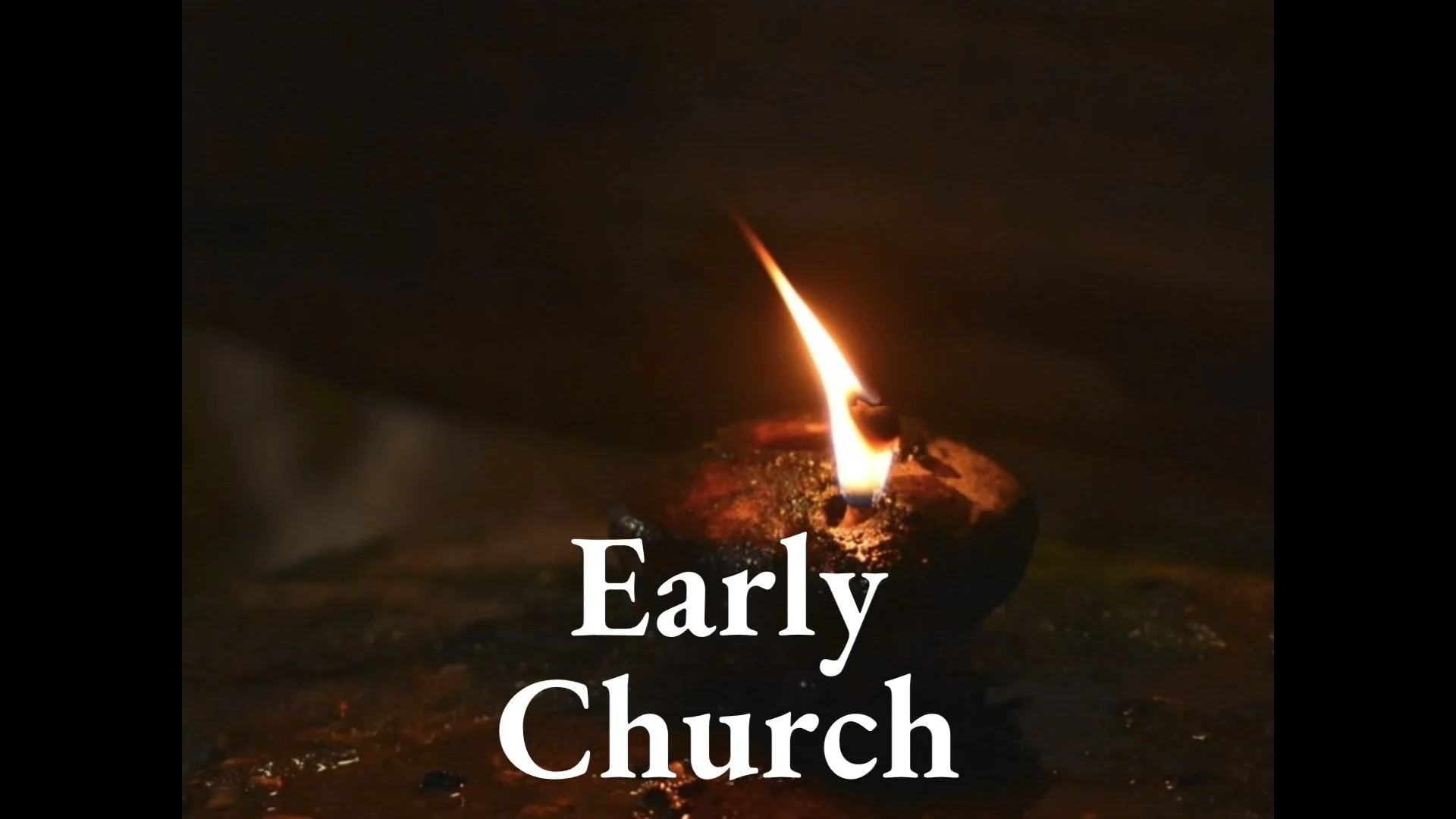
An old clay oil lamp from Nazareth, Israel. Photo credit: Olivia Armstrong.
Introduction
These resources explore Christians reflections from the first eight centuries — concluding with John of Damascus (675--749) — on God’s creation order and its meaning as God’s vision for relationships between human beings, and also between human beings and the created world.
Messages and Resources
Photo credit: Maria Charitou, Flickr CC-2.0. At 17:47, Mako highlights the Early Christian response to prostitution: The Council of Elvira, which was probably in large part based on 1 Corinthians 6:9 -7:40 and 11:2 - 16. At 32:29, Mako and Katelyn discuss the building blocks for the Christian view of the restoration of women, categorically. At 1:04:15, Mako addresses the question of patriarchy and female subordination. At 1:15:24, Mako explains the early Christian response to poverty and God's “Housing First Program.” At 1:28:52, Mako addresses the challenge of libertarianism and John Locke's private property absolutism. See also the slides to this presentation.
See also the slides to this presentation. Given October 2, 2021 to the Reconstruction class. Explores early Christian emancipation and abolition. While Christians did not eliminate all forms of servitude, since servitude for civic penalties, indebtedness, war captivity, and self-indenture persisted, Christians eventually did eliminate what we know as chattel slavery. The presentation examines Old Testament institution of the Hebrew ebed servant, and the New Testament approach to Greco-Roman modes of servitude. We glance at how colonialism and Trans-Atlantic slavery deformed traditional Christian teaching, mindful that more slavery exists today across the globe than every before, and that in the U.S., indebtedness and incarceration show that we have greatly exaggerated the claims that the U.S. has done better than the Bible on “slavery” and its constellation of challenges. For more resources, see Race, Slavery, and Belief Systems.
See also the slides to this presentation. Given to the 2022 Reconstruction class. Greek and Roman views of the inferiority of women began with Plato and Aristotle (4th century BC). But Pulcheria was a Christian woman who became Roman augusta in 414 AD and presided over the Third and Fourth Ecumenical Councils. Empress Theodora was very influential in the 500s. And Irene became Emperor of the Romans by 800 AD. How did this happen? This presentation explores vocation as the main category by which Christians empowered women in roles distinct from family, examining the Catacombs of Priscilla, Irenaeus of Lyons, The Acts of Paul and Thecla, the Martyrdom of Perpetua and Felicitas, Montanism and the orthodox reaction to it, Melania the Elder, Paula of Rome, Nino of Georgia, Brigit of Ireland. The presentation also discusses the disagreements between Irenaeus, Tertullian, and Origen about how to interpret women in 1 Corinthians 11. See also Church and Women’s Leadership for more resources.
See also the slides to this presentation. Given to the 2022 Reconstruction class. The introduction features John Winthrop vs. Roger Williams to highlight the debate over freedom of religious Conscience vs. Christendom. The presentation highlights Christian accomplishments in health and hospitals, education and schools, land ownership and economic justice, and criminal justice reform.

Divine Fire
God’s Goodness and Divine Fire in Scripture
Hell as the Love of God, and the Goodness of God in the Theme of Fire
This page is a collection of messages, papers, early church citations, and contemporary exegesis. Even an eternal hell is consistent with divine restorative justice, in the following way: Hell is a condition of addiction and self-deception, so that when God calls upon unrepentant offenders to participate in their restoration, they experience it as torment and insult. This comes from the larger biblical theme that God made us to be human beings and human becomings, whose nature is co-determined by God and us in partnership, and set by what and who we choose to love.
Other Resources
Christian Good in Society (website) an impressive list that discusses health care, education, human rights, literacy and communication, etc.; lists organizations and individuals as well, through modern history
Wikipedia, San Marino, a small democratic republic in Italy, a continuation of a Christian monastic community founded in 301 AD
Charles Avila, Ownership: Early Christian Teaching. Wipf and Stock | Amazon page, 1983. A very helpful compilation and analysis.
Anaphora of St. Athanasius, Liturgy of the Ethiopian Orthodox Tewahedo Church. Athanasius of Alexandria (298 - 373) was bishop of Alexandria, and appointed Frumentius to be the first abuna of the Ethiopian Church. This prayer over the eucharist was named for him, although authorship cannot be ascertained. Lines 168 - 169 read:
“As David said in the Psalms, Lord, who shall abide in Thy tabernacle? Who shall dwell on the hill of Thy sanctuary? Then the Holy Spirit answered and said . . . He that puts not out his money to usury, nor takes a bribe against the innocent . . .” [Psalm 15]
Basil the Great, John Chrysostom, and Augustine, What Did the Early Church Say About Economic Justice? Plough, Sep 14, 2017.
Basil of Caesarea, Where Your Treasure Is. Plough, Jul 20, 2023. Includes readings from Nikolai Berdyaev, Maria Skobtsova, C.S. Lewis, and Dorothy Day.
Ambrose of Milan, On Naboth. Beneath the Ninth Station blog. Milan was the Wall Street of the Roman Empire, and Ambrose, bishop of Milan, delivered a magisterial critique of the concentration of wealth and power at the landowners and officials.
John Chrysostom, from Father Georges Florovsky, Life, Works, and Thought of Saint John Chrysostom:
“The possessions of the Emperor, the city, the squares, and the streets, belong to all men, and we all use them in an equal degree. Look at the economy that God has arranged. He has created some things that are for everyone, including the air, sun, water, earth, heaven, sea, light, and stars, and He has divided them equally among all men, as if they were brothers. This, if nothing else, should shame the human race. The Emperor has made other things common to all, including the baths, cities, squares, and streets. There is not the slightest disagreement over this common property but everything is accomplished peacefully. If someone tries to take something and claim it as his own personal possession, then quarrels arise. It is as if the very forces of natures were complaining, and as if at that time when God was gathering them from everywhere they were trying with all their might to separate among themselves, to isolate themselves from each other, and to distinguish their own individual property by coldly saying that ‘this is yours but that is mine’. If this were true, quarrels and bitterness would arise, but where there is nothing of this sort neither quarrels nor disagreements occur. In this way we see that for us as well a common and not an individual ownership of things has been ordained, and that this is according to nature itself. Is not the reason that no one ever goes to court about the ownership of a public square the fact that this square belongs to all?""
Peter Brown, Through the Eye of a Needle: Wealth, the Fall of Rome, and the Making of Christianity in the West, 350 - 550 AD. Princeton University Press | Amazon page, Mar 2014. Magisterial analysis of Christian teaching on wealth in Late Antiquity.
Alister E. McGrath, Iustitia Dei: A History of the Christian Doctrine of Justification. Cambridge University Press | Amazon page, fourth edition 2020. McGrath sets the standard for how righteousness (Hebrew tsedeq) in Old Testament ethics involved not just punishing and rewarding bad/good behaviors, but returning to a creation order where the poor and vulnerable were supplied, protected, included, and honored. The implication is that God's justice is restorative, and neither fundamentally retributive, nor consistently so (Ps.103:10). The further implication is that Paul, when using the term justification (Greek dikaioo), does not have penal satisfaction as a foundation and pre-condition for justification. McGrath shows how the Greco-Roman pagan ethic of meritocratic-retributive justice overturned the Hebraic-Christian concept of restorative justice. McGrath’s book was honored by N.T. Wright as must reading; see N.T. Wright, Justification: God's Plan & Paul's Vision. InterVarsity Press | Amazon page, 2009.
John Philip Newell, Listening for the Heartbeat of God: A Celtic Spirituality. Paulist Press | Amazon page, 1997. Emphasizes the goodness of creation, which serves as a Christian resource for creation-care. See also John Philip Newell, Celtic Treasure: Daily Scriptures and Prayer. Eerdmans | Amazon page, Oct 2005) for a readable daily prayer guide.
Timothy S. Miller, The Birth of the Hospital in the Byzantine Empire. Johns Hopkins University Press | Amazon page, Jun 17, 1997. A masterpieceshowing one of the most positive interactions between church and government. It is impressive how much data we have. This also makes a good case that our science, medicine, and health system should be publicly supported in some form. See also The Cosmological Vision of St. Basil and the First Hospital. Servant of Prayer blog, Apr 8, 2014. See also Father Johannes Jacobse, St. Basil the Great and Christian Philanthropy. American Orthodox Institute USA, Dec 20, 2014. See also Thomas Heyne, Reconstructing the World's First Hospital: The Basiliad. Hektoen International: A Journal of Medical Humanities, Spring 2015.
Oliver O’Donovan and Joan Lockwood O’Donovan, From Irenaeus to Grotius: A Sourcebook in Christian Political Thought. Eerdmans | Amazon page, 1999. See also this bibliographic summary by Patristic Evangelism, Readings in Patristic Ethics. Patristic Evangelism blog, date unknown.
Oliver O’Donovan, The Desire of the Nations: Rediscovering the Roots of Political Theology. Cambridge University Press | Amazon page, 1999. O’Donovan deals with the biblical presentation of the church, states, and Israel - not simply 'church and state' - and does an excellent job in biblical exposition and church history. Foundational work.
Robert M. Frakes, Contra Potentium Iniuras: The Defensor Civitatis and Late Roman Justice. Google book, 2001.
Oliver O’Donovan, Bonds of Imperfection: Christian Politics, Past and Present. Eerdmans | Amazon page, 2003. Covers leading Christian thinkers, actors, and decisions in pre-modern and modern Western history.
Peter Brown, Poverty and Leadership in the Later Roman Empire. Brandeis University Press | Amazon page, 2001. See also Walter Brueggemann's review, How the Early Church Practiced Charity. Religion Online, Jun 14, 2003.
O.M. Bakke, When Children Became People: The Birth of Childhood in Early Christianity. Fortress Press | Amazon page, 2005. An absolutely invaluable study of how Christian faith made an enormous and decisive impact on how children were treated as fully human, overturning Greek and Latin practices of infanticide, etc. which accorded only instrumental value to infants and children. See Pascal Emmanuel Gobry, How Christianity Invented Children. The Week, Apr 23, 2015.
Bogdan Popescu, Human Rights in Early Christian Writings. Mozaic, 2005/1, also a pdf file.
David Bentley Hart, Atheist Delusions: The Christian Revolution and Its Fashionable Enemies. Yale University Press | Amazon page, 2010)
Kevin Knight, Influence of the Church on Civil Law. New Advent website, 2012)
John A. McGuckin, The Ascent of Christian Law: Patristic and Byzantine Formulations of a New Civilization. St. Vladimir’s Seminary Press | Amazon page, Jan 2012.
Ethan Gannaway, Saint Ambrose and Toleration. The Academy for the Study of Ambrose of Milan, Apr 4, 2013. Gannaway makes helpful historical remarks concerning Ambrose, given the bishop's engagement with political events.
Kate Ward, Porters, Catapults, Community, and Justice: Augustine on Wealth, Poverty, and Property. New Theology Review, Sep 2013. Ward’s paper is an impressive and thorough summary of Augustine of Hippo’s teachings on wealth and ownership.
Eberhard Arnold, The Economy of the Early Church: Why the Early Church Abandoned Private Property. Plough, Jan 5, 2015.
Peter Wehner, The Christmas Revolution. New York Times, Dec 25, 2015.
Ronald Osborn, The Scandalous Origins of Human Rights. Veritas Forum, Jan 15, 2016.
Michael J. Thate, Labor and the Social Order. Cosmologics Magazine, Mar 20, 2016. Thate notes how early Christian monasticism posed a challenge to bishops like Augustine, because monks claimed to be worthy of support, like the apostles. But were they? Why or why not? It demonstrates the beginning of vocation, discernment, mobilization, and self-consciousness in Christian monasticism.
Alan Kreider, The Patient Ferment of the Early Church: The Improbable Rise of Christianity in the Roman Empire. Baker Academic | Amazon page, Mar 29, 2016. Kreider gives an excellent historical treatment of Christian treatises on patience, in the face of persecution or difference, or mission. The character quality of patience in politics needs to be re-taught, and re-learned.
Jack Davila-Ashcraft, The Early Church on Government. Paleo-Orthodoxy, Oct 3, 2016.
David Bentley Hart, Human Dignity Was a Rarity Before Christianity. Church Life Journal, Oct 26, 2017.
Trevor Saxby, ‘Always Enough’: Early Church Leader Basil of Caesarea and Sustainability. Making History Now blog, Dec 4, 2017.
David Bentley Hart, A Prayer for the Poor. University of Notre Dame Church Life Journal, Jun 5, 2018. An examination of the Lord’s Prayer.
Sabine R. Huebner and Christian Laes, The Single Life in the Roman and Later Roman World. Cambridge University Press | Amazon page, 2019. Important because for Christians, singleness became a flexible form of “vocation” in which other communities, gifts, and callings emerged. The church (generally) and the monastery (particularly) radically reoriented notions of family, breaking the hierarchy of the paterfamilias and the subservience of the family to the military and the state, and allowing younger people to challenge older. See review by Jed W. Atkins, How Christianity Changed Singleness (First Things, Jan 2020)
Thomas Meagher, Social Justice and the Spirituality of Gregory of Nyssa. Macrina Magazine, February 15, 2020. “Gregory’s account of the bodies of the poor is largely built on his belief that the human person is not merely a physical body. Individuals share a common humanity or pleroma that is not fully complete unless the individuals that comprise it are united.”
Jonathan David Faulkner, Jesus, Church History, and Disability. God’s Heart for Those, Jul 29, 2020. A heartwarming essay. He argues that Irenaeus made a mistake by defining “image” and “likeness” as the “form” and “character.” I think Irenaeus was correct, however, as I’ve written about in my studies of Irenaeus, other early Christian writings, and Scripture. For Irenaeus’ definitions are not only shared by others contemporaneous to him, making it likely that these definitions are apostolic, they are the firmest way to anchor an extraordinarily high view of the human body, even if we are vulnerable to other factors in the world outside the garden. Irenaeus may not mention or explore our vulnerability to the exile, but his basic framework for “image” and “likeness” are correct. But I concur with Faulkner’s gratitude towards the Cappadocians.
Tish Harrison Warren, The Early Church Saw Itself as a Political Body. We Can Too. Christianity Today, Oct 22, 2020. “A Christian vision of the public square starts with being a different kind of people.”
Roman Montero, A Patristic Critique of Political Economy. Notre Dame Church Life Journal, Dec 16, 2021. Montero explores the thought of Ambrose of Milan, Basil of Caesarea, and John Chrysostom, and compares with Enlightenment liberalism.
Benjamin M. Smith, Justice and Justification. Dissertation. Quest for One blog, 2023. Abstract: “Justification is said to be the article by which the church stands or falls, but Western ideas of justice differ significantly from those expressed in scripture and in the earliest fathers. This paper will trace the twin ideas of justice and justification from the concepts and language of the Greek Old Testament to quotations and usage of such language in the New Testament and the Greek Fathers. It will then contrast these with the ideas of the Latin Fathers, showing a distinct change in doctrine with the shift to Latin. Modern non-Western traditions, such as Orthodoxy, have views more closely aligned with the Greek Fathers. This reveals that language and cultural barriers created a doctrinal difference that persists to the present day. I conclude that Western conceptions of justice and justification are cultural artifacts that inhibit advancing the gospel in a post-modern world and divide the church.” Smith covers the Old Testament, the New Testament, and the Early Church.
Sources of Christian Restorative Justice:
This section explores theological reflection on God’s justice as restorative: in Scripture; the Early Church up to John of Damascus; the Orthodox tradition, both Eastern and Oriental; the Roman Catholic tradition; and the Protestant tradition. See our Restorative Justice Tutorial, or go back to the main page of Sources, or the main page of Politics for how to apply this vision.