A bound set of New Testament manuscripts. Photo credit: Atlantios, Creative Commons Zero.
Introduction
In Scripture, God seeks to restore all people, all relationships, and all creation to the path of growth He intended from the beginning. Hence, divine justice is restorative and forward-looking, insisting on our partnership in repair and growth, not retributive and backward-looking, as if God insists on our suffering. God’s restorative justice is shown in Jesus, who restores human nature and shares his Spirit with us to restore our human nature and God’s relational vision. Scripture leads us to a common good, public good paradigm; see this brief debate on X/Twitter.
Four Principles of Justice and the Secular Inability to Organize Them
The following messages and presentations are good examples of how to engage non-Christians and Christians alike. Mako has discussed Christian restorative justice at Gordon-Conwell Theological Seminary, Harvard law school, church groups, neighborhood and community meetings. For practical action steps, see our Study Guide. For a good introduction, check out this video, below:
The Heart of Christian Restorative Justice in the Heart of God (link opens YouTube video) Mako spoke at Eastern Nazarene College’s chapel service on February 6, 2013. This 35 minute video highlights the four types of justice and the secular inability to organize them. Republicans elevate libertarian justice (in economic issues) and then meritocratic-retributive justice, whereas Democrats elevate libertarian justice (in social issues) and then distributive justice (e.g. human welfare) and then meritocratic-justice. But in Scripture, God puts restorative justice first, then distributive second, then meritocratic-retributive third, and then libertarian fourth with modifications. When secular people use “justice” language, we show we were made by a God of restorative justice, are alienated from Him, and need Jesus who restores human nature, first in himself, now in us.
Supplements:
Hank Green, What is Justice? Crash Course Philosophy #40. Crash Course, Dec 19, 2016. Green gives a very helpful introduction to different principles of justice, without ordering them, and acknowledging that secular thinking does not know how to organize them.
David Brooks, Trump, Taxes and Citizenship. New York Times, Oct 4, 2016. David Brooks, conservative commentator, is an example of someone who longs for a relational and communitarian ethic of citizenship, as opposed to a merely transactional ethic of individual taxpayers, although he searches within the Enlightenment traditions, but arguably in vain.
Jonathan Haidt, The Righteous Mind: Why Good People Are Divided By Politics and Religion. Pantheon Books | Amazon page, Mar 2012. Jonathan Haidt, social psychologist, illustrates how principles of morality and justice exist in us, but in some kind of disorder. Haidt argues that there are six major moral feelings-principles that we use in politics. However, philosopher John Gray warns that Haidt’s appeal to science and human nature is “scientism” and mistakenly assumes American political discourse is close to that of other countries; see John Gray, The Knowns and the Unknowns. The New Republic, Apr 20, 2012.
Christian Restorative Justice
God’s Justice: Restorative, Not Retributive (link opens YouTube video) A 40 minute presentation with 20 minutes of Q&A following. Mako Nagasawa spoke at Gordon-Conwell Theological Seminary in March 2022, explaining various activities of God in Scripture as His restorative justice: 1) "An Eye for an Eye" as Restorative Justice; 2) God's Treatment of Israel as Restorative Justice; 3) God's Presence in Israel as Restorative; and 4) God's Atonement in Christ as Restorative. These slides accompany the presentation. This video follows a chapel service which was not recorded, which was on the four principles of justice (see above). See also a 60 minute English and Spanish translation of the most important parts of this content (Zoom video recording).
This page is a collection of messages, papers, early church citations, and contemporary exegesis. Even an eternal hell is consistent with divine restorative justice, in the following way: Hell is a condition of addiction and self-deception, so that when God calls upon unrepentant offenders to participate in their restoration, they experience it as torment and insult. This comes from the larger biblical theme that God made us to be human beings and human becomings, whose nature is co-determined by God and us in partnership, and set by what and who we choose to love.
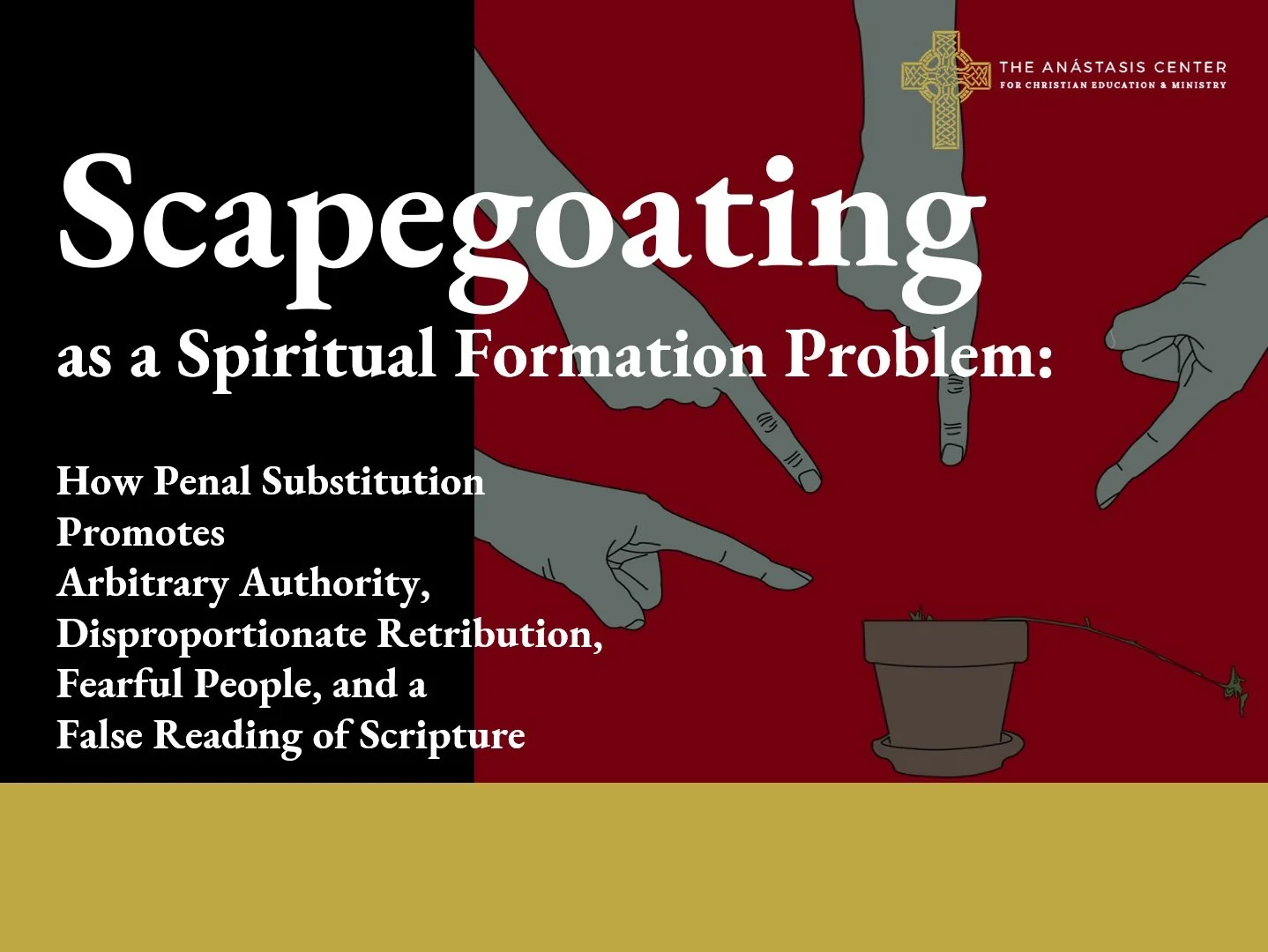
Like fallen Adam in the garden, we desire to deflect blame, and therefore we scapegoat others. On the political level, this builds group cohesion and creates a social outsider, who is blamed for the group’s woes, who the group must exile or kill or marginalize in order to maintain a hopeful lie. This series explores what political scapegoating has looked like in the U.S. Why is it so easy for people — including Christians, especially Christians — to scapegoat people who are considered other for their own feelings of anxiety, anger, and disgust? See more about the course. See more about the overall topic.
-
Human Dignity: Does Every Individual Matter?
A long essay arguing that science, philosophy, existentialism, and other belief systems do not support the view that every human being matters; only a robustly Trinitarian Christian faith anchored in the patristic formulation of medical-ontological atonement can. A 30 - 40 minute read.
What's More Important to God? Individual or Social Order?
Text and slides of a message from Genesis 1 - 11, analyzed as literature that is critiquing other creation story literature of the Ancient Near East.
-
Text and slides of a message about the role Christian faith played in history, bringing about hospitals, abolition of slavery, education, science and technology, beauty and the arts.
The Role of Jesus in Revolution and the Pursuit of Justice
Text of a message giving examples of twentieth century non-violent resistance movements and how they were influenced or led outright by Christians; explores why that is significant in the era of nation-state-building.
A Long Repentance: How Christian Mistakes Play a Role in Our Modern Racial and Political Climate
A recorded video message, given to Evangelicals 4 Justice Conference, Nov 25, 2019. A 35 minute Youtube video introducing our course, A Long Repentance. We start with a contrast between John Winthrop and Roger Williams on theocratic nationalism vs. principled pluralism.
-
The Creation Order and Jesus' Ethic of Radical Sharing: Matthew 19:13 - 30
An exegetical essay arguing that Jesus’ vision of generosity and sharing comes from the creation order of Genesis 1 - 2.
Article written for The Christian Century, Apr 12, 2016. A short article introducing how Western Enlightenment political philosophy is faulty for starting from an individualistic standpoint. 5 min read.
Christian Restorative Justice: Beyond Charity - God's Restorative Justice for Children and Families
Slides of a presentation given to Boston Chinese Evangelical Church, 2014. An introduction to Christian history elevating and protecting children; an examination of the four types of justice with regards to children's issues such as public education and health.
Slides of a presentation on how early Christian leaders read Genesis 1 as God providing land and wealth for all, but how Protestant heretic John Locke - the father of classical liberalism and “meritocracy” - argued that more “productive” people could take land from less “productive” people. The majority of white American evangelicals follow John Locke’s heretical views about wealth.
Christian Restorative Justice: Financial Reform
Video of a message given to New Hope Fellowship Baltimore, Maryland, May 2015. A sermon exploring the biblical commands against interest rate lending, and important financial reforms that we need today; and also slides.
Christian Restorative Justice: A Response to American Christian-Libertarian Syncretism
A long essay critiquing the individualistic foundations of the politics of Congressman Ron Paul, a libertarian, and the “Austrian economists.” See also Debate with a Christian Libertarian on the Role of Government in Romans 13 (Facebook, Nov 10 - 12, 2020) a debate between Mako and JL on Facebook.
-
Restorative vs. Retributive Justice and the Implications for Public Life
Article written for the Journal of Urban Ministry, June 2020. Starts from the need for criminal justice reform and explains the biblical background of restorative justice.
Audio recording and slides of a presentation given to Reality San Francisco Church, May 9, 2016. The recording is just over one hour and has two parts: (1) the four types of justice in Scripture; and (2) connections to Michelle Alexander's book The New Jim Crow. Here is a shorter version.
Pearl Harbor and September 11th, 2001
A reflection on the importance of Christian love for neighbor, and the need to not overreact with a bloodthirsty desire for retribution, written Sep 16, 2001.
-
Christian Restorative Justice in Anti-Trafficking, in Scripture, and Beyond
Slides of a presentation given to International Christian Alliance on Prostitution / Route One Ministries Conference in Boston on Sep 12, 2018. This explores recent application of restorative practices in the prosecuting of former traffickers. It highlights what we can learn and apply in other fields, both in evangelism and social justice ministry, as well as in the interpretation of Scripture.
Christian Restorative Justice: Slavery in the Early Church
Slides of a presentation for understanding how Christian faith results in abolitionism. See also Slavery in Christianity, Part 1: Slavery in the Bible, Slavery Today (and slides), and Slavery in Christianity, Part 2: Abolitionism from the First to Fifteenth Century, and Slavery in Christianity - Worksheet.
-
The Creation Order and Jesus' Vision for Marriage: Matthew 19:1 - 12
An exegetical essay focusing on the biblical vision of marriage and sex.
Whose Family? Which Union? Reflections on Scripture, Human Sexuality and God's Purposes
A paper summarizing the five Letters to a Gay Friend. This is an exegetical and pastoral paper examining biblical passages that are important in the discussion about what God’s vision for human sexuality is: Genesis 1 - 2; Leviticus 18 and 20; Matthew 19 (and Mark 10); Romans 1; 1 Corinthians 6 - 7; 1 Timothy 1. Ultimately, we have to look at the the nature of human desire in general, as a gift from God to move us towards extending ourselves towards Him and others. However, we are called to submit our desires to Jesus, who demonstrated the normative human emotions and desires.
Should I Support or Oppose Gay Marriage?
An essay analyzing a biblical and theological position: Why the First Amendment (from Roger Williams' accurate interpretation of religious liberty of conscience) requires that we acknowledge different religious definitions of the word “marriage,” and therefore remove the word from public policy. Otherwise “marriage” becomes a formal legal term with a particular content, that is used to discriminate against others who define it differently. We need a neutral term for public policy.
-
Jesus and Our Desire for Justice
Slides of a presentation demonstrating why biblical justice and Jesus’ atonement are linked through God’s vision for relationship. The presentation examines the four types of justice: meritocratic-retributive; distributive; libertarian; and restorative. We observe these four principles in Scripture, so each of them are important, but secular thought has no ability to organize them. Scripture, however, does organize them in the following way, generally: restorative; distributive; meritocratic-retributive; and libertarian. We further anchor this order in a restorative, healing atonement accomplished by Jesus of Nazareth: sin as “obstruction of justice” through the corruption of human nature, and Jesus as healing human nature in himself as a faithful human partner to God, and therefore establishing divine restorative justice.
Atonement and Social Justice: Isaiah 53, 58, 59, and Romans 11:26. In Isaiah 58, Isaiah gives his rousing sermon about the lack of social justice with regards to fair wages, debt-enslavement and debt-forgiveness, hospitality and economic sharing, and Sabbath rest (Isa.58:1 – 14). All of these issues are both interpersonal and structural issues because they are based on the original Mosaic vision of fair land distribution, limitations on inheritance, regular debt-forgiveness, and upholding the dignity of the poor (Lev.25; Dt.15:1 – 18; 24:10 – 22). Behind the Mosaic vision lies the original creation order, even if only in part due to the ‘hardness of heart’ that had set in since the fall (Mt.19:8; cf.19:3 – 12) since Israel was called to be God’s true human family living in God’s garden land, like Adam and Eve lived in the original garden. Isaiah then foresees God intervening. The Redeemer will come to Zion in what appears to me as a passage about incarnation and atonement, to bring about social justice.”
Sources of Christian Restorative Justice:
This section explores theological reflection on God’s justice as restorative: in Scripture; the Early Church up to John of Damascus; the Orthodox tradition, both Eastern and Oriental; the Roman Catholic tradition; and the Protestant tradition. See our Restorative Justice Study Guide, or go back to the main page of Sources, or the main page of Politics for how to apply this vision.