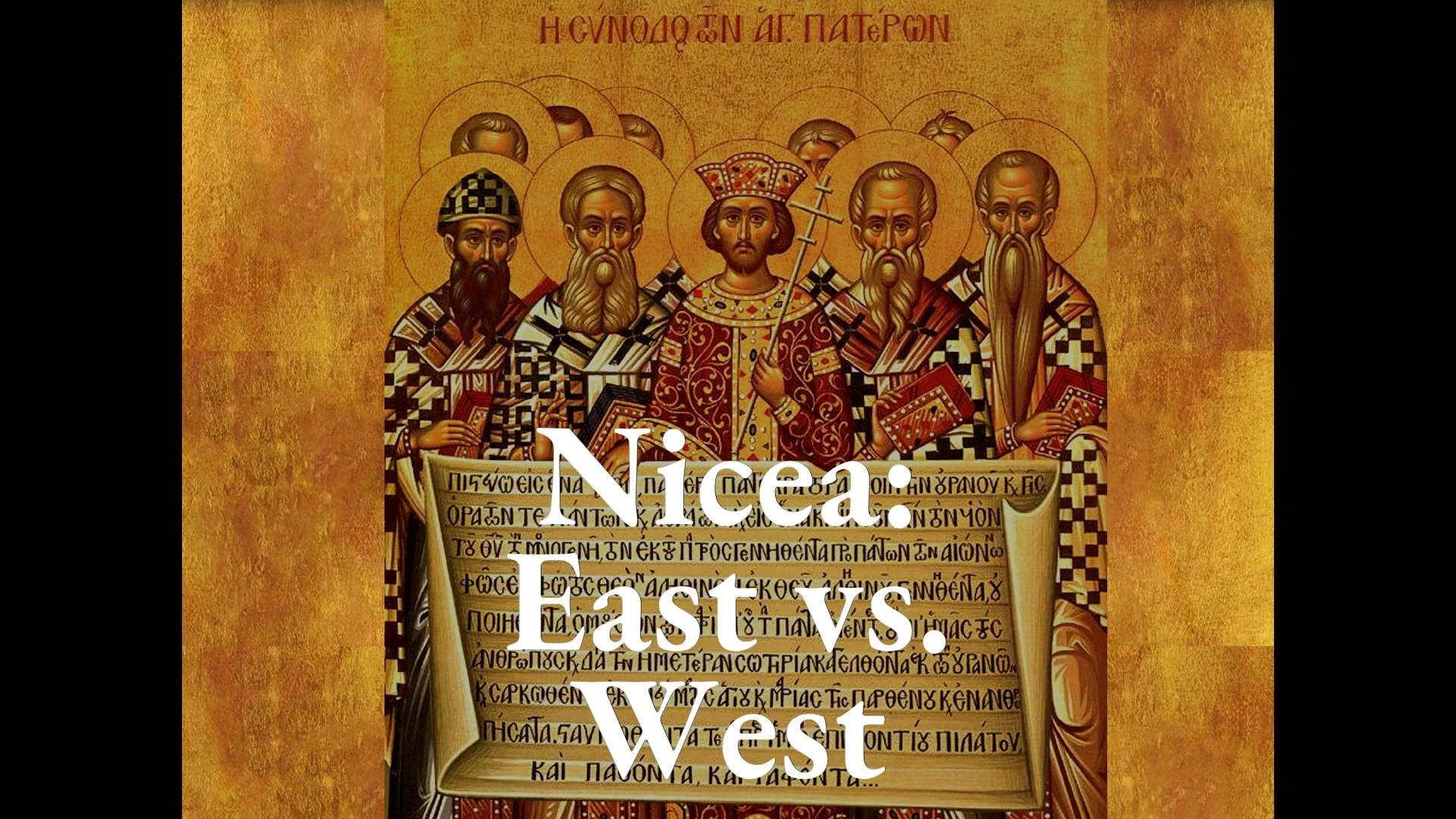
Photograph: This is an icon of the Council of Nicaea of 325 AD, holding up the Creed as it was adjusted in 381 AD by the Council of Constantinople. It is a symbol of the unified Church. Photo credit: Unknown | Public Domain.
Introduction
The Council of Nicaea of 325 AD was the first ecumenical Christian council. Roman Emperor Constantine requested that bishops from across the rapidly growing church — some of whom lived outside the Roman Empire — decide together about the teachings of Arius. Arius taught that the Son of God, however powerful and exalted, was a created being and not co-eternal with God the Father. The bishops met at the city of Nicaea on the Black Sea.
The Council of Nicaea formulated the doctrine of the divinity of the Son and doctrine of the Trinity. A second ecumenical council convened in Constantinople in 381 to elaborate more on the Holy Spirit. That is called the Nicene-Constantinopolitan Creed of 381, but the Nicene Creed of 325 is commonly taken as the baseline understanding.
The convictions of God’s Restorative Justice and Jesus’ Healing Atonement rest upon the foundation of the doctrine of the Trinity. God is love by nature. The love within God — or the love God is — is the fundamental activity of the divine persons and therefore the fundamental attribute of God. God is fundamentally other-centered, and the biblical story and writings bear witness to God’s creation and redemption being motivated by other-centered love. Divine justice, therefore, must be restorative, not retributive — for the motivation to “satisfy retributive wrath” is a self-centered motivation, and God by definition is not self-centered. By extension, and also based on the biblical witness, Jesus’ work of atonement is a healing of human nature, i.e. a Healing Atonement, or a Medical Substitution, not a Penal Substitution.
Our Theology from Nicaea Study Guide shares some material with the section of our website on God’s Goodness. However, God’s Goodness explores God’s Triune nature in the biblical story and in our understanding as we respond to God. The Theology from Nicaea Study Guide introduces the beginner to the Nicene Creed and also engages the experienced student of theology. It highlights the split between East and West starting with Augustine of Hippo.
Messages and Resources
An Introduction to the Trinity vs. the Singularity: Models of God and Why They Matter
Text of a message. God is, and has always been, a loving community of persons. This means He is not a narcissist, but is other-centered, by nature. He is good because He is love, and everything He does is an expression of love. If you enjoyed this message, you might enjoy our Theology 101.
Teaching the Trinity, Part 1: The Theme of the Father-Son Relationship
A discussion guide to passages primarily from John's Gospel, on the Son revealing the Father, what that means for the character of God, and for our sharing in Jesus' relationship with the Father.
Correspondence with TF about the Goodness of God and the Will of God
This is a short exchange on Facebook, copy-pasted, showing the importance of defining God's nature before explaining God's will.
The Trinity: Can Other Gods Be Personally Known?
God is immanent and locatable; God is transcendent and not contained by His appearance; and God is the link between them. This is what makes God personally knowable.
Workbook style, with quotes and questions to help you compare, contrast, and discuss. The differences are enormous, and deeply relevant.
From Dec 25, 2020, a sprawling discussion that started with a quote by Athanasius, explores God’s activities in both the Old Testament and in Christ, shows the importance of including “human nature” in the atonement and not just “human personhood,” and “human desires” in salvation and not just “human deeds.” This link will take you to the actual post on Facebook.
Other Resources Introducing the Trinity
Jeremy Begbie, The Trinity and Music. Seedbed, Jun 15, 2016. On sight vs. hearing as modalities of knowing.
William Paul Young, The Shack. Windblown Media | Amazon page, Jun 2008. Young tells a touching parable about a man who encounters the Father, Son, and Spirit in the shack in which his daughter was kidnapped and murdered. A good introduction to God’s character and fundamental nature as defined by the love between the three Persons, and how that matters to issues of evil and suffering.
C.S. Lewis, Mere Christianity. HarperOne | Amazon page, 1952. Lewis gives a simple and helpful introduction to the Trinity. Lewis starts first with human moral sensibility searching for an anchor point in a framework of good and evil, then moves to Jesus and his work of atonement, then the Trinity. Only a fully good God can heal humanity of our evil, and therefore anchor a moral framework of good and evil.
The Bible Project, God. The Bible Project, Oct 18, 2018. Tim Mackie and Jon Collins do an outstanding job giving an introduction to how an understanding of God developed throughout the biblical time period, eventually offering a way to understand the Trinity in a way that the biblical human authors came to express.
Luke J. Wilson, The Trinity In The Early Church Writings. That Ancient Faith blog, Jan 4, 2022. Wilson compiled a very nice list of quotations from the early Christian writers, with some narration for context.
God’s Goodness: Topics:
Here’s how to navigate this section on . The Introduction focuses on the biblical presentation of Father, Son, and Holy Spirit; and the implications. Human Becoming spotlights creation and humanity, especially how God made humans as human beings and human becomings. Human Desires explores how God made human desires good, but how the sin-sickness distorts those desires. Evil explains why God is good by solving the problem of human evil in a loving way. Suffering explains why God is good because He suffers with us since the fall, and heals the deepest suffering behind the suffering. Israel tackles big questions about why God needed ancient Israel, why God took human life to protect ancient Israel’s vocation. Jesus explains God revealing Himself fully in Jesus, and addresses Protestant notions of limited atonement and double predestination as incompatible with God’s Triune character of love. Holy Spirit explores the divine person of the Spirit and the gifts of the Spirit. Human Destiny explains how desire and development are part of the outworking of human becoming, destiny, and God’s goodness. Divine Fire explains why the portrayal of divine fire in Scripture is always God’s call to participate in refinement and purification.