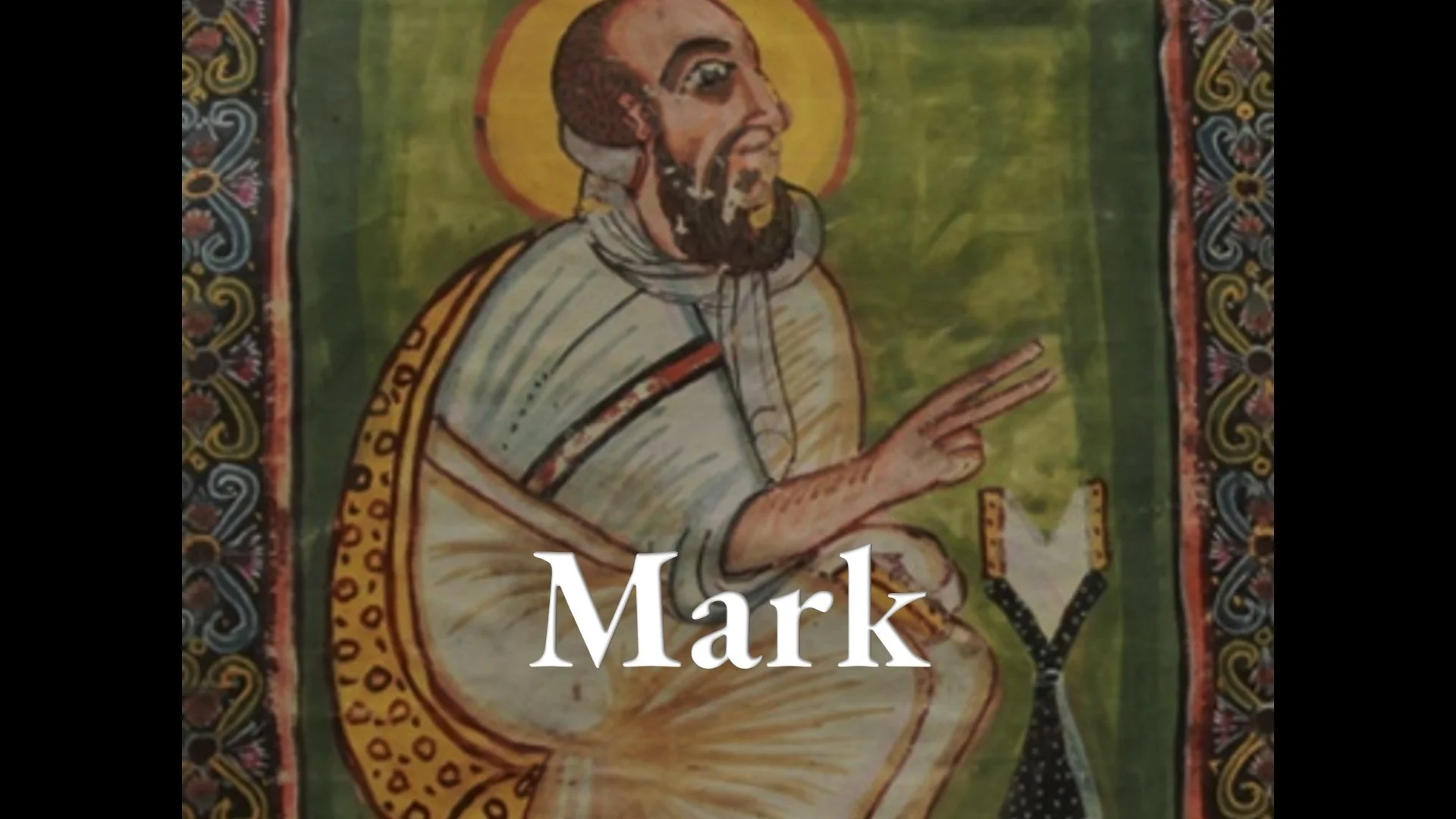
Photograph: Depiction of Mark, the Gospel writer, in an Ethiopian biblical manuscript in the Ethiopian Abba Garima Monastery. The Ethiopian manuscript dated to 390 - 570 AD, making it the oldest surviving Ethiopian manuscript of any kind, Christian or otherwise. It is housed in the Ethiopian Abba Garima Monastery. Abba Garima is said to have arrived in Ethiopian in 494 AD, one of nine Syrian Christians who evangelized parts of rural Ethiopia during the Kingdom of Axum. There are three surviving manuscripts in all. They come from Ethiopia's ancient Christian civilization. Photo credit: Unknown | Public Domain, Wikimedia Commons.
Below are messages, small group leader notes, and exegetical notes on the Gospel of Mark.
Spotlight
God Becomes the Hero: Psalm 22 and How Jesus Retold David’s Story. This is Session Eight from our 2019 conference, Healing Atonement. We made it public in June 2025 because our October 2025 conference, Constant Connection, expanded on the themes of why God does not separate Himself from us. On the cross, Jesus quoted Psalm 22:1, “My God, my God, why have you forsake me?” (Mark 15:34). This “cry of dereliction” has long puzzled Christians. Some advocates of penal substitutionary atonement claim that Jesus experienced God the Father turning against or away from him. But not only does this violate various Scriptures and theological convictions about the Father-Son union flowing from the Gospel of John and the Nicene Creed, there is a much better explanation, rooted in the pattern of Jesus retelling David’s story. Medical substitution stresses the active, not passive, obedience of Jesus, and God’s faithfulness to restore that which was broken, lost, and incomplete.
-
Mark 5:1 - 20 Jesus Heals Our Fragmented Identity. Text of a message taking the experience of the man afflicted by the “Legion” of demons as an analogy for having a fragmented identity.
-
How to Develop Bible Studies and Curriculum from the Gospels
A short and simple diagram showing the two major themes of every Gospel. First, Jesus is going on a human journey to be faithful where Adam and Eve, Israel, and David were not faithful. Second, Jesus is training the disciples in his mission of new humanity for all humanity.
The Art of Biblical Narrative: Mark's Gospel
An outline drawing from the literary scholarship of Robert Alter and many others. We have the literary skills because we watch modern movies! We distill four techniques into this acronym: TEDS. Themes running through the whole narrative that affect how we integrate one passage into a larger narrative tapestry; Echoes of earlier biblical stories that are asking us to compare the two; Disclosure of detail that affect how we interpret characters; and Structures like chiasms or poetic parallelism which help us identify the point.
Small Group Leader Notes for Mark’s Gospel
Leader’s Q&A discussion points for Mark’s Gospel, following the literary methods above. These notes are complete through Mark 1 - 8. Notes for Mark 9 - 16 are mostly incomplete.
A Problematic Use of Mark's Gospel
An essay that Mako wrote for InterVarsity Christian Fellowship in the early 2000s, and submitted to the organization’s top leaders.
Hell as Fire and Darkness: Remembrance of Sinai as Covenant Rejection in Matthew's Gospel
This is a long essay exploring how Jesus' use of the phrase "fire and darkness" is a motif that comes from the story of God at Mount Sinai, where Israel rejects the covenant, and resists being purified by God. “Fire” is an intertextual connection to the Old Testament appearances of God; the paper briefly explores virtually all the New Testament texts dealing with "fire" as a motif. There is some discussion of Jesus’ statement in Mark 9:48, “everyone will be salted with fire” and its implications for Mark’s Gospel as well as Isaiah 66:24 and the entire Book of Isaiah.
Whose Family? Which Union? Reflections on Scripture, Human Sexuality and God's Purposes
A paper summarizing the five Letters to a Gay Friend. This is an exegetical and pastoral paper examining biblical passages that are important in the discussion about what God’s vision for human sexuality is: Genesis 1 - 2; Leviticus 18 and 20; Matthew 19 (and Mark 10); Romans 1; 1 Corinthians 6 - 7; 1 Timothy 1. Ultimately, we have to look at the the nature of human desire in general, as a gift from God to move us towards extending ourselves towards Him and others. However, we are called to submit our desires to Jesus, who demonstrated the normative human emotions and desires.
Jesus, Jairus, and Jairus' Daughter. Harvard Ichthus blog, Mk.5:21 - 43, March 5, 2015.
King of Kings. Harvard Ichthus blog, Mark 6:14 - 29, March 6, 2015.
The Source of Each Person's Corruption. Harvard Ichthus blog, Mark 7:1 - 23, March 7, 2015.
Jesus on Marriage and Human Nature. Harvard Ichthus blog, Mark 10:1 - 12, March 17, 2015.
The Soldiers Mock Jesus. Harvard Ichthus blog, Mark 15:16 - 20, April 2, 2015.
-
N.T. Wright, Questions and Answers on Mark. Facebook video, Oct 22, 2021.
Jonathan Pageau, Transfiguration: The End of Symbolism - with Aidan Hart. Jonathan Pageau, Aug 3, 2023. A 53 minute video discussion. “This is a discussion from the Princeton Scala Foundation conference that took place in April 2023 with the title, “The Transfiguration: Glory and Grace in the World”. I sat down with Margarita Mooney Clayton and iconographer and author Aidan Hart to discuss the Transfiguration of Christ, how God's glory fills the world, and that the ultimate goal of the spiritual life is encountering God face to face.”
Jason A. Staples, The Father Did Not Turn His Face Away. Details Matter: By Jason A. Staples | Substack, Apr 4, 2026. “Correcting a Common Misreading of the Cry of Dereliction from the Cross.” Staples makes helpful observations about the Gospel of Mark, primarily about the “I am” statements.
Bible Studies and Messages from The Anástasis Center: The New Testament:
Bible Studies and Messages from The Anástasis Center: