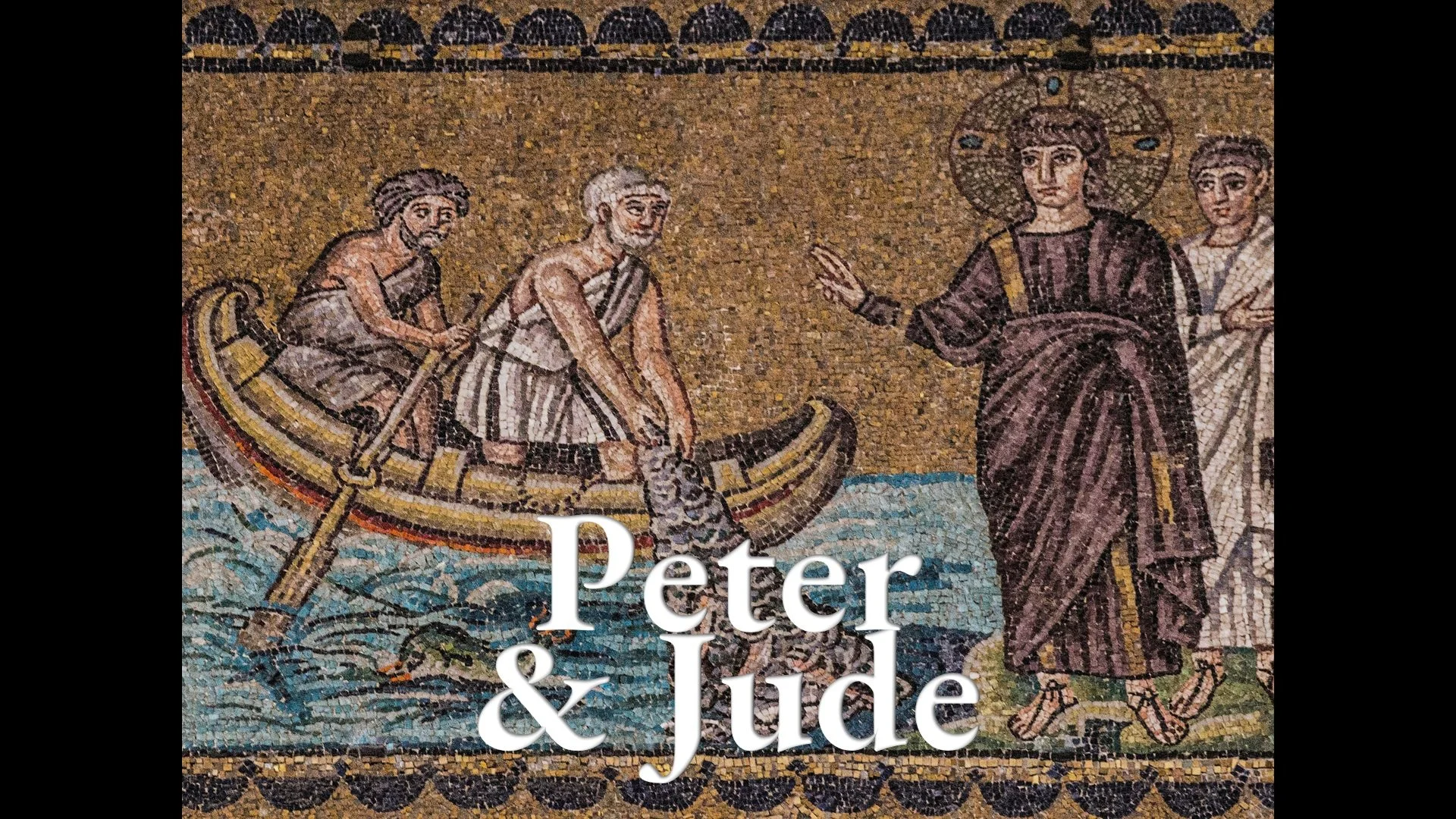
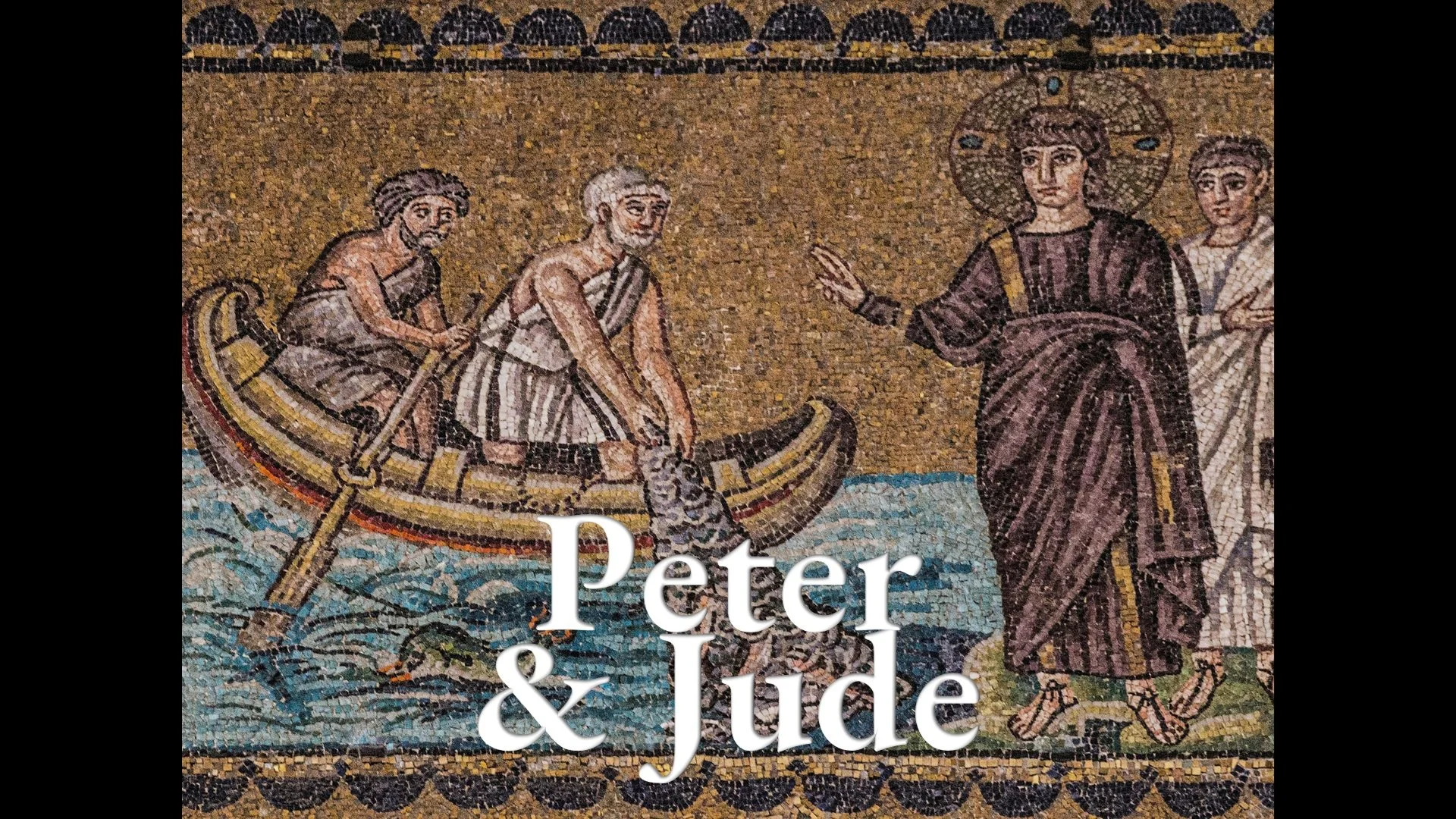
Photograph: Mural of Christ calling Simon Peter, from the Basilica of Saint Apollinaris in Classe, Ravenna, Italy. The scene comes from the story in Luke 5:1 - 11. It dates from the beginning of the 6th century. Photo credit: Father Lawrence Lew, OP | CC2.0, Flickr.
Below are messages, small group leader notes, and exegetical notes on the Letters of Peter and Jude.
Spotlight
See also the slides to this presentation. Mako Nagasawa guest lectured in a class at Gordon-Conwell Theological Seminary in February 2024. Here is the English text of the treatise, which Ambrose wrote in 389. Ambrose uses King Ahab as a case study of greed when he seized Naboth’s vineyard, in 1 Kings 21. This presentation relates to the Genesis creation story because Ambrose structures it around Genesis 1. He says that God gave all humans a shared dominion over the creation. In Christ, God gives us dominion, in principle, over sin. Covetousness, therefore, is a double problem. It interferes with the shared dominion over the creation, and it causes us to fail in exercising proper Christ-centered dominion over the sin in ourselves. Ambrose shows that Ahab became cruel, like the wild dogs that eventually fed off his dead, unburied body, as in 2 Peter 2:19 - 22. Ambrose also draws upon Matthew 6:19 - 24 because of how moths and rust share in our physical goods whereas God shares in the development of our moral goodness. Ambrose draws as well on Luke 12:13 - 34 because the greedy tear down barns/granaries and build bigger ones, finding more pleasure in the rising price of grain, not its widespread availability. A few slides refer to Ambrose’s understanding of the human being as a human becoming, Jesus’ work of atonement as a medical substitution healing human nature for us and inviting us to share in him, the pressing issue being human desires and not deservingness per se, and hell as the love of God but experienced by those who have become addicted to sin.
-
2 Peter 1:1 - 11 Why Are Christians Bossy? Or, Why is Good Good? Why is Evil Evil?
2 Peter 1:1 - 4 Into the Divine Nature, Into the Family God Is God is a loving Tri-Unity, and salvation is His work of adjusting us to the culture of the Trinity
2 Peter 1:5 - 11 Why Jesus, Faith, and Character Come Before Affection and Love (TBD) Contrary to what our culture tells us, that we're ready for affection and love, Christian faith says that we need to rebuild with Jesus as our foundation
2 Peter 1:12 - 21 Jesus, the Transparent One. Jesus heals human nature, making it transparent to the Father, so he gives us an ethic of transparency
2 Peter 2:1 - 10 False Leaders Who God Will Separate
2 Peter 2:11 - 17 False Leaders Who Resist Authority
2 Peter 2:18 - 22 False Leaders Who Resist Purification
2 Peter 3:1 - 18 Jesus Will Repair the World
-
Thematic Study The Theme of Fire in Second Peter
-
Slavery in Christianity, Part 1: Slavery in the Bible, Slavery Today
Research and slides which explores the Old Testament, then the New Testament. It looks at what the Hebrew "ebed" service meant in context, and then what Greek "duolos" meant and how the New Testament understood the various ways people could enter servitude. It uses a sociological approach, exploring different ways in to becoming an “ebed” or “duolos,” what rights and responsibilities those roles had, and how one could leave and/or escape. Slavery and Belief Systems links to a page on our website which examines the relationship between various faith traditions and slavery-abolition. See also our resources on modern day Human Trafficking.
Christ's Proclamation to the Dead: An Analysis of 1 Peter 3:19, Its Context, and Its Significance
An exegetical essay about the meaning of Jesus’ descent into Sheol/Hades to present himself to all those who died before he died. Peter’s brief mention of this event in 1 Peter 3:18 - 20 and 4:6 has great meaning to his overall argument.
-
Hilarion Alfeyev, Christ the Conqueror of Hell. St. Vladimir’s Seminary Press | Amazon page, Nov 20, 2009. A very valuable resource. See nice review by Josh Cho, Book Review: Christ the Conqueror of Hell by Archbishop Hilarion Alfeyev. ThatsChoJosh blog, Feb 13, 2017. Robert Arakaki, Evidence for Christ’s Descent Into Hell. Orthodox-Reformed Bridge: A Meeting Place for Evangelicals, Reformed, and Orthodox Christians, Apr 6, 2018. Arakaki explains how John Calvin changed the meaning of the ancient church’s understanding. Kenneth L. Waters, Jesus in the Heart of the Earth: Deciphering the Jonah Saying (Matthew 12:39–41). Sage Journals, May 4, 2021.
David Bentley Hart, Interview - Crackers and Juice Podcast. ObjectiveBob, Feb 27, 2017. At 45 min mark on 1 Peter 3 on 2 Th.1:9 on the absence or presence of Jesus.
Bible Studies and Messages from The Anástasis Center: The New Testament:
Bible Studies and Messages from The Anástasis Center: