The Church in the Latin Kingdoms
800 - 1787 AD
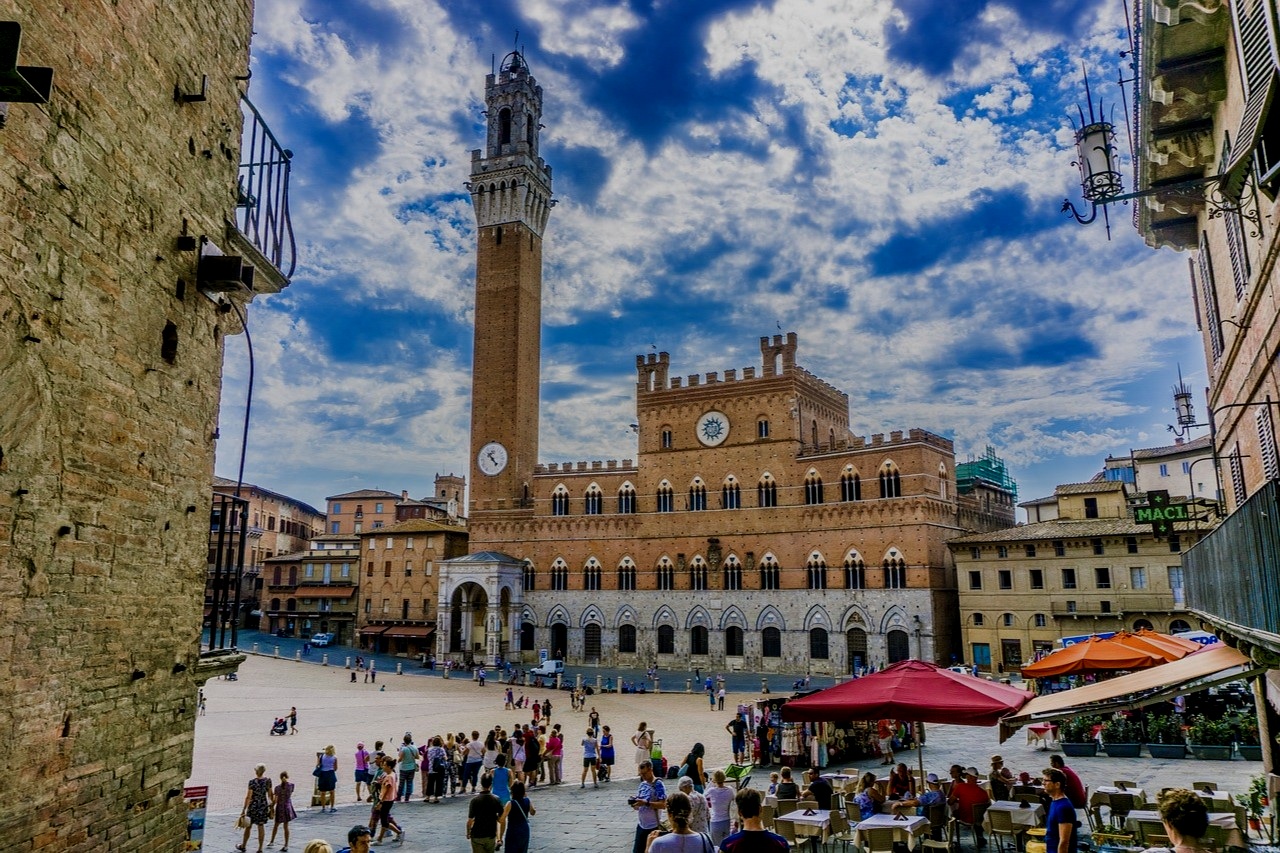
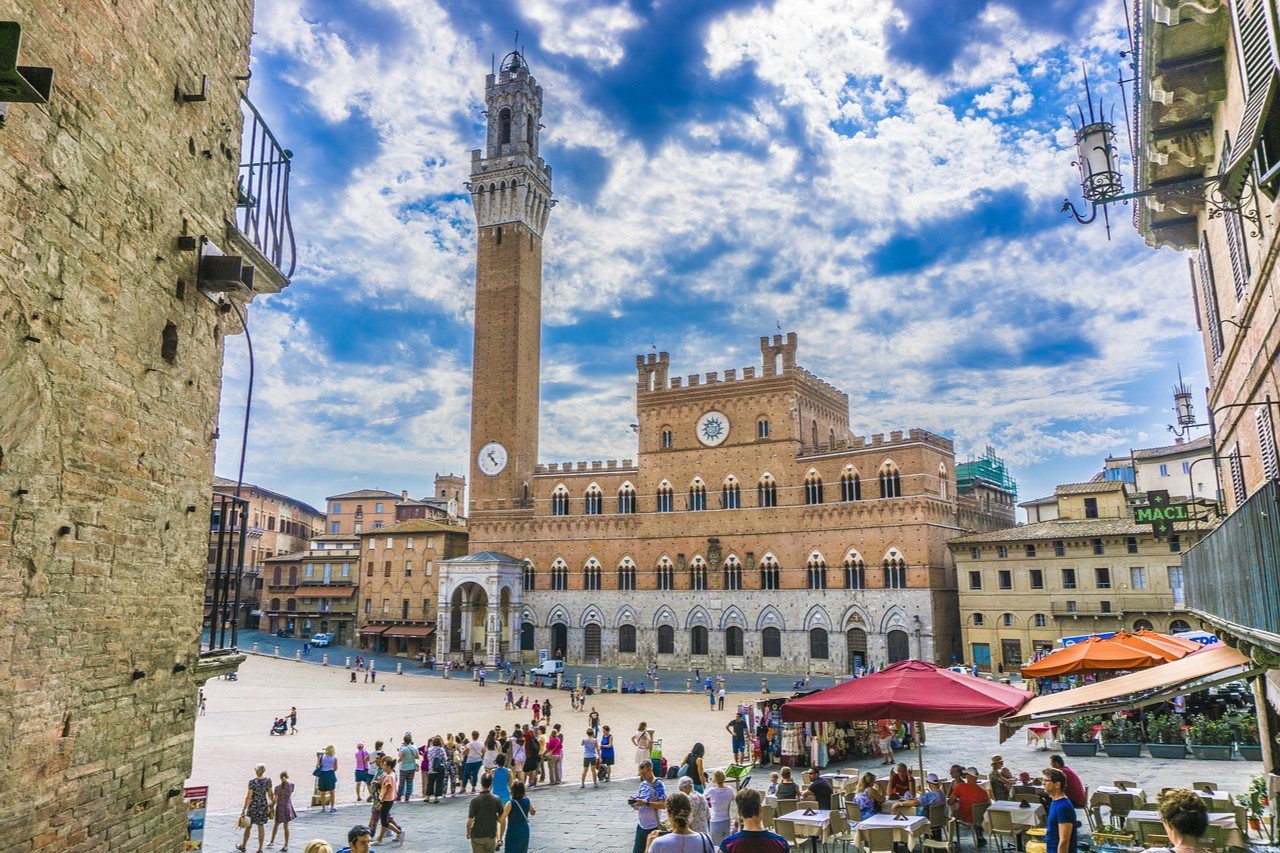
Photograph: This is the Campo (city plaza) of the city of Siena, in Italy's Tuscany region. Photo credit: Siena News | CC-3.0. Siena's Campo (city plaza) represents an achievement of Christian ethics applied to urban planning, narrated well by Dr. Timothy Gorringe's lecture Radical Abundance. The city was redesigned by magistrates who excluded the nobility from the process. The Campo was created in the 14th century to be big enough for the whole city population to meet. Sermons were preached there; feasts were celebrated there; food was distributed there during famines. No one was allowed to bear arms there. Building regulations ensured harmony without uniformity. The private palaces around the plaza were completed by the publicly created palace, which had the highest tower - symbolizing the common good over individual, family, or factional fortunes. The city magistrates were informed by Catholic theology, primarily Thomas Aquinas' writings on the common good. The year 1787 marks the French Revolution, perhaps the first major political movement of non-Christian ideas.
Introduction
The selection of perspectives on church history in this section — Church and Empire — has been guided by three factors: (1) to demonstrate that Christianity has not been a “white man’s religion”; (2) the study of empire as a recurring motif in Scripture by recent biblical studies scholars; and (3) explorations of biblical Christian ethics on issues of power and polity, to understand how Christians were faithful to Christ or not. Christian relational ethics continues a Christian theological anthropology that began with reflection on the human nature of Jesus, and the human experience of biblical Israel.
This section explores the experience and activities of Christians under the “Western” Roman Empire from the year 800, when Charlemagne, King of the Franks, claimed the title, “Emperor of the Romans,” while Emperor Irene ruled from Constantinople as Emperor of the Romans, until the year 1787, when the French Revolution inaugurated a formally secular government in Western Europe.
Messages
Text and slides of a message about the role Christian faith played in history, bringing about hospitals, abolition of slavery, education, science and technology, beauty and the arts.
-
Nicholas of Cusa (1401 - 1464) (Wikipedia article). In his De concordantia catholica II xiv, Nicholas writes about democracy and the consent of the governed:
“Accordingly, since by nature all men are free, any authority by which subjects are prevented from doing evil and their freedom is restrained to doing good through fear from penalties, comes solely from harmony and from the consent of the subjects, whether the authority reside in written law or in the living law which is in the ruler. For if by nature men are equally strong and equally free, the true and settled power of one over the others, the ruler having equal natural power, could be set up only by the choice and consent of the others, just as a law also is set up by consent.”
See also George Holland Sabine, A History of Political Theology. Holt, Rinehart, and Winston | Anna’s Archive, 1937, p.319.
R.W. Southern, Western Society and the Church in the Middle Ages. Penguin Books | Amazon page, Aug 16, 1990. Southern has very important facts about the Roman Popes of late Antiquity being Syrian, Greek, etc. When the Popes became uniformly Latin, the Roman Church became notably less interested in unity with the broader church.
Oliver O’Donovan and Joan Lockwood O’Donovan, From Irenaeus to Grotius: A Sourcebook in Christian Political Thought. Eerdmans | Amazon page, 1999. and this bibliographic summary by Patristic Evangelism, Readings in Patristic Ethics . Patristic Evangelism blog, date unknown.
Christianity Today, The Conversion of Scandinavia: Christian History Timeline. Christianity Today, 1999.
Henry Chadwick, East and West: The Making of a Rift in the Church: From Apostolic Times until the Council of Florence. Oxford University Press | Amazon page, 2003.
Lance Ralston, Charlemagne Part 1. Communio Sanctorum, Jul 27, 2014. Ralston writes a short, readable history of the Merovingian and Carolingian dynasties of the Franks, including Pope Zachary's and Pope Stephen II's rulings in 748 and 751 that Pepin III was the legal ruler, not the Merovingian line, and Pope Leo III's coronation of Charlemagne in 800. See also Lance Ralston, Charlemagne Part 2. Communio Sanctorum, Aug 3, 2014.
Rodney Stark, The Victory of Reason: How Christianity Led to Freedom, Capitalism, and Western Success. Random House | Amazon page, Sep 26, 2006. Stark’s account is excellent, with the exception of his preference for usury.
David Bentley Hart, Atheist Delusions: The Christian Revolution and Its Fashionable Enemies. Yale University Press | Amazon page, 2010.
Rodney Stark, God’s Battalions: The Case for the Crusades. HarperOne | Amazon page, Nov 9, 2010. Stark helps us understand the historical context, so perhaps "understanding the Crusades" would be a better title.
Peter Brown, The Rise of Western Christendom: Triumph and Diversity, A.D. 200 - 1000. Wiley-Blackwell Press | Amazon page, Feb 4, 2013. surveys both East and West, though he focuses more attention on the West.
Geraldine van Bueren, Should We Have an Enforceable Right to Food? UK Human Rights Blog, Oct 18, 2013. Professor van Bueren discusses the ongoing relevance of the Charter of the Forest (1217), an English law ensuring food and energy to peasants, in the form of rights to fish, graze, farm, and gather firewood from the “Forest”, which was an encompassing term for public, common land. English common law reflects a development from King Alfred the Great (848 - 899) and his Doom Book issued circa 893, which reflected a Christianization of three previous Saxon law codes: Aethelbert of Kent (602); Ine of Wessex (694); and Offa of Mercia (786).
Larry Siedentop, Inventing the Individual: The Origins of Western Liberalism. Belknap Press | Amazon page, Mar 31, 2015. Siedentop gives an overview of how the growth of the papacy in the 11th - 14th centuries corresponded to the growing powers of monarchs, as the church sought to protect individuals and its own role as guardian of souls
Bradley J. Birzer, Tolkien & Anglo-Saxon England: Protectors of Christendom. The Imaginative Conservative, Mar 2016.
The Economist, The Search Goes On. The Economist, Nov 5, 2016. A review of Nick Spencer, The Evolution of the West: How Christianity Has Shaped Our Values. SPCK | Amazon page, Sep 15, 2016.
Rodney Stark, Bearing False Witness: Debunking Centuries of Anti-Catholic History. Templeton Press | Amazon page, Oct 9, 2017.
Eleanor Janega, There’s No Such Thing as the Dark Ages, But OK. Going Medieval Blog, May 26, 2017. Rigor, humor, and a few choice and spicy words. Delightful reading.
Eleanor Janega, Medieval Healthcare and American Barbarism. Going Medieval Blog, May 26, 2017. On Greek views of bodily fluids, Christian approaches to medicine and public health being communal and not individual, and the moral failure of American healthcare switching it around.
A Brief History of the Moravian Church. Moravian Church of North America. See also the longer history by Rudolf Rican, History of the Unity of Brethren: A Protestant Hussite Church in Bohemia and Moravia. Interprovincial Board of Communications| Amazon page, 1992. about this remarkable early Protestant group known for their political pluralism, commitment to education, prayer, anti-slavery stance and expression of Christian mission as the first Protestant missionary movement. See also Count Nicholas Zinzendorf 1700 - 1760 (website) which has helpful links about the Moravian Brethren.
Casey Chalk, Why Thomas Aquinas Stands the Test of Time. The American Conservative, Jan 28, 2019. "More than anyone else, he synthesized the ancient Greek into a unified Western philosophical system"; although this neglects "Eastern" Byzantine philosophy.
Eleanor Janega, On Colonialism, Imperialism, and Ignoring Medieval History. Going Medieval Blog, July 26, 2019. On the similarity between intra-European wars and global colonialism (violence), and the differences between them: intermingling vs. racial dominance; settling vs. wealth extraction; etc. Janega points out that the Germanic Holy Roman Empire was the most “Christian” and least involved in colonialism, whereas the English were secularizing in their attempt to resolve Catholic-Protestant differences, and were the most involved in colonialism.
Walter Scheidel, Escape from Rome: The Failure of Empire and the Road to Prosperity. Princeton University Press | Amazon page, Oct 2019. explores the role of Christian faith from the fall of Rome in 476 as one of many factors
David Noonan, Western Individualism Arose from Incest Taboo. Scientific American, Nov 7, 2019. “Researchers link a Catholic Church ban on cousins marrying in the Middle Ages to the emergence of a way of life that made the West an outlier.” Helpful social science perspective, even though credit for the “incest taboo” is misplaced. Credit must be given to early Christianity and Judaism.
Erik Strandness, Tom Holland: “I Began to Realize That Actually, In Almost Every Way, I Am Christian.” Unbelievable | Patheos, Sep 17, 2020. “Historian Tom Holland created waves with an article he penned in 2016 in the New Statesman which suggested that we owe the underlying ethos of our Western Culture to Christianity and not ancient Rome or Greece. He concluded his article by stating, “In my morals and ethics, I have learned to accept that I am not Greek or Roman at all, but thoroughly and proudly Christian.”
Tristan Semiond, The Mantle of Roger II: The Legacy of a Multi-Cultural Society. Funci: Islamic Culture Foundation, Sep 12, 2021. This article provides a short and fascinating history through the lens of the physical kingly mantle designed by Roger II of the Kingdom of Sicily. The mantle had both Christian and Muslim symbolism, and the Kingdom of Sicily under King Roger II became a thriving multi-religious society. See also Hubert Houben, Roger II of Sicily: A Ruler between East and West. Cambridge University Press | Amazon page, 2002. And Dawn Marie Hayes, Roger II of Sicily: Family, Faith, and Empire in the Medieval Mediterranean World. Brepols Publishers | Amazon page, Feb 2020.
Simone Harari Baulieu and Jonathan Hayoun, A History of Antisemitism: Part 1: 38 - 1144. Deutsche Welle Documentary, Jul 23, 2022. The documentary highlights how the first Christian acts of violence against Jews started during the First Crusade and were sustained. The impact of what we would call “Christian nationalism” or “political identity” connected to violence turns against minority groups like Jews. Abbot Bernard of Clairvaux was a positive example who stood against this violence. Augustine’s theory about Jewish witness but inferiority was complicated. The documentary also highlights Christian tropes of Jews: deicide or christ-killers; human sacrificers; ritual contamination. Part 2: 1144 - 1791 covers physical tropes of Jews and economic ones of Jews as usurers, bankers, greedy financiers. This segment also covers Spain during the Inquisition, which began the blood theory of race. Part 3: 1791 - 1945 covers the French Revolution and new political movements that viewed European and “World Jewry” through a conspiratorial lens. Part 4: 1945 to Today covers the foundation of the State of Israel, Holocaust-denial, and other forms of anti-semitism. See also Antisemitism in Europe, Wikipedia and Massacre of 1391, Wikipedia.
Dominic C. Sandbrook and Tom Holland, The Cross And The Sword: The Rise of The Papacy In The Middle Ages. The Rest Is History, Dec 19, 2024. Charles Martel replaced the Christian bishops in Roman Gaul with Frankish loyalists as bishops. “The Frankish king, Charlemagne the Great, is one of the titanic figures of European history, simultaneously renowned and shadowy. His rise to supreme power is a staggering story of warring religious empires, betrayal, battle, blindings and brutal conquest. How, then, did this one time Frankish interloper become the father of Europe, progenitor of a Holy Roman Empire whose descendants would rule right up until the time of Napoleon, and Emperor of the West? It begins in 741 AD when, following the death of the Frankish leader Charles Martel - ‘The Hammer’ - his two sons, Carloman and the pious by ruthless Pepin were forced to look to the Pope in Rome, then a subsidiary to the Byzantine empire, to buttress their authority. The Pope too was increasingly embattled at that time, struggling against invasions by the ferocious Germanic Lombards from the north of Italy. Desperate, he called upon Pepin for aid. So it was that, after his brother’s abdication, Pepin was officially anointed by the Pope as the sole King of the Franks, before crossing the Alps and smashing Lombardy. After his death, he would leave his kingdom the foremost power in Western Europe, and in the hands of to his own two sons: Carloman and Charles, later known as Charlemagne. A terrible power struggle would ensue…”
-
John S. Romanides, Franks, Romans, Feudalism, and Doctrine: An Interplay Between Theology and Society. Romanity, 1981. gave these lectures for the Patriarch Athenagoras Memorial Lectures in 1981. He argues that the Frankish incursion, and Charlemagne's enthronement, began a shift in the West against the city of Rome per se, and the Greek Byzantines in the East. He believes it tilted Western theology towards Augustine, who was wrong on several counts, though Rome itself took much longer to tilt. Romanides' arguments have been examined and critiqued; see for example Vladimir Moss, Against Romanides: A Critical Examination of the Theology of Fr. John Romanides (2012) from among the Eastern Orthodox. But they still remain very formidable.
Thomas F.X. Noble, The Republic of St. Peter: The Birth of the Papal State, 680-825. University of Pennsylvania Press | Amazon page, 1984. traces decisions made by the Roman Popes about the Byzantines, the Normans, and the Franks; these decisions laid the groundwork for the Western Catholic and Protestant dependence on political and military power
Gregory Paul, The Great Scandal: Christianity’s Role in the Rise of the Nazis. Church and State, Oct 11, 2003. traces the Christian alliance with the Roman Empire into anti-semitism and the rise of German Aryan "Volkism" and the German equivalent of "manifest destiny" through the conquest of Lebensraum ("living space").
Timothy Tennent, It Invitation to World Missions: A Trinitarian Missiology for the Twenty-First Century. Kregel Academic & Professional | Amazon page, Jan 25, 2010. says on p.248, “It is important to note that the sixteenth-century Protestant Reformation did not produce any missionaries.” This suggests a preoccupation with nation-state building on the part of the magisterial Reformers, unlike the Anabaptists.
Rowena Willard-Wright, Saxon Easter Customs and Where They Survived. English Heritage, Mar 24, 2016. These customs survived the Norman Conquest of 1066, that is - a good example of how Christians preserved aspects of culture worth remembering, despite political turmoil.
John C. Rao, Luther and His Progeny: 500 Years of Protestantism and Its Consequences for Church, State, and Society. Angelico Press |Amazon page, 2017. a collection of mainly Catholic authors critiquing the effects of the Protestant Reformation.
Bryan W. Van Norden, Western Philosophy is Racist. Aeon, Oct 31, 2017. Van Norden writes a history of philosophy, highlighting interactions between the Jesuit communication back to Europe of Chinese Confucian philosophy where ethics were not premised on metaphysics or theology, and the European Enlightenment which sought the same. Yet this history of interaction is typically forgotten, where the international impact is downplayed while the religious movement from Christianity to atheism is praised. Christian philosophers like Emmanuel Kant, however, played a contributing role to this overall negative movement.
Stephen Waldron, What Was a Nazi Church Service Like? Theology Corner, Jan 4, 2018. A fascinating historical overview.
Alice Speri, It Took a Handful of Women to Kneecap One of the World's Most Brutal Crime Networks. The Intercept, Sep 9, 2018. Speri narrates Italy's Ndragheta, an organized crime family, and the women who brought them down. This story raises a sociological question: Why did organized crime develop alongside the Roman Catholic Church, in its Italian heartland. Could this be the sociological effect of (1) having an all-male hierarchy, (2) moving the practice of confession away from transparency with the broader Christian community into secret-sharing with male priests, and (3) portraying the Virgin Mary (the ideal woman) not as a pro-active loudmouth (biblical) but as a silent, submissive sufferer?
Helena Horton, Stop Referring to Middle Ages as 'Dark Ages' Because It Was an 'Enlightened Era', British Library Expert Says. The Telegraph News, Oct 17, 2018.
Sarah Zhang, The Genetic Legacy of the Spanish Inquisition. The Atlantic, Dec 21, 2018. re: Sephardic Jewish migration to Latin America because of persecution.
Editors, Anti-Semitism. History.com, Jun 10, 2019. The problem is that, despite what the apostle Paul said in Romans 9 - 11 about respecting and protecting Judaism, Christians took over the pagan imperial hostility towards Jews.
Alan Mikhail, God's Shadow: Sultan Selim, His Ottoman Empire, and the Making of the Modern World. Liveright | Amazon page, Oct 2021. See short video by Emir-Stein Center, Columbus, Islam, and Native Americans. Emir-Stein Center, Oct 23, 2024. Columbus was shaped in Genoa and Europe generally by the threat of Islam. He thought he saw Islam in the Caribbean as well.
Simone Harari Baulieu and Jonathan Hayoun, A History of Antisemitism: Part 1: 38 - 1144. Deutsche Welle Documentary, Jul 23, 2022. The documentary highlights how the first Christian acts of violence against Jews started during the First Crusade and were sustained. The impact of what we would call “Christian nationalism” or “political identity” connected to violence turns against minority groups like Jews. Abbot Bernard of Clairvaux was a positive example who stood against this violence. Augustine’s theory about Jewish witness but inferiority was complicated. The documentary also highlights Christian tropes of Jews: deicide or christ-killers; human sacrificers; ritual contamination. Part 2: 1144 - 1791 covers physical tropes of Jews and economic ones of Jews as usurers, bankers, greedy financiers. This segment also covers Spain during the Inquisition, which began the blood theory of race. Part 3: 1791 - 1945 covers the French Revolution and new political movements that viewed European and “World Jewry” through a conspiratorial lens. Part 4: 1945 to Today covers the foundation of the State of Israel, Holocaust-denial, and other forms of anti-semitism.
Highland Clearances (Wikipedia article). The displacement of many Scottish farmers led to the Scotch-Irish in the U.S. South, whose trauma led to strong territorial and racial-ethnic group defensiveness. Today, Scotland has the highest percentage of land owned by absentee landlords.
David Chao, The 1517 Project and the Spirit of Post-Christendom Christianity. Center for Asian-American Christianity, April 29, 2023. This lecture was part of the 2023 Asian American Theology Conference “Multiple Belongings in Transpacific Christianities: Christian Faith and Asian Migration to the US.” Find out more about the conference here: https://pts.events/events/aat-2023-mbtc/. In 1517, Martin Luther initiated the Protestant Reformation and continued a “Christendom Project” to christianize European society. Less recognized, however, is the missio Dei and the Spirit of Christ moving across space since ancient times outside of Anglo-European languages and cultures. I dub the latter development “Post-Christendom Christianity.” Fast forward to the modern US context when the 1965 Immigration and Nationality Act substantially repealed Chinese exclusion and simultaneously changed the face of US society. By extension, 1965 ushered in post-Christendom forms of Christianity from the majority world to the US. Rather than thinking in terms of Anglo-European formations of faith, which have naturalized doctrinal difference and similarity through various culture wars, US discourses about Christianity need new wineskins that make explicit the varying social formations of migrational Christianity from the majority world. I present a threefold formation of Asian American Christian consciousness as a post-Christendom way to understand the interplay of doctrine, practical reasoning, and identity formation.
Church and Empire in Europe: Topics:
This section explores the experience and activities of Christians under various European regimes: the Roman Empire 313 - 800, the Celtic Kingdoms 431 - 1798, the Eastern Roman Empire 800 - 1453, the Latin Kingdoms 800 - 1787, and the Slavic Kingdoms 988 - 1917. See also our page on The Myth of Christian Ignorance, for resources contesting Christian faith as anti-science, politically backward, etc.
Church and Empire: Topics:
This page is part of our section on Church and Empire. These resources begin with a biblical exposition of Empire in Church and Empire and the meaning of Pentecost in Pentecost as Paradigm for Christianity and Cultures, then grouped by region: Middle East, Asia, Africa, Europe, Americas, then Nation-State, with special attention given to The Shoah of Nazi Germany.