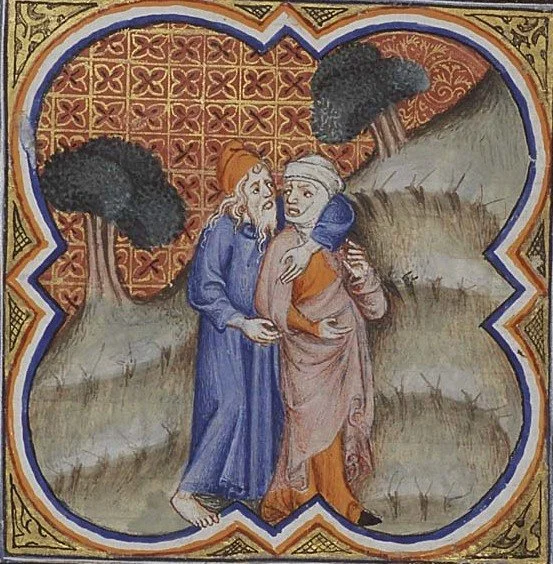
Photograph: The prophet Hosea and his wife Gomer, from the 1372 Bible Historiale, the predominant medieval translation of the Bible into French. Photo credit: Anonymous, public domain.
Below are messages, small group leader notes, and exegetical notes on the Book of Hosea.
-
Jonah 4 Running Away from God's Mission
Micah 4:1 - 5:15 God Will Be Our King
Micah 5:2 - 5 God Remembers the Forgotten (Neighborhood Church of Dorchester, Dec 19, 2021) Advent week 4 (Love) also Luke 1:39 - 45
Haggai Build the House of God
-
Zechariah 9 The Coming of Israel's King
Zechariah 10 The King Will Regather the People
Malachi The Theme of Fire in Malachi
-
Robert Alter and Frank Kermode, The Literary Guide to the Bible. Harvard University Press | Amazon page, Sep 1, 1990. Very helpful insights, book by book.
John Sailhamer, Introduction to Old Testament Theology: A Canonical Approach. Zondervan | Amazon page, Oct 14, 1999. Links Amos and Obadiah through the topic of the Edomites.
Thomas L. LeClerc, Introduction to the Prophets: Their Stories, Sayings, and Scrolls. Paulist Press | Amazon page, 2007, 2017.
Christopher Seitz, Prophecy and Hermeneutics: Towards a New Introduction to the Prophets. Baker Academic | Amazon page, Aug 1, 2007.
Christopher Seitz, The Goodly Fellowship of the Prophets: The Achievement of Association in Canon Formation. Baker Academic | Amazon page, Oct 1, 2009. How the twelve minor prophets are related, literarily.
Marg Mowczko, God on Divorce (Malachi 2:16). Marg Mowczko, May 21, 2016. “The Hebrew of Malachi 2:16 is not straightforward. The Septuagint, the ancient Greek version of the Old Testament, is somewhat easier to understand and uses second person language: “If you hate [and] send away/divorce …” which makes it clearer that God is speaking about someone else and God is not the one doing the hating.”
Richard Beck, The Most Controversial Verse in the Bible, Part 1: Exodus in the Plural. Experimental Theology, Feb 20, 2024. Amos 9:7 shows that the Sinai covenant, not the Exodus per se, is what made Israel unique.
The Exodus is what made Israel Israel, what made them distinct and special. Consequently, the provocation of Amos 9:7 is its attempt to to relativize, undermine, and marginalize Israel's specialness by relativizing, undermining, and marginalizing the Exodus. Let's see how Amos does this. To start, God, through Amos, asks Israel a question: "Israelites, are you not like the Cushites to me?" The obvious answer is, "Of course not! We, the children of Israel, are not like the Cushies. We are Israel, the chosen people." But Amos' question is a set up. Having tricked Israel into her initial answer, Amos leads them further into the trap with a follow-up question: “Did I not bring Israel from the land of Egypt?” And the answer is, "Of course! The Exodus is what made us God's chosen people." And at this moment--Israel re-convinced of her specialness in light of the Exodus--Amos springs his trap: “...and the Philistines from Caphtor, and the Arameans from Kir?”
What we have here, in the words of Walter Brueggemann, is "Exodus in the plural." Amos suggests that Israel's Exodus wasn't so special after all. Apparently, God performed an exodus for both the Philistines and the Arameans. What Israel thought made them unique and distinctive is something God had done for others. There wasn't one Exodus, but many. Exodus in the plural. The implication of this news is deeply destabilizing.
Daniel Epp-Tiessen, Micah 3 and Corrupt Leaders: Survival Literature, Trauma, and Hope. Scriptural Works, May 9, 2026. A 65 minute video. “Dr. Dan Epp-Tiessen (Canadian Mennonite University) offers a close reading of Micah 3 as survival literature for communities enduring political collapse, military invasion, and generational trauma. Drawing on his Believer's Church Bible Commentary on Joel, Obadiah, and Micah, Epp-Tiessen situates the prophet within the brutal Assyrian and Babylonian campaigns against Judah, arguing that the prophetic books were intentionally shaped to help traumatized communities name their pain and survive faithfully. The episode unpacks Micah's searing cannibalism metaphor against corrupt rulers—leaders who flay the flesh of their people through land seizure, economic exploitation, and unjust governance—and the prophet's equally sharp critique of the false prophets who provided divine legitimation for the regime. The conversation explores Robert Wilson's distinction between central prophets (on the king's payroll) and peripheral prophets (rooted in marginalized communities), the dynamics of true versus false prophecy, and the remarkable intertextual moment in Jeremiah 26 where Micah 3:12 is quoted to defend Jeremiah from a lynch mob. Epp-Tiessen then traces Micah's rhythm of indictment and hope across the book's three judgment-deliverance cycles, culminating in the swords-into-plowshares vision of Micah 4, the vine-and-fig-tree promise of peasant security, and the gracious, merciful God of Micah 7. The result is a trauma-informed, peace-theology reading that holds together rigorous scholarship and ecclesial relevance—offering pastors, students, and serious readers a framework for hearing Micah's voice in contexts of contemporary injustice, polarization, and the urgent question of faithful leadership today.”
-
Jon Ossoff, “We See a Faithless President.” Jon Ossoff at Beulah Missionary Baptist Church, Jun 21, 2026. On the prophet Amos. See commentary by Pat Kahnke, A Jewish Senator Just Preached the Sermon MAGA Pastors Are Too Afraid to Give. Culture, Faith, and Politics, Jun 22, 2026.
Bible Studies and Messages from The Anástasis Center: Prophets:
Bible Studies and Messages from The Anástasis Center: