Healing Atonement
Ancient Liturgies
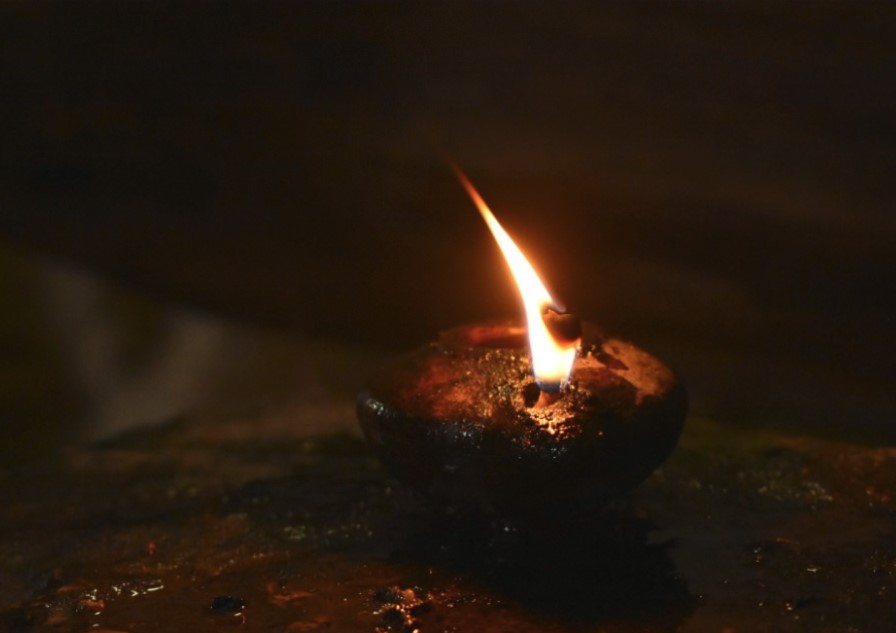
Photograph: An old clay oil lamp from Nazareth, Israel. Photo credit: Olivia Armstrong.
Communion as Isaiah’s Burning Coal of Divine Fire
Christians received and used liturgies as the most standard “best practices” of Christian communities everywhere. These liturgies bear witness to Christians receiving the bread and wine as similar to the burning coal in the vision Isaiah the prophet had (Isaiah 6:6). In that vision, God touched the lips of Isaiah with this fiery coal to purify his words.
Since communion was purifying, it was restorative and medicinal. Therefore, Jesus and his atoning work also had to be restorative and medicinal, which we see, for example, in the account of Matthew’s Gospel. Christians also commonly called the bread and wine “the medicine of immortality.” Find out more about atonement in Scripture and in the early church.
The Divine Liturgy of Saint James: The oldest Christian liturgy, originating in Jerusalem, though known to have been slightly modified by Cyril of Jerusalem in the 4th century, says:
“receiving the fiery coal” (labein to pyrinon anthrax) from the Eucharistic altar
The Liturgy of Ephrem the Syrian: The priest, representing Jesus “in persona Christi,” is the tong of the angel used to touch the burning coal — i.e. the Eucharist — to purify the lips of the faithful, represented by Isaiah:
“The coal carried [by the seraph] cleansed the lips of Isaiah. It is I [Jesus] Who, carried now to you by means of bread, have sanctified you. The tongs which the Prophet saw and with which the coal was taken from the altar, were the figure of Me in the great Sacrament. Isaiah saw Me, as you see Me now extending My right hand and carrying to your mouths the living Bread. The tongs are My right hand. I take the place of the seraph. The coal is My Body. All of you are Isaiah.” (Sermones in Hebdomada Sancta, 4, 5)
The Divine Liturgy of Saint John Chrysostom:
The Prayer of St. Basil the Great
O Master Christ, our God, King of the ages and creator of all, I thank You for all the good things You have granted me and for the Communion of Your pure and life-giving Mysteries. I beseech You, therefore, O Good One Who loves mankind, keep me under Your protection and in the shadow of Your wings; and grant that, with a clear conscience and until my final breath, I may worthily partake of Your Holy Gifts for the remission of my sins and for life eternal. For You are the bread of life, the well-spring of holiness, and the giver of all that is good, and to You we ascribe the glory, with the Father and the Holy Spirit, now and forever and to the ages of ages. Amen.
The Prayer of St. Symeon the Metaphrastes (The Translator)
O You Who willingly grant me Your Flesh for food, You are a fire, and You consume the unworthy! Burn me not, O my Maker, But rather pass through my composite members Into all my joints, my innermost core, and my heart.
Burn up the thorns of all my transgressions; Purify my soul; sanctify my thoughts; Make firm my legs, as well as my bones; Illumine the clarity of my five senses; Nail down the whole of me by Your fear. Ever overshadow, watch, and guard me from every soul-destroying act and word.
Purify, cleanse, and train me; Adorn, elucidate, and illuminate me; Show me to be the dwelling of Your Spirit alone, And no longer the dwelling of sin;
So that, as Your house, by the entrance of Communion As Fire, every evildoer and passion may flee, I bring to You intercessors, all the sanctified, The captains of the bodiless angels, Your Forerunner, the wise apostles, And to them I add Your pure, immaculate Mother. Receive, O my compassionate Christ, their petitions, And make of your hired servant a child of light!
For You are alone our sanctification, O Good One, and the brightness of our souls; And to You, as is fitting, as our God and Master, Do we all ascribe glory from day to day.
[…]
Priest communes from the holy Chalice and says:
“This has touched my lips, and the Lord takes away all my iniquities and cleanses my sins.”
Deacon then communes, and the Priest says:
“This has touched your lips, and the Lord takes away all your iniquities and cleanses your sins.”
People then receive Holy Communion, and the Priest says:
“The servant of God (Name) partakes of the Body and Blood of Christ for the remission of sins and life eternal.”
Cyril of Alexandria (376 - 444), archbishop of Alexandria:
“One of the seraphim is sent to Isaiah with a burning coal which he took from the altar with tongs. This is clearly a symbol of Christ, who, on our behalf, offered himself up to God the Father as a pure and unblemished spiritual sacrifice with a most pleasing fragrance. In the same way, Christ is received from the altar. We must, however, explain why Christ is like a burning coal. It is customary in Holy Scripture for the divine nature to be likened to fire. God appeared in this way to the people of Israel as they stood before the Lord at Horeb, which is Mount Sinai.” (Commentary on Isaiah 6.6. Translation slightly adapted from Isaiah: Interpreted by Early Christian and Medieval Commentators, ed. and trans., Robert Louis Wilken with A. R. Christman and M. J. Hollerich, The Church’s Bible (Grand Rapids: Eerdmans, 2007), p.82.)
John of Damascus (675 - 749), a Syrian priest and theologian who is widely considered to have written an authoritative summary of the Christian writings before him:
“Wherefore, in all fear and with a pure conscience and undoubting faith let us approach . . . let us receive the body of the Crucified One. With eyes, lips, and faces turned toward it, let us receive the divine burning coal, so that the fire of the coal may be added to the desire within us to consume our sins and enlighten our hearts, and so that by this communion of the divine fire we may be set afire and deified.” (On the Orthodox Faith 4.13. Translation slightly adapted from Saint John of Damascus, Writings, trans. Frederic H. Chase, Jr., The Fathers of the Church, vol. 37 (Washington, DC: Catholic University of America Press, 1958), p.359.)
Communion as Our Gift Together Back to God
“In my Protestant experience, I have heard of the bread and wine being called gifts from God to us. Assuredly, these gifts do descend, as it were. Yet here, Irenaeus calls them gifts from us to God, or gifts that ascend. Why? What might we gain from Irenaeus’ understanding?
“First, we retain the meaning that Jesus’ life nourishes us, as God’s gift to us. And we still perceive his faithfulness in the elements. For Jesus gave us bread and wine, not grain and grapes. Bread and wine take human work. Likewise, Jesus labored hard to purify and perfect his new humanity to share with us (Heb.1:3; 2:10; 4:14 – 16; 5:7 – 10; 12:1 – 2). We retain that meaning. Jesus’ hard-won new humanity is for all humanity.
“Second, however, we gain the sense that Jesus is among us, helping us give gifts to the Father. Like a big brother helping us younger ones honor Mom and Dad on Mother’s Day and Father’s Day, Jesus involves us in his gift-giving to the Father…
“Third, we gain an expression of relational unity in the church. Irenaeus quotes from Jesus’ teaching about offering a gift upon the altar, which is a lesson about prioritizing relationships and addressing anger (Mt.5:21 – 26)… Irenaeus hears in Jesus’ words instruction for Christians today about the Lord’s Supper…”
From chapter 13 of Mako A. Nagasawa, Lent with Irenaeus: Journeying with Jesus Towards Becoming Truly Human. Beverly, MA: Trinity Press, 2025. A book of thirteen short devotional readings for Lent, from Ash Wednesday to Resurrection Sunday, drawn from the writings of the second century Christian leader, Irenaeus of Lyons. Mako wrote a short Guide for Reflection and Discussion, too. For more on Irenaeus, see this page.
Orthodox-Catholic Liturgies
Menaion: Epiphany (Jan.2) says,
"Again my Jesus is cleansed in the Jordan, or rather cleanses our sins; for he truly comes to Baptism, wishing to wash out Adam’s record... Christ, has come to make beggared Adam rich through the Spirit... The Law of old and the company of the Prophets say, ‘Christ has come, by baptism refashioning us who had grown old by many offences.’”
Menaion: Forefeast of the Lights (Jan.3) says,
"See, the enlightenment of believers, see, our atonement is about to enter the streams of the river to wash away the stain of humans’ wickedness, and to refashion us who had been crushed."
Matins on the Feast of Ascension. Kiilehua.
"In a manifestation of great glory He Who humbled Himself in the flesh hath risen above the heavens; and our fallen nature hath been honored by sitting with the Father"
Anaphora of the Apostles, Liturgy of the Ethiopian Orthodox Tewahedo Church. This prayer over the eucharist was named for him, although authorship cannot be ascertained. Lines 113, 117, 146 read:
“O my Lord Jesus Christ, let not this Thy mystery be iniquity in me, rather let it be for the purifying of my soul and my body . . . Holy, holy, holy Trinity ineffable, grant me to receive this body and His blood for life and not for condemnation. Grant me to bring forth fruit that shall be well-pleasing unto Thee, to the end that I may appear in Thy glory, and live unto Thee, doing Thy will . . . And further I pray Thee and beseech Thee, O my Lord, that this Thy body and blood which I have received shall neither be for my shame nor for the guilt of my soul and body, but let them give me life and health; and teach me Thy fear, and instruct me in Thy love, so that I may please Thee all the days of my life and glorify Thee without ceasing.”
Anaphora of St. John, Liturgy of the Ethiopian Orthodox Tewahedo Church. This prayer over the eucharist was named for him, although authorship cannot be ascertained. Lines 33, 38 - 40 read:
“He Who sits upon the cherubim abode in a daughter of flesh; the consuming fire put on flesh; the invisible Spirit has been clothed with flesh; He was born from that which was hidden unto that which was open; He who forms infants in the womb became an infant; they wrapped with clothes Him who was clothed in light. He dwelt in the house of the poor as one Who is poor: as a King, He sent messengers to bring Him presents from far . . . They beat Him on the head as a servant and He set us free from the yoke of sin as Lord of all. He suffered all. He who cured the blind with his spittle and gave us the Holy Spirit received the spittle of the unclean. He who forgives sin was accused as a sinner by them. The judge of judges was judged by them. He was crucified on the tree to destroy sin: He was counted with the sinners to enroll us with the righteous. He died through His will, and was buried willingly; He died to destroy death, He died to give life to the dead; He was buried to raise those who were buried, to keep the living, the purify the impure, to justify the sinners, to gather together those who were scattered, and to turn the sinners to glory and honour.”
Anaphora of St. Basil, Liturgy of the Ethiopian Orthodox Tewahedo Church. Basil of Caesarea (330 - 379) was bishop of Caesarea, and this prayer over the eucharist was named for him, although authorship cannot be ascertained. Lines 20 - 22 read:
“He took flesh and was made man and taught us the path of salvation and granted us the birth from on high, of water and of the Holy Spirit. And He made us unto Himself a pure people, and purified us by the Holy Spirit, because He loved His own who are in this world, and gave Himself up by His will to deliver us from the death which reigned over us. By reason of it we were bound and sold through our sins. He descended into hell [hades, Sheol] from the cross.”
Anaphora of St. Cyril, Liturgy of the Ethiopian Orthodox Tewahedo Church. Cyril of Alexandria (376 - 444) was 24th patriarch of Alexandria, and this prayer over the eucharist was named for him, although authorship cannot be ascertained. Lines 81 - 82 read:
“Let not this coal of fire, which we have laid before Thee upon Thy holy altar, be our accuser, and let not this bread of worship which we break be for vengeance because we did not purify our soul and our body. It is fearful to open the lips to eat burning fire and swallow glowing coal, if the belly is not purified from deceit.”
Anaphora of St. Dioscorus, Liturgy of the Ethiopian Orthodox Tewahedo Church. Dioscorus of Alexandria (died 454) was 25th patriarch of Alexandria, and this prayer over the eucharist was named for him, although authorship cannot be ascertained. Lines 25, 35, 43, and 63 read:
“He who created man stretched forth His hands for suffering to set free Adam from the yoke of sin . . . The immortal died, died to destroy death, died to quicken the dead as He had promised them with the word of covenant . . . Grant it together unto all Thy people that it may be unto them for life and for purification from sin, unto endless ages. . . . As Thou did join the body of Thy Son with our body, and Thou did mix the blood of Thy Messiah with our blood, so put Thy fear in our heart and the beauty of Thy worship in our mind.”
Verona / Leonine Sacramentary: This prayer is significant because the Verona Sacramentary is the oldest surviving liturgical book of the Roman rite, containing prayers for mass. It is called “Leonine” because tradition ascribes at least some of the collection to Pope Leo I, who died in 461 AD.
“God, you who marvelously created the dignity of human substance and more marvelously reformed it: grant us, we ask, to be sharers in the divinity of your Son, Jesus Christ, who deemed it worthy to become a partaker of our humanity” (Ve 1239).
Oktoechos, Sunday Matins, Tone 1, Canon, Ode 1, Troparion 1 (formalized 9th century) “Having divinely fashioned me out of the dust at the beginning . . . You extended your arms on the Cross, calling from earth my corruptible body, which you assumed from the Virgin” Ode 3, “O Christ, as the hypostatic Life and as compassionate God, Thou hast clothed Thyself with me, the corrupted one, descending, O Master, unto the dust of death, destroying the power of death, and arising on the third day, whereby Thou hast clothed me with incorruption”
John Scotus Eriugena (c.800 - c.877), Periphyseon.
Through sin our nature has become tarnished
It no longer bears the likeness of God
Likeness brings us nearer to God
Unlikeness removes us to a distance
However, it is not by paces of the foot
That we move towards or away from God
Rather we move closer or further
By the affections of our minds
The light of the sun is not lost because of distance
We lose its light when we close our eyes
It is not space which separates us from health
We are separated from health by our pain
It happens in exactly the same way
When we leave behind the virtues
Of life, blessedness, and wisdom
Sin is the emptiness where they once were
In the same way that skin is infected with leprosy
So human nature is infected with sin
In this illness the soul ceases to resemble
The likeness of Jesus Christ its maker
When the soul is cured of that leprosy
By the medicine of the Divine Grace
It will be restored to its former beauty
And I will tell you one thing more
The nature which is created in the image of God
Never truly lost the blossom of its beauty
Nor did it lose the integrity of its essence
Nor could such a thing ever happen.
See 4 minute reflection by Justin Coutts, The Mirror of the Heart. In Seach of a New Eden blog, Jun 26, 2022.
Prayers on the Day of Assumption/Ascension. Anastasis, Ecumenical Patriarchate of Constantinople, Archdiocese of Thyateira and Great Britain.
"Lifting up on your shoulders the nature which had been led astray, O Christ, you were taken up and brought it to God the Father... Lifting up our nature which had been slain by sin, O Saviour, you brought it to your own Father... The majesty of him who became poor in the flesh has been raised above the heavens and our fallen nature honoured by sitting with the Father... and having through compassion exalted our fallen nature, you have seated it with the Father. O God, having renewed in yourself Adam’s nature, which had descended to the lower parts of the earth, you took it up to-day above every rule and authority; as you loved it, so you made it sit with you; as you had compassion on it, so You united it to Yourself; as united with it, so you suffered with it; as not subject to suffering, yet you suffered and glorified it with yourself. When you came down from heaven to things on earth and as God raised up with you Adam’s nature which lay below in Hades’ prison, you brought it to heaven by your Assumption, O Christ, and made it sit with you on your Father’s throne, as you are merciful and love humankind."
Vespers Hymn.
O Lord Most High, eternal King,
By you redeemed, your praise we sing.
The bonds of death are burst by thee,
And grace has won the victory.
Ascending to the Father's throne
You claim the kingdom as your own;
And angels wonder when they see
How changed is our humanity.
You are our joy, O mighty Lord,
As you will be our great reward;
Let all our glory be in thee
Both now and through eternity.
O risen Christ, ascended Lord,
All praise to you let earth accord,
Who are while endless ages run,
With Father and with Spirit, One.
Sources of Atonement Theology
Bible Studies and Messages from The Anástasis Center: