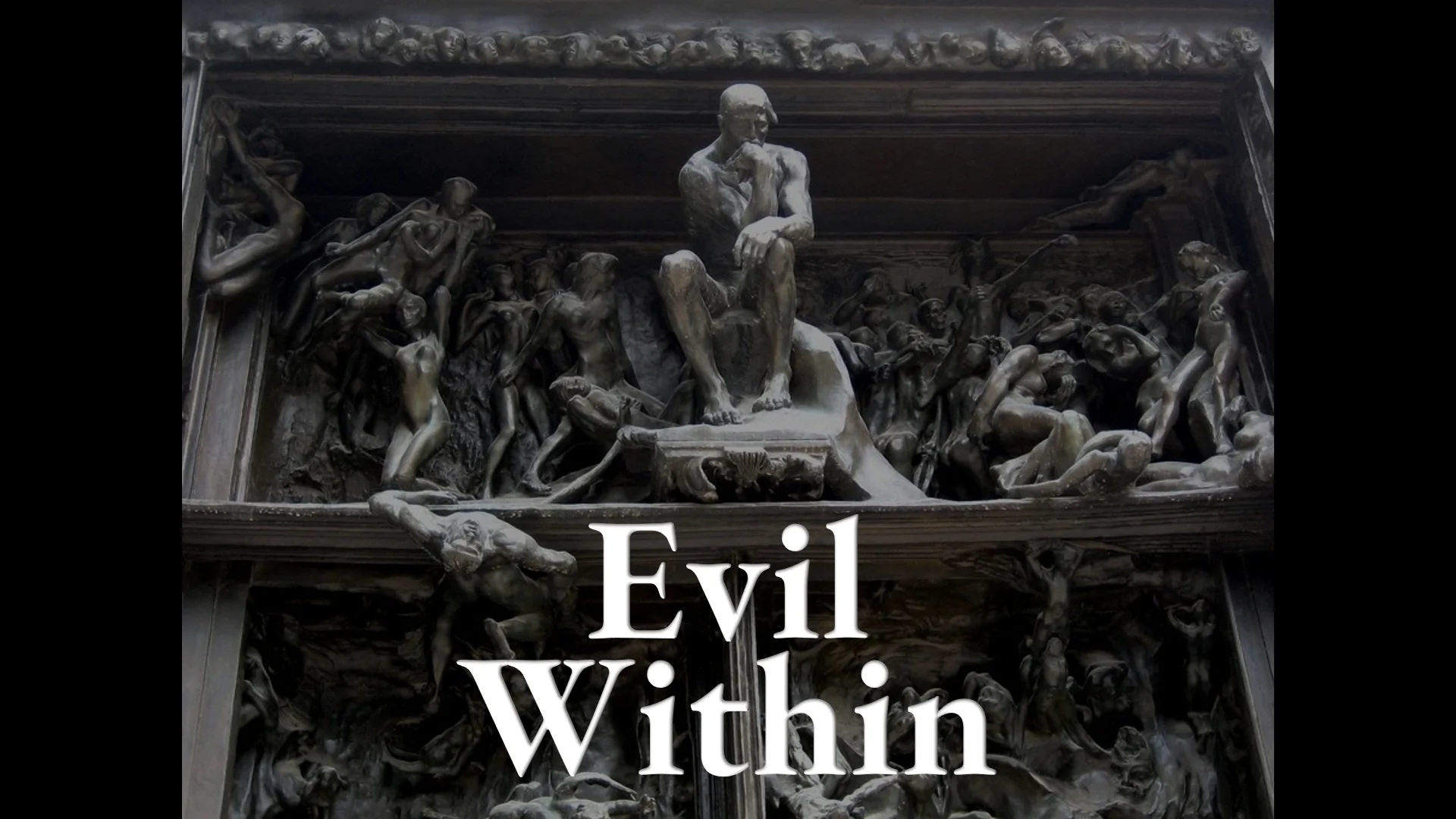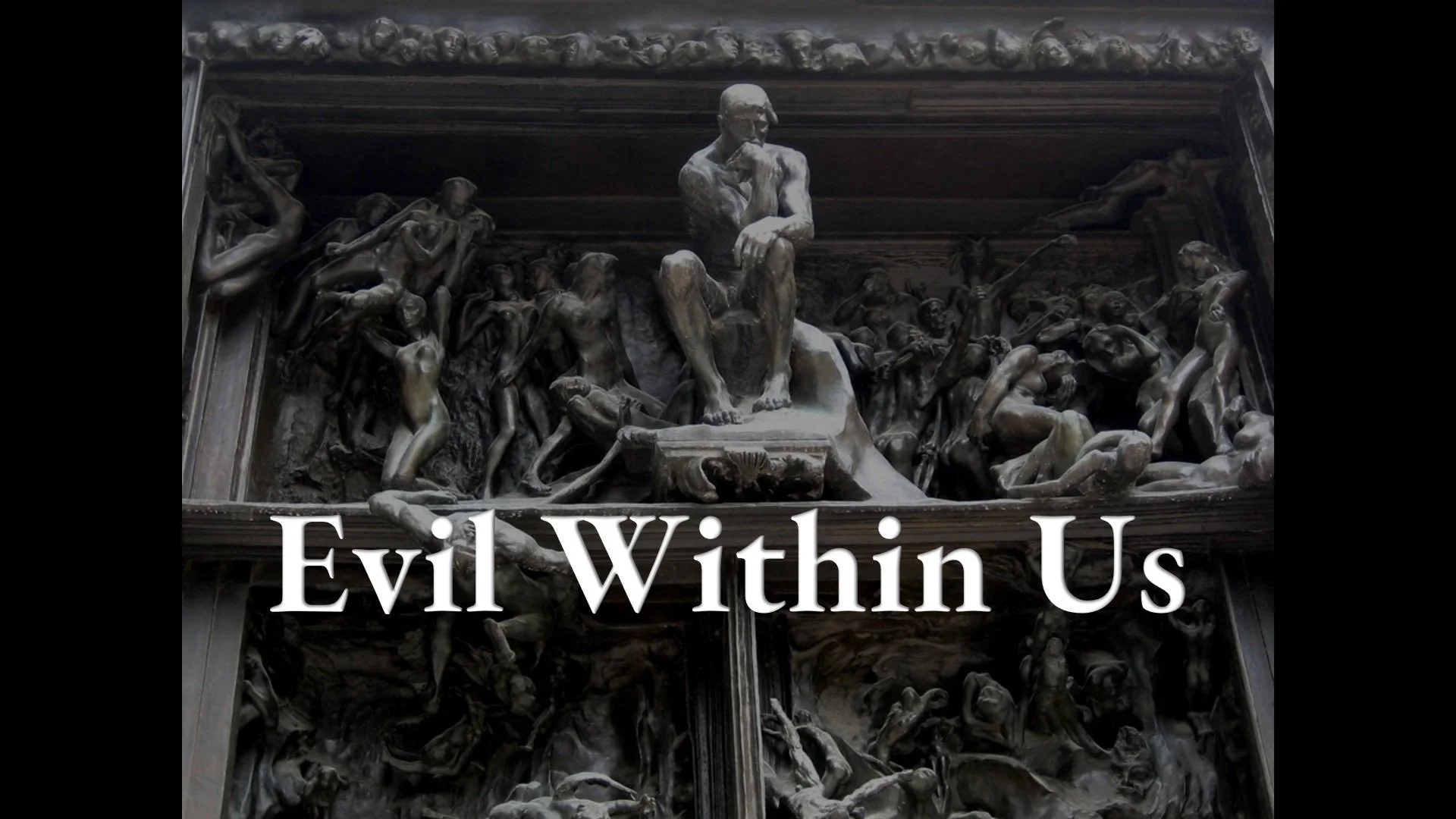
Photograph: Auguste Rodin's sculpture The Gates of Hell, modeled after Dante Alighieri's Inferno, a portrayal of hell as primarily psychological based on what human beings have done to their own hearts and minds through their own choices. The Thinker might be Adam, contemplating fallenness. Photo credit: Wally Gobetz, Creative Commons 2.0.
Introduction: The Evil Within
The “problem of evil” is sometimes thought to be a dilemma for Christians. How can God be fundamentally and thoroughly good when there is evil? However, the problem of evil is an even bigger dilemma for people who are not Christians. The category “evil” requires the category “good,” which requires a morally consistent God who anchors those categories and is the source of whatever goodness we have and experience. So when we see people do evil things, we do not need merely a theoretical explanation, but a concrete remedy for the corruption of sin within human nature. The real question, then, is whether there is a God good and loving enough to heal human beings of our evil, and undo the damage we cause to ourselves and others. That is where Jesus comes in.
The following clips are from our 2019 Conference: Healing Atonement. The first highlights the importance of stories where good triumphs over evil, and what they reveal about us. The second highlights what Jesus has done with human nature to retell and heal our stories.
The resources below are examples of evil as a disorder in human nature. They illustrate our need to search out good and evil as real moral categories, along with our need for a loving God to heal human nature in a loving way. That is where Jesus comes in. We keep this page as a resource for conversation, reflection, and preaching.
Spotlighted Resources
The Hero’s Journey and the Defeat of Evil as Atonement and Salvation (link to YouTube video)
This video is part 7 of our series on The Theology of J.R.R. Tolkien’s The Lord of the Rings. It offers us as an illustration of a healing atonement. The hero’s journey is a successful retelling of the past stories of tragic heroes. The hero’s resistance to external evil and defeat of internal evil is atonement and salvation. Just as Gandalf retold Saruman’s story, Aragorn retold Isildur’s story, and Frodo retold Smeagol’s story (almost), Jesus retold Israel’s story, David’s story, and Adam and Eve’s story. He had to: they set up the conditions of sin-sickened humanity, exile, and conflict that we all inherit and must struggle against.
Our full 11 part video series, The Theology of J.R.R. Tolkien’s The Lord of the Rings, is found on our Arts and Theology page and our YouTube channel, where we put brief descriptions of each video. It’s a great way to engage people who have an appreciation for the stories. Each video has questions for group discussion and/or personal reflection.
Human Being, Human Becoming in Tolkien and Christian Theology (link to YouTube video)
This video is part 5 of our series on The Theology of J.R.R. Tolkien’s The Lord of the Rings. It offers us as an illustration of the nature of human beings — that we are human beings and human becomings. It looks at Smeagol-Gollum and Boromir as case studies of human being and human becoming. Their choices towards addiction and freedom are vital to understand. Tolkien’s vision of what humanness means is rich, insightful, and sobering.
Our full 11 part video series, The Theology of J.R.R. Tolkien’s The Lord of the Rings, is found on our Arts and Theology page and our YouTube channel, where we put brief descriptions of each video. It’s a great way to engage people who have an appreciation for the stories. Each video has questions for group discussion and/or personal reflection.
The Music of the Ainur (link to YouTube video)
This video is part 3 of our series on The Theology of J.R.R. Tolkien’s The Lord of the Rings. It explains why a loving God logically requires human beings as human becomings, and why resistance to God’s love is possible but never required. It looks at the framework of music and symphony as the way to understand the partnership God hopes for with His creatures. In Tolkien's world, Eru Iluvatar (God) teaches the Ainur (angels) to sing, and their symphony structures creation and history. How does this compare with the biblical portrayal of God speaking the creation into existence? And how does Tolkien's Eru continue to partner with other beings using music? Is it similar to how the biblical God partners with humans?
Our full 11 part video series, The Theology of J.R.R. Tolkien’s The Lord of the Rings, is found on our Arts and Theology page and our YouTube channel, where we put brief descriptions of each video. It’s a great way to engage people who have an appreciation for the stories. Each video has questions for group discussion and/or personal reflection.

The Theology of J.K. Rowling’s Harry Potter (link to YouTube video)
A fun, 40 minute presentation. A fun exploration of J.K. Rowling's reliance on Christian motifs and the biblical plot arc. Why is book 4 the turning point of the 7 books? Why do the two New Testament passages quoted in book 7 summarize the whole story? Why did Harry have to surrender his life?
What Made Chadwick Boseman’s T’Challa Heroic -- And His Vision for Wakanda’s Gift (link to YouTube video)
Part 4 looks at T'Challa, who was heroic -- but why? Was it because he honored women? Because he honored tradition and the ancestors? Because he challenged his ancestors? Because he sought to include others and the concerns of others? Because he rejected both the imperialistic and isolationist options for Wakanda? Because he allowed himself to be influenced by Nakia and Killmonger? We look at T'Challa's heroism as rooted in his willingness to suffer for others, to descend again and again, which then invites us to compare T'Challa's arc to Jesus' arc.
To see our four part video series (with one more for Wakanda Forever), see our Arts and Theology page, or our YouTube channel, where we put brief descriptions of each video. It’s a great way to engage people who have an appreciation for the movies. Each video has questions for group discussion and/or personal reflection.
-
Text of a message that reflects on our desire for love, meaning, and justice. Where do these desires come from? Are they connected to the God who reveals Himself in Jesus Christ? This might be called the “problem of goodness,” specifically human goodness. This was the first of three messages at a retreat. The second is Jesus Is God’s New Humanity, from Romans 5:12 - 21. This message explores how Jesus became a “new Adam,” fulfilling the role that God originally set forth for Adam and Eve. The third was God's Victory Over Human Evil in Jesus — the text of a message from Romans 6:1 - 11 about how Jesus’ death and resurrection was the way he triumphed over the corruption of sin in the human nature he took on, and how we die and rise with Jesus to share in that victory. For more on this, see How Our Choices Shape Our Desires: Experiencing the Triune God, the text of a message on Genesis 1 - 2 and Proverbs 2 leading into questions for reflection and/or discussion. The message was given to students at Boston College, and reflects the concerns to discern God’s will as far as vocation and career and major are concerned. If you enjoy these topics, see our section on Desire: Jesus Leads Us to True Beauty.
The Healing of Human Nature in Jesus
A 30 minute video of a message given to students at Boston College, Nov 15, 2013. This message is rooted in the story of Jesus going through his baptism and wilderness temptation, in Matthew 3:13 - 4:11, reflecting his commitment to fix and fulfill his human nature by going all the way through his faithful life, death, and resurrection, in order to share himself with us by his Spirit.
Images of God in a Broken World
The following three messages were given at a weekend retreat. Images of God in a Broken World is the first; it explains why, in a broken world, we get the impression that if there is a “god,” that “god” is evil, at least partially. Jesus is the Image of God is the second; it is an explanation of Colossians 1:15 - 20, how Jesus is the accurate and perfect image of God despite our broken world, because he healed human nature in himself via his life, death, and resurrection. In Jesus, We Are God’s Image Bearers is the third; it is from Colossians 3:5 - 4:6, about how Jesus renews the image of God in us by his Spirit, to share God's goodness in a broken world.
God's Response to Human Evil: The Faithfulness of Jesus
A written message from Romans 3:21 - 26 about how Jesus’ faithfulness as a human being reflects and expresses the faithfulness of God to His promises to Israel, to bring about a healed human heart.
The Tree of Knowledge of Good and Evil: What Was It, Really? Was Evil Necessary?
This is a small group discussion guide to Genesis 2:8 - 17 and the nature of the Two Trees in the original Garden of Eden. They are not arbitrary, but were, in fact, necessary.
The Role of Jesus in Revolution and the Pursuit of Justice
A written message, graphics included, on how Jesus inspired twentieth-century non-violent resistance movements around the world, and why. Spotlights Tolstoy in Russia; Gandhi in South Africa and India; Ahn Chang-ho in Korea; the Civil Rights Movement in the U.S.; the Filipino People Power Revolution; Solidarity in Poland; the Truth and Reconciliation Commission in South Africa. This is a shining thread of moral clarity, courage, and hope during humanity’s bloodiest century.
A written message and slides on how Jesus brought about a radical change to human history. Christian faith brought about dramatic improvements in health care and hospitals, abolition, education and schools, science and technology, criminal justice reform, and beauty and the arts.
Jesus' Kingdom of God Movement
Written messages, notes, short reflections, and papers on the Gospel of Matthew. Great to get acquainted with Jesus and his movement, learn how to follow him, as presented by Matthew.
God's Great News for Humanity's Great Problem
Messages, notes, and papers on Paul's Letter to the Romans. Great to understand Jesus engages with human fallenness and rescues us from it, which includes Jesus’ relationship to his own Jewish background and the Sinai covenant.
Evangelism With the New Humanity Paradigm
An evangelism training packet with Bible study material, sample conversations, and diagrams of the conceptual flow of the conversations.
Illustrations of Sin as Self-Harm to Human Nature
Stories, analogies, illustrations for reflection, and for teachers. If you are leading a group or giving a message, and need stories, look here.
Illustrations of the Atonement
Stories, analogies, illustrations for reflection, and for teachers. If you are leading a group or giving a message, and need stories, look here.
Medical Substitutionary Atonement, Personal Healing, and Social Justice
A presentation given at the Honor-Shame Conference 2017, a gathering of missionaries, scholars, and ministry practitioners
Assignment #1: Jesus is the Answer, What's the Problem?
An exercise designed for Christians who have some familiarity with the Bible. It asks for people to find examples in Scripture of how Jesus is God’s solution to three problems: the wrath of God; Satan and the demonic; and the corruption of human nature.
Assignment #2: Comparing Views of Evil.
An exercise designed to follow Assignment #1, above. It asks for people to reflect on two quotations: one is from Jesus about evil in the human heart; the other is from Time magazine essayist Lance Morrow, from his 2003 article, “The Real Meaning of Evil,” where he has difficulty “locating” from where human evil comes.
Big Questions About God: Contrasting Early and Reformed Theologies
Workbook style, with quotes and questions to help you compare, contrast, and discuss. The differences are enormous, and deeply relevant.
-
If you’re looking for Christian reflections — ancient and modern — on the corruption of sin in human nature, and how we can have good and evil within us while God is thoroughly and only good, see the following resources below. They go in chronological order.
Athanasius of Alexandria, Against the Heathen, chapters 1 - 6 In volume one of his two part work, one of the greatest Christian theologians of the first few centuries, Athanasius bishop of Alexandria (298 - 373 AD), argues for why the Christian God is still good despite human beings falling into sin
Athanasius of Alexandria, On the Incarnation, chapters 1 - 5 From volume two of his two part work, Athanasius explains who the Son of God is, and how he assumed human nature in order to heal it, first in himself, and then in us.
Gregory of Nyssa, Address on Religious Instruction says, 'Evil in some way arises from within. It has its origin in the will, when the soul withdraws from the good. For the origin of evil is not otherwise to be conceived than as the absence of virtue... Just as darkness follows the removal of light, and disappears in it's presence, so, as long as goodness is present in a nature, evil is something nonexistent. But when there is a withdrawal from the good, it's opposite arises.'
Augustine of Hippo, Enchiridion, chapters 11 - 14 describes evil as a sickness and deficiency because of the will's resistance to God who is the good
C.S. Lewis, Mere Christianity. pdf book, 1942 - 1944. Especially books 1 and 2
C.S. Lewis, God in the Dock. Eerdmans | Amazon page, 1970. Chapter 1
Alvin Plantinga, God, Freedom, and Evil. pdf book, 1974.
Henri Blocher, Evil and the Cross. Kregel Academic | Amazon page, 2005.
David Bentley Hart, The Doors of the Sea: Where Was God in the Tsunami? Eerdmans | Amazon page, 2005. A short book on how a Trinitarian view of God influences how we think about suffering and evil. Includes a critique of the Calvinist tendency towards God's omnicausality. Lays out the categories in very clear, simple terms. This website is dedicated to the promoting the theological thought of David B. Hart, an Eastern Orthodox theologian.
William Paul Young, The Shack. Windblown Media | Amazon page, 2007. A story about a man who loses his daughter in a rape-murder, and wrestles with God about it - reveals good insights about the Trinity and the character of God. Roger Olson's analysis of the book, Finding God in "The Shack" is also helpful. My response to Mark Driscoll's youtube criticism of the book is here.
N.T. Wright, Evil and the Justice of God. InterVarsity Press | Amazon page, 2009.
Patrick Downey, Desperately Wicked: Philosophy, Christianity, and the Human Heart. InterVarsity Press | Amazon page, 2009.
David Bentley Hart, Suffering and the Problem of Evil. Centre for Public Christianity, Feb 25, 2010. A 6 minute video.
Robert Woodberry, The Missionary Roots of Liberal Democracy. American Political Science Review, May 2012.
Philip Tallon, The Poetics of Evil: Toward an Aesthetic Theodicy. Oxford University Press | Amazon page, Nov 2012. “What role does art play in responding to the theological problem of evil? What can beauty show us about God’s goodness in a fallen world? Philip Fallon constructs a theodicy that attempts to answer these questions through an examination of Christian aesthetics.”
David Bentley Hart, Is, Ought, and Nature's Laws. First Things, Mar 2013. A rejection of 'natural law' without revelation.
Brad Littlejohn, The Late, Great Natural Law Debate. blog, Mar 26, 2013.
David Bentley Hart, An End to All Endings. Aragorn123ist, Sep 1, 2013.
Centre for Public Christianity, Suffering and Evil. Centre for Public Christianity website.
James Hoskins, 16 Reasons Why I Believe in God: (9) The Existence of Evil (blog, May 13, 2013.
Tell Me More Staff, How One Woman's Faith Stopped a School Shooting (NPR, Jan 31, 2014.
Hugh Halter, Flesh: Bringing the Incarnation Down to Earth. David C. Cook | Amazon page, Feb 2014.
Dargan Thompson, If God is in Control, Why Does Bad Stuff Keep Happening? N.T. Wright on the Good News. Relevant Magazine, Jan 20, 2015.
Donald Miller, How Do So Many Good People Get Away With Bad Things? Storyline blog, May 11, 2015.
David Gelernter, Why Should a Jew Care Whether Christianity Lives or Dies? First Things, Mar 24, 2015.
Nancy Hill, Can We Have Martin Luther King's Dream Without His Faith? Veritas Forum, May 8, 2015.
Peter Wehner, The Christmas Revolution. New York Times, Dec 25, 2015.
Ronald Osborn, The Scandalous Origins of Human Rights. Veritas Forum, Jan 15, 2016.
Glenn M. Harden, The Sex Trade, Evil, and Christian Theology. Wipf and Stock | Amazon page, Apr 7, 2016.
Nonna Verna Harrison and David G. Hunter, Suffering and Evil in Early Christian Thought. Baker Academic | Amazon page, 2016.
Sarah Irving-Stonebraker, How Oxford and Peter Singer Drove Me from Atheism to Jesus. Veritas Forum, May 22, 2017.
Alan Snyder, Evil Is a Parasite, Not an Original Thing. Pondering Principles, Sep 22, 2018. On C.S. Lewis' view, which comes from the early Christian view, and continues in the Orthodox and Catholic traditions
Father Stephen Freeman, Does Goodness Require the Possibility of Evil? Glory to God for All Things, Feb 1, 2021. Freeman oes not focus on the human nature problem, but the ontology of goodness and evil itself. Freeman points out that our choices in themselves are not ultimate. “It is God, to whom we commend ourselves, one another, and all our lives, who gathers our choices into His own goodness, truth, and beauty, making of them what we could never do of our own selves. In none of this, however, is evil necessary. It has no being. It is only misdirection. It is a parasite.”
-
If you’re looking for reflections on the human nature condition — that we are wounded by evil yet long for a restoration to goodness — see the following resources below. They go roughly in chronological order of publication.
Wikipedia, Freudian Coverup (Wikipedia article) about Freud's early research exposing fathers molesting their daughters, and his cover up of the evidence
Oliver Wolcott, Jr., The Intimate Life of Alexander Hamilton. Letter, Jul 13, 1804.
Noam Chomsky and Michel Foucault, Debate on Human Nature. book, 2006 based on the debate in 1971. See also video excerpt. youtube. See also Stephen Pinker's critique of Chomsky's view of human nature. youtube, Nov 27, 2012.
Carol Tavris and Elliot Aronson, Mistakes Were Made (But Not by Me): Why We Justify Foolish Beliefs, Bad Decisions, and Hurtful Acts. Harvest Books | Amazon page, 2007.
Cordelia Fine, A Mind of Its Own: How Your Brain Distorts and Deceives. W.W. Norton & Company | Amazon page, Jun 2008.
Dan Ariely, The Honest Truth About Dishonesty: How We Lie to Everyone--Especially Ourselves. Amazon book, 2013.
Alan S. Miller & Satoshi Kanazawa, Ten Politically Incorrect Truths About Human Nature. Psychology Today, Jul 1, 2007.
Tom Ferry, The 4 Addictions That Destroy Your Dreams (They’re Not What You Think. Huffington Post, May 24, 2010. Addiction to others' opinions, drama, the past, worry
Daniel R. Hawes, When Ignorance Begets Confidence: The Classic Dunning-Kruger/ Psychology Today, Jun 6, 2010.
Milton Rokeach, The Three Christs of Ypsilanti: A Psychological Study. NYRB | Amazon page, 2011. Originally written in 1964.
“In 1959, at Ypsilanti State Hospital in Michigan, the social psychologist Milton Rokeach brought together three paranoid schizophrenics: Clyde Benson, an elderly farmer and alcoholic; Joseph Cassel, a failed writer who was institutionalized after increasingly violent behavior toward his family; and Leon Gabor, a college dropout and veteran of World War II. The men had one thing in common: each believed himself to be Jesus Christ. Their extraordinary meeting and the two years they spent in one another's company serves as the basis for an investigation into the nature of human identity, belief, and delusion that is poignant, amusing, and at times disturbing. Rokeach draws us into the lives of three troubled and profoundly different men who find themselves "confronted with the ultimate contradiction conceivable for human beings: more than one person claiming the same identity.””
In the 1981 edition of the book, Milton Rokeach added an afterword, "Some Second Thoughts About the Three Christs: Twenty Years Later." In it, he described a lecture he had given shortly after the experiment ended, during which he accidentally said there had been four gods under study rather than three. He came to see this as a Freudian slip—an unconscious acknowledgment that he himself had been operating under a delusion of omnipotence. By 1984, he was ready to apologize. "I really had no right, even in the name of science, to play God and interfere round the clock with their daily lives," he wrote in a new afterword. "While I had failed to cure the three Christs of their delusions, they had succeeded in curing mine—of my God-like delusion that I could change them by omnipotently and omnisciently arranging and rearranging their daily lives." The experiment had been designed to break open the patients' beliefs. Instead, it revealed something about belief itself—its extraordinary resilience, its capacity to absorb contradiction, its role in protecting the self from unbearable realities. And it revealed something about the researcher, too: the ease with which a person convinced of his own righteousness can cause harm while believing he is doing good.
The Three Christs of Ypsilanti has since been adapted into a stage play, two operas, and a 2017 film starring Peter Dinklage. The original Cessna Bird Dog that Leon might have called a machine-operated corpse-Christ now hangs in a museum of a different kind—the museum of psychological history, where we keep the experiments we're no longer sure we should have conducted. What remains most striking about the story is not the failure of the experiment but its unintended success. Rokeach set out to prove that identity delusions could be broken by confrontation with reality. What he proved instead was that our sense of self is far more creative than we imagine—capable of rewriting the world before it will rewrite itself. Three men believed they were Jesus Christ. When forced to confront each other, not one of them concluded he might be wrong. Each simply decided the others were not real. Perhaps that's the most human response of all.”
Scott Barry Kaufman, Do Narcissists Know They Are Narcissists? Psychology Today, Mar 25, 2011.
Pamela Meyer, How to Spot a Liar. TED talk, Oct 13, 2011.
Frans de Waal, Moral Behavior in Animals. TED talk, Nov 2011. Both positive and negative
Susannah Cahalan, Greed is Good (And So is Lust, Envy, Pride, Anger, Sloth, and Gluttony. New York Post, Feb 5, 2012.
Julien Pretot, Lance Armstrong Doping: International Cycling Union Strips Champion Of 7 Tour De France Titles, Bans Him For Life. Huffington Post, Oct 22, 2012. lying and self-deception
Kathleen McGowan, Living a Lie. Psychology Today, Jan 2, 2013.
Joe Fassler, What Flannery O'Connor Got Right: Epiphanies Aren't Permanent. The Atlantic, Jan 4, 2013. On human nature, truth, the limits of self-improvement.
Dylan Garrity, Friend Zone. Button Poetry, May 6, 2013.
U.K. Chief Rabbi Jonathan Sacks, Atheism Has Failed. Only Religion Can Defeat the New Barbarians. The Spectator Magazine, Jun 15, 2013.
Marty Kaplan, Most Depressing Brain Finding Ever. Huffington Post, Sep 16, 2013.
Alexander Nazaryan, A Good God is Hard to Find: The Prayer Journal of Flannery O'Connor. Newsweek, Nov 19, 2013.
Environment, This Video Will Make You Lose Faith in Humanity. ShareDots, Mar 27, 2014.
Adam Serwer, Lyndon Johnson Was a Civil Rights Hero, But Also a Racist. MSNBC News, Apr 11, 2014.
Stephen Pinker, The Modern Denial of Human Nature. youtube, Apr 14, 2014.
Chris Hedges, War is a Force That Gives Us Meaning. book, Apr 2014. about the psychology of war and our acclimatization to it
Jerry Adler, The Reformation: Can Social Scientists Save Themselves? Pacific Standard, Apr 28, 2014.
Jeffrey Kluger, How Do You Spot a Narcissist? Just Ask. Time, Aug 5, 2014.
Melissa Dahl, Scientific Evidence That Self-Promoters Underestimate How Annoying They Are. New Yorker Magazine, Oct 17, 2014.
Noah Zandan, The Language of Lying. TED Ed, Nov 3, 2014.
John Gray, What Scares the New Atheists. The Guardian, Mar 3, 2015.
Annie Reneau, 10 Things I Thought Were Caused by Bad Parenting, Until I Had My Own Kids. Scary Mommy, May 2015.
Huff Post Show, Dikipedia: Bikram Choudhury. Huffington Post, May 29, 2015.
Elizabeth Gilbert, Confessions of a Seduction Addict. NY Times, Jun 24, 2015.
Rebecca Nicholson, Is the Ashley Madison Hack Another Step Towards a Post-Embarrassment World? The Guardian, Jul 24, 2015.
Randi Kreger, Therapists Confirm Trump's Narcissistic Personality Disorder. Psychology Today, Nov 13, 2015.
Husna Haq, The Surprising Relationship Between Intelligence and Racism. Christian Science Monitor, Jan 7, 2016.
Heather McLean, Moral Licensing. youtube video, Jan 11, 2016.
Marty Kaplan, The Most Depressing Discovery About the Brain, Ever. Raw Story, Feb 27, 2016.
Ana Swanson, How to Tell If Other Other People Think You're Hot, According to Science. Washington Post, Apr 2, 2016. Ultimately, it’s about people's inability to place themselves in another's shoes
Jeff Guo, This Unusual Test Reveals How Smart You Are. Washington Post, Apr 14, 2016. about intelligence and lying
Diane Langberg, Narcissism and the Systems It Breeds. Forum of Christian Leaders Online, May 5, 2016.
Hank Green, The Problem of Evil: Crash Course Philosophy #13. Crash Course, May 9, 2016. A short 10 minute video
Jeff Guo, We're Really Good at Forgetting All the Terrible Things We've Done. Washington Post, May 20, 2016.
Joshua Epstein, Here's the Proof That Donald Trump's a Pathological Liar You've Been Asking for, Trolls. New Civil Rights Movement, May 29, 2016.
Joseph Tkach, The Tragedy of Untruthfulness. GCI, Jul 6, 2016.
David Greenberg, Are Clinton and Trump the Biggest Liars Ever to Run for President? Politico, Jul/Aug 2016.
Christopher Ingraham, New Study Finds That Men Are Often Their Own Favorite Experts On Any Given Subject. Washington Post, Aug 1, 2016. Although for partial rebuttal, see Rebecca Onion, Mansplaining Is Real! But Male Self-Citation in Academic Work Isn’t So Simple Slate, Aug 2, 2016. But it suggests an explanation for Jessica Chasmar, Donald Trump: I Consult Myself on Foreign Policy, 'Because I Have a Very Good Brain'. Washington Times, Mar 17, 2016.
Brad Evans and Henry A. Giroux, The Violence of Forgetting. New York Times, Jun 20, 2016.
Bobby Azarian, A Neuroscientist Explains What May Be Wrong With Trump Supporters' Brains. Raw Story, Aug 4, 2016.
David Ignatius, Why Facts Don't Matter to Trump Supporters. Washington Post, Aug 4, 2016.
Zygote Films, The Dangers of the Deep Web. The Atlantic, Aug 4, 2016.
Sky Palma, When Researchers Trolled Facebook Conspiracy Nuts With Random False Info, They Bought It Every Time. Dead State, Sep 11, 2016.
Buster Benson, You Are Definitely Not Living in Reality Because Your Brain Doesn't Want You To. Quartz, Sep 16, 2016.
Sam Wang, How Lies Live And Grow In The Brain – 2016 edition. Princeton Election Consortium, Sep 20, 2016.
Bahar Gholipour, You Can’t Always Trust Your Own Thoughts, And This Terrifying Chart Shows Why. Huffington Post, Sep 22, 2016.
Michael Barbaro, What Drives Donald Trump? Fear of Losing Status, Tapes Show The Run-Up. New York Times, Oct 25, 2016.
Jonathan Haidt and Ravi Iyer, How to Get Beyond Our Tribal Politics. Wall Street Journal, Nov 4, 2016. The challenge of tribalism.
Brendan Nyhan, Fact-Checking Can Change Views? We Rate That as Mostly True. New York Times, Nov 5, 2016. But why "mostly"?
Akshat Rathi, A Philosophy Professor Explains Why You're Not Entitled to Your Opinion. Quartz, Dec 4, 2016.
Brian Resnick, A New Brain Study Sheds Light on Why It Can Be So Hard to Change Someone's Political Beliefs. Vox, Dec 28, 2016.
Rachel Marie Stone, How Not to Be Afraid. New York Times, Jan 20, 2017. Note the self-hatred of her grandfather, who became a Nazi.
Sam Levin, Trump Pressured Parks Chief for Photos to Prove 'Media Lied' About Inauguration Crowd - Report. Guardian, Jan 27, 2017.
Juliet Macur, Why Do Fans Excuse the Patriots’ Cheating Past? New York Times, Feb 5, 2017. On tribal loyalties and group identity.
Hayley MacMillen, This Rape Survivor and the Man Who Raped Her Have Teamed Up to Tell Their Story. Marie Claire, Feb 8, 2017.
Andrew Sullivan, The Madness of King Donald. New York Magazine, Feb 10, 2017.
Carlos Maza, Kellyanne Conway's Interview Tricks, Explained. Vox, Feb 13, 2017. On the art of lying and misdirection
Drake Baer, Rich People Literally See the World Differently. New York Magazine, Feb 14, 2017.
Elizabeth Kolbert, Why Facts Don't Change Our Minds. The New Yorker, Feb 27, 2017.
Tony Schwartz, I Wrote 'The Art of the Deal' with Trump. His Self-Sabotage is Rooted in His Past Washington Post, May 16, 2017. On need for approval.
David Brooks, When the World is Led by a Child. New York Times, May 15, 2017. about impulse control, self-awareness, and other-awareness
Matthew Yglesias, Donald Trump Gets a Daily Briefing All About How Great He Is. Vox, Aug 8, 2017.
Paul Bloom, The Root of All Cruelty. The New Yorker, Nov 27, 2017. about dehumanization and its ubiquity. Although see Sean Illing, Why Humans Are Cruel. Vox, Jan 16, 2018. A counterargument to dehumanization - we are cruel because we humanize an adversary and hold them morally accountable for something, even if falsely. We sometimes believe certain people are worthy of intense retributive suffering.
Alex Wong, Trump's Lifelong Addiction. Politico, Apr 17, 2018. to lawyers
Brian Resnick, We're Underestimating the Mind-Warping Potential of Fake Video. Vox, Apr 23, 2018.
Like Stories of Old, The Unexplored Depths of Spider-Man 3 – Facing the Dragon of Grandiosity/ Like Stories of Old, Apr 30, 2018.
Stephen Colbert, Now We Know Who's Willing to Defend Caging Children. The Late Show, Jun 19, 2018. Note Colbert points out Kirstjen Nielsen's flip-flop
Ed Yong, Parasites Can Mind-Control Animals Without Infecting Them. The Atlantic, Jun 20, 2018. an intriguing metaphor for sin
Lyz Lenz, Women Are Evil. Huffington Post, Jun 21, 2018.
Rukmini Callimachi, An American Couple Found Many Moments of Kindness While Cycling the World. Then Came Day 369. Boston Globe, Aug 7, 2018. when an ISIS group killed them; sadly, they believed that evil was a construct
Jack Lewis, The Science of Sin: Why We Do The Things We Know We Shouldn't. Amazon book, Sep 11, 2018.
Trevor Noah, Trevor Doesn’t Buy Senator Orrin Hatch’s Defense of Brett Kavanaugh. The Daily Show, Sep 19, 2018. about the hidden side of ourselves that most people don't know
Linda Rodriguez McRobbie, The Why a Little Evil is Good - and a Lot of Empathy is Bad. Boston Globe, Oct 27, 2018.
Lauren Hough, I Was A Cable Guy. I Saw The Worst Of America. Huffington Post, Dec 30, 2018. "A glimpse of the suburban grotesque, featuring Russian mobsters, Fox News rage addicts, a caged man in a sex dungeon, and Dick Cheney."
Peter Dockrill, This Online Test Can Tell You How Many 'Dark Traits' Like Psychopathy and Narcissism You Have. Business Insider, Jan 1, 2019.
Shensheng Wang, Why Does It Feel Good to See Someone Fail? Salon, Jan 7, 2019. "To feel a pang of pleasure at the misfortune of others is to be human" shows an interesting psychological and spiritual dimension to the desire to believe in meritocracy
The Young Turks, Fear and Loathing in the Conservative Mind. The Young Turks, Feb 14, 2019. the emotion of disgust, and its correlation to politically conservative instincts; how language triggering disgust is often used with religious ideology of a "pure community." References Kathleen McAuliffe, Fear This Is Your Brain on Parasites: How Tiny Creatures Manipulate Our Behavior and Shape Society. Amazon book, 2016. ; see Kathleen McAuliffe, The Psychology (and Politics) of Disgust. Big Think, Sep 23, 2016.
Sean T. Collins, The Tragedy of Daenerys Targaryen. New York Magazine, May 17, 2019. comparison between Tolkien’s Lord of the Rings and the temptation and fall of Frodo with Martin’s Game of Thrones and the temptation and fall of Dani.
Lawrence O’Donnell, Psychiatrist On ‘The Essential Emptiness Of President Donald Trump’. The Last Word | MSNBC, Aug 22, 2019.
James Clear, Why Facts Don’t Change Minds. James Clear blog, date unknown.
Lore of Middle Earth, Saruman the White: Why Saruman Turned Evil. Lore of Middle Earth, Sep 17, 2019. Saruman’s corruption began with jealousy and impatience.
Alexandru Micu, The Dunning-Kruger Effect, or Why the Ignorant Think They’re Experts. ZME Science, Feb 13, 2020. “To err is human. But, to confidently persist in erring is hilarious.”
History of Middle Earth, Did Sauron & Morgoth See Themselves as Evil? History of Middle-Earth, Apr 3, 2020. although I’m unsure of his assessment of Morgoth, his narration of Sauron highlights how a villain does not think of her/himself as a villain.
Anand Giridharadas, The Mitch McConnell Story. Seat at the Table | Vice, May 20, 2020. thoughtfully compares FDR and Mitch McConnell as polio victims, and how McConnell interpreted his recovery as his own victory, despite being treated at a facility established by FDR.
Rutger Bregman, The Real Lord of the Flies: What Happened When Six Boys Were Shipwrecked for 15 Months. The Guardian, May 9, 2020. fascinating, more optimistic than the book
Elliot Aronson and Carol Tavris, The Role of Cognitive Dissonance in the Pandemic. The Atlantic, Jul 12, 2020. “The minute we make any decision—I think COVID-19 is serious; no, I’m sure it is a hoax—we begin to justify the wisdom of our choice and find reasons to dismiss the alternative.”
Eileen Jones, Ronald Reagan Paved the Way for Donald Trump. Jacobin Magazine, Dec 12, 2020. surprisingly personal look at Ronald Reagan’s capacity for self-deception
Cailin O’Connor, Daniel P. Relihan, Ashley Thomas, Peter H. Ditto, P. Kyle Stanford, James Owen Weatherall, Moral Judgments Impact Perceived Risks from COVID-19 Exposure. MetaArXiv, May 5, 2021. “activities that are morally justified are perceived as safer while those that might subject people to blame, or culpability, are seen as riskier.”
Michael Tesler, Republicans’ Pessimistic Views On The Economy Have Little To Do With The Economy. FiveThirtyEight, May 5, 2021. partisan bias causes huge swings on opinion, for both Democrats and Republicans.
Ryan Arey, LOKI: Tragedy of a Hero Born to Lose, Over and Over and Over and Over | Marvel Character Breakdown. Screen Crush, Jun 4, 2021. explores Loki’s character arc as trapped in a loop, because of self-protection. Only through his relationship with Thor, his brother, was he able to reach acceptance and break the loop. This is a helpful example of how in Scripture, sin sets a person into a loop, from which we need to break free.
So Uncivilized, The Importance of Luke Skywalker. So Uncivilized, Jul 31, 2021. Luke’s desire to be heroic (will to power, self aggrandizement, even unquestioned loyalty) is what undoes him; Luke winds up needing to be saved, and relies on the goodness of another
Sprouts, Bonhoeffer‘s Theory of Stupidity. Sprouts, Oct 15, 2021. Features nationalist and ethno-fascist jingoism.
Jessica Winter, The Harsh Realm of “Gentle Parenting”. The New Yorker, Mar 23, 2022. “One of the major themes in “Brain-Body Parenting,” and in gentle-parenting discourse generally, is that children don’t defy for the sake of defiance, but that their challenging behavior is a physiological response to stress and should be seen as essentially adaptive. The assumption unto itself is questionable: if little Timmy is on the front lawn tossing gardening implements at traffic, his motivations are probably obscurer than stress. This is one of the most confounding dilemmas of parenting, especially as kids exit the toddler stage: that sometimes a child tests or destroys boundaries for the thrill of it.”
Giles Fraser, Atheists Have an Evil Problem. UnHerd, Mar 25, 2022. “We can’t blame God for the war in Ukraine.” Compares the Lisbon earthquake to Putin’s invasion, and both cultural aftermaths.
Stephanie Ruehl, Tom Nichols: What Are Trump Supporters Afraid Of? The 11th Hour | MSNBC, Jun 23, 2022. GOP Rep. Adam Kinzinger has received death threats against himself, his wife, and 5 month old child, for his participation in the January 6 Select Committee. Dr. Tom Nichols discusses how people handle cognitive dissonance by shooting the messenger. Morning Joe and Eddie Glaude, Jan. 6 Committee Member Releases Audio Of Threats Made To His Office. Morning Joe | MSNBC, Jul 6, 2022. The threats against Adam Kinzinger are deeply rooted in Christian language. Joe Scarborough correctly condemns Christian nationalism for believing that God’s will entailed the Jan 6 insurrection and the death of Capitol Police officers. They highlight Paul Weyrich, Jerry Falwell, and the Moral Majority using abortion to bring evangelicals into the Republican Party.
Thom Hartmann, The Psychology Of Trump's Guilty Conscience Featuring Dr. Justin A. Frank. Thom Hartmann Program, Aug 15, 2022. Dr. Frank argues that Trump needs to be incarcerated first, and then indicted, which is legally and morally questionable. However, his observation of Trump’s psychopathic behavior -- in that he never admits wrong, and blames others -- is insightful. Trump has been triggering a shared sense of victimhood in others, to produce stochastic terrorism. Trump’s shared sense of victimhood gives people permission to no longer behave themselves in society. He wants people to be violent on his behalf, while he retains plausible deniability.
Ted Van Green, Growing Share of Americans Say Their Side in Politics Has Been Losing More Often Than Winning. Pew Research Trust, Oct 3, 2022.
StudioBinder, What is Hamartia — The Secret to Writing a Tragic Flaw. StudioBinder, Oct 16, 2023. Aristotle defined “hamartia” as a tragic flaw, and in storytelling, the tragic flaw has to be portrayed in certain ways.
Ingrid Faro, Demystifying Evil: A Biblical and Personal Exploration. IVP Academic | Amazon page, Dec 2023.
Ben Meiselas, Trump Lawyer Flips Out After Devastating NY Verdict. Meidas Touch, Feb 16, 2024. “Their complete lack of contrition and remorse borders on pathological.”
Jimmy Kimmel, Marjorie Taylor Greene Begs Christian Women to Stop Sexualizing Themselves & We Prank Trumpers! Jimmy Kimmel Live, Feb 23, 2024. At the 6:55 min mark, Fox News hosts contradict themselves on the economy by saying how good the economy’s metrics are but Bidenomics is awful. Also, Trump supporters condemn Trump’s statements and actions when they are told Biden said and did them. But they bend over backwards to justify Trump when told it was actually Trump.
Tom Linden, Movie Monologues That Changed My Entire Worldview. Like Stories of Old, Mar 26, 2024. A 30 minute YouTube video, offering a touching reflection on the power of dialogue that describes our human being as human becoming.
David Pakman, Former Republican Strategist's Devastating Warning to Trump. David Pakman Show, Aug 20, 2024. Strategist Steve Schmidt never thought Biden would step aside, because it meant he would subordinate his political ambition for the sake of love of country. This illustrates the dynamic that the Bible and J.R.R. Tolkien discuss: evil ultimately defeats itself. Link set to Schmidt’s comment at 0:47.
Margaret Hoover, Counting The Vote: A Firing Line Special with Margaret Hoover. PBS Firing Line, Aug 27, 2024. A very important one hour documentary starting from election integrity reforms passed by Florida after the 2000 election between Bush and Gore. The U.S. has the world’s best election system, including voting by mail. Ironically and amazingly, mail-in voting would have enabled Trump to win in 2020. But he doubled down on the conspiracy theory that mail-in voting is insecure. If he had insisted that people vote by mail, and just maintained and insisted on transparency, he would have won. Link set to Hoover’s comment at 52:40. Evil ultimately defeats itself. And sometimes we get a glimpse of that dynamic prior to eternity.
Ken Harbaugh, Wow! Veterans Turn Against Trump in Massive Numbers. Meidas Touch, Sep 3, 2024. Navy SEAL Dan Barkhuff, founder of Veterans for Responsible Leadership, explains why Donald Trump will be the first Republican presidential candidate in modern history to lose the veteran vote. Barkhuff explains why General John Kelly is credible and Trump is not when considering Kelly’s statement that Trump called dead soldiers “suckers.” The Arlington Cemetery photo-op was the last straw for many veterans. Trump’s inability to understand sacrifice is costing him politically.
Will Saletan, The Hardest Job in the World is Making Trump Look Human. Bulwark Tales | The Bulwark, Jul 5, 2024. Clips from recent speeches.
Will Saletan, Trump Wanted to Ban Muslims from America, Now He Wants Their Votes. Will's Take | The Bulwark, Oct 29, 2024.
Will Saletan, Infuriating Clip Shows Just How Little the Truth Matters to Trump. Will's Take | The Bulwark, Nov 29, 2024. Will Saletan allows for Trump having mental illness. But he is certainly undaunted by facts and by his own self-contradictions.
Michael Reneau and Megan Dent, What ‘Gentle Parenting’ Misunderstands About Human Nature. Dispatch Faith, Dec 8, 2024.
Kyle Kulinski, ‘HE’S EVIL!’: Steve Bannon Goes Nuclear On ‘Racist’ Elon Musk. The Kyle Kulinski Show, Jan 13, 2025.
Tim Miller, The GOP Has Embraced Reactionary Ignorance At All Costs (w/ Mark Lilla). The Bulwark, Apr 8, 2025. At the 22:15 minute mark, Lilla explores the motif in philosophy and politics of willful ignorance and unknowing. It serves an evil purpose.
Rebecca Watson, Study: Conservatives Hate Science (All Of It). Rebecca Watson (Skepchick), Apr 23, 2025.
Aaron Bastani, Silicon Valley Insider Exposes Cult-Like AI Companies | Aaron Bastani Meets Karen Hao. Novara Media, Jun 29, 2025. From the 1:11:49 mark. What is the impact on people who work as content moderators of AI and social media? Author Karen Hao says they had to categorize content and degrees of: hate speech, harassment, violent content, sexual content. The work destroyed their lives. It left them with PTSD, completely changed their personalities, and damaged their families and communities.
Heather Cox Richardson, Trumps’s Lashing Out at Murdoch and the WSJ | Explainer. Heather Cox Richardson, Jul 30, 2025. Trump is demanding that Rupert Murdoch personally testify in court. He is pursuing $10 billion in the lawsuit. This reads as if Trump is just harrassing Murdoch. He’s always had someone to messes better for him.
Kyle Kulinski, Trump’s Desperate Lies Are Completely Out Of Control. The Kyle Kulinski Show, October 27, 2025. Kyle demonstrates recent examples of Trump’s lies. Both external and internal guardrails have fallen.
James Vanderbilt, Nuremberg (Nov 7, 2025). Scripts from the Loft, Dec 3, 2025.
[Kelley] “You know what sets him apart from us? Nothing.”
[…]
[Host] “I have to be honest, Dr. Kelley. I find some of the conclusions in your book quite unbelievable. You were dealing with the Nazis, who you must admit are unique people.
[Kelley] They are not unique people. There are people like the Nazis in every country in the world today.
[Host] Not in America.
[Kelley] Yes, in America. Their personality patterns are not obscure. There are people who want to be in power. And while you say they don’t exist here, I would say I’m quite certain there are people in America who would willingly climb over the corpses of half the American public if they knew they could gain control of the other half.
[Host] Doctor, please.
[Kelley] They stoke hatred. It’s what Hitler and Göring did, and it is textbook. And if you think the next time it happens we’re going to recognize it because they’re wearing scary uniforms, you’re out of your damn mind.”
The movie Nuremberg is based on the work by Dr. Douglas M. Kelley, 22 Cells in Nuremberg. W.H. Allen | Amazon page, 1947. Dr. Kelley’s book was widely rejected and ignored in the U.S., which he tried to warn; he died by suicide in 1958. See also Jack El-Hai - The Nazi and the Psychiatrist: Hermann Göring, Dr. Douglas M. Kelley, and a Fatal Meeting of Minds at the End of World War II. PublicAffairs | Amazon page, 2013.
Stephanie McCrummen, What Happened to Pam Bondi? The Atlantic, Jan 20, 2026. “As Bondi’s local fame grew, this side of her personality grew as well, people who knew her said. She could be hyper-defensive and hyper-sensitive to criticism… She could be thoughtful and kind, yet she would exile friends at the first hint of disloyalty. She needed constant reassurance, and sometimes this came from dogs.”
Novara Media, Europe Takes Revenge On Elon Musk. Novara Media, Feb 6, 2026. An examination of Elon Musk’s lie, where he claimed to have refused Epstein’s invitation. The Epstein emails show that Elon Musk begged Epstein for an invitation.
Novara Media, The Sickest Epstein Email. Novara Media, Feb 7, 2026. Epstein’s eugenics attitude.
Drew Harwell, He Made a Fake ICE Deportation Tip Line. Then a Kindergarten Teacher Called. Washington Post, Feb 20, 2026. “A Nashville comedian’s deportation hotline, set up as a joke, has gone viral among viewers who say it shows the “banality of evil personified.””
Jonny Thomson, The 3 Elements of Stupidity, According to Philosophy. Big Think; Jonny Thomson, Jul 24, 2026. Thomson starts with Bonhoeffer. Stupidity is the choice to outsource our moral thinking, or willful ignorance, or conformity to a group over the pursuit of truth.
Jo Glanville, Conversations with an Executioner: A Chilling Classic Reveals the Mind of a Nazi Mass Murderer. The Guardian, Aug 17, 2026.
“In 1949, Kazimierz Moczarski, a leading member of the Polish resistance, was in his fourth year of incarceration when he was moved into a cell with two Nazis at Warsaw’s Mokotów prison. One of them was Jürgen Stroop – a war criminal and SS general who had led the infamous destruction of the Warsaw ghetto and was responsible for the murder or capture of more than 56,000 Jews. They shared the same four walls for 255 consecutive days.”
John Gray, Jonny Thomson, History Shows That Human Progress is a Myth. The Institute of Art and Ideas; Jonny Thomson, Aug 29, 2026.
“Why does every generation assume the future will be more civilized than the past? John Gray argues this belief in progress is both false and dangerous—a secular myth that blinds us to the recurring conflicts of history. In this interview with Jonny Thomson, he explains why science and technology accumulate but gains in ethics and politics are fragile, unwinding every few generations. The future, he warns, is not destined to be better than the past. John Gray, hailed as "Britain's best philosopher," is a leading critic of liberalism and the Enlightenment. He has long challenged the belief in inevitable progress, predicting both the 2008 financial crisis and the rise of populism.”
-
These are the images used in artistic physical displays. They are survey questions and conversation starters that are topically and thematically organized. They demonstrate how Jesus is relevant to each topic or theme. You can also just view the images on your device. If you would like, see all our Conversation Stations; below are the ones that relate to the topic of Evil Within Us.
What Can We Do About Evil? (and instructions and conversation tree) and smaller version and brochure version
What Story Do You Live In? (and associated message)
Does the Good Outweigh the Bad? (and instructions)
Find Your Heart's Desire? (and instructions and theological essay)
How Much Truth is in Harry Potter?
Evil: Topics:
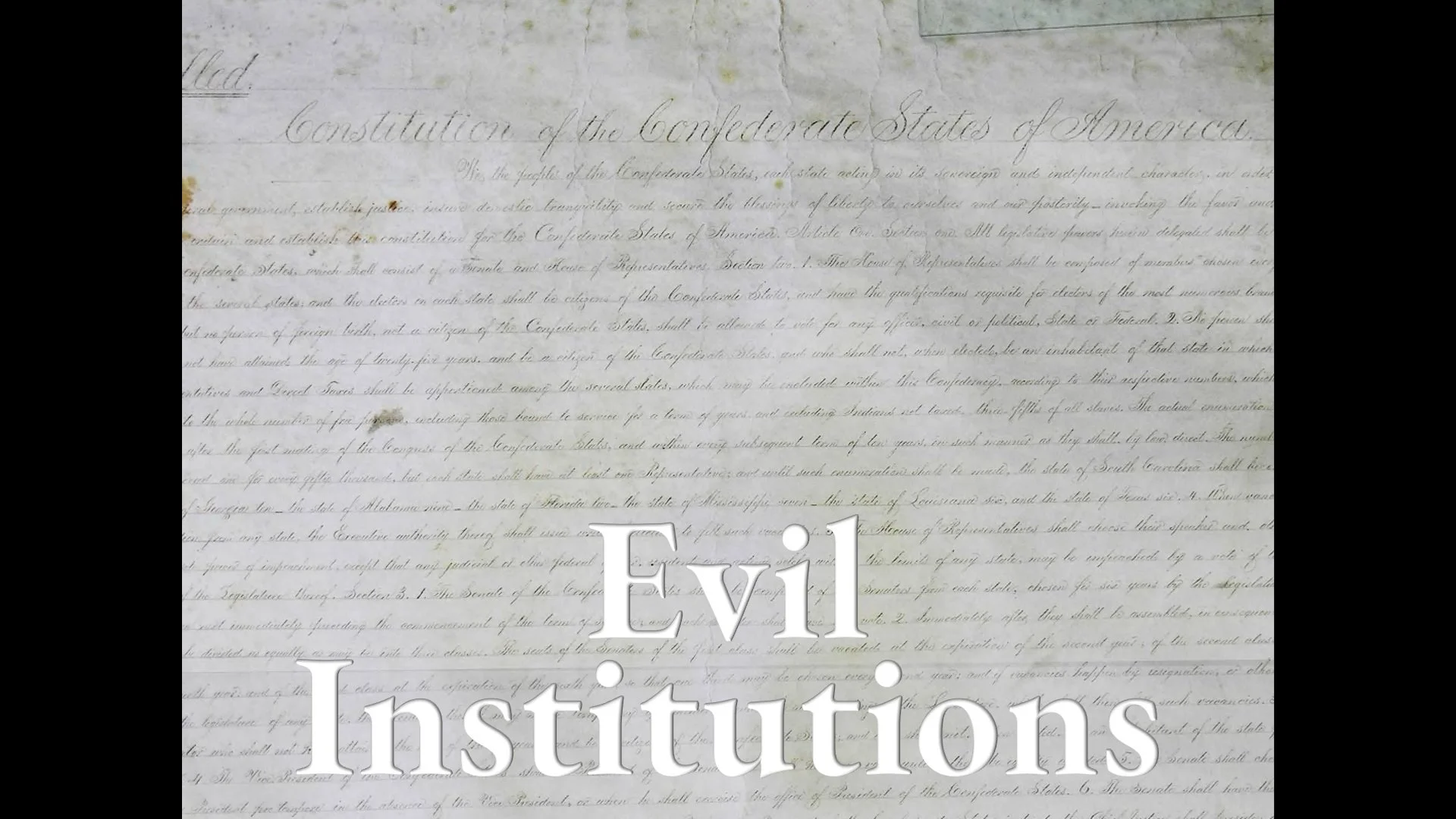
Christian teaching explains the Evil Within as the source of the Evil Between, Evil Laws, and Evil Institutions. Evil and God’s Goodness spotlights God’s call for our partnership in undoing evil, via the theme of divine fire in Scripture. So if you are on a spiritual search, consider browsing through our materials in that sequence.