Photo credit: Basile Morin | CC4.0, Wikimedia Commons.
Introduction
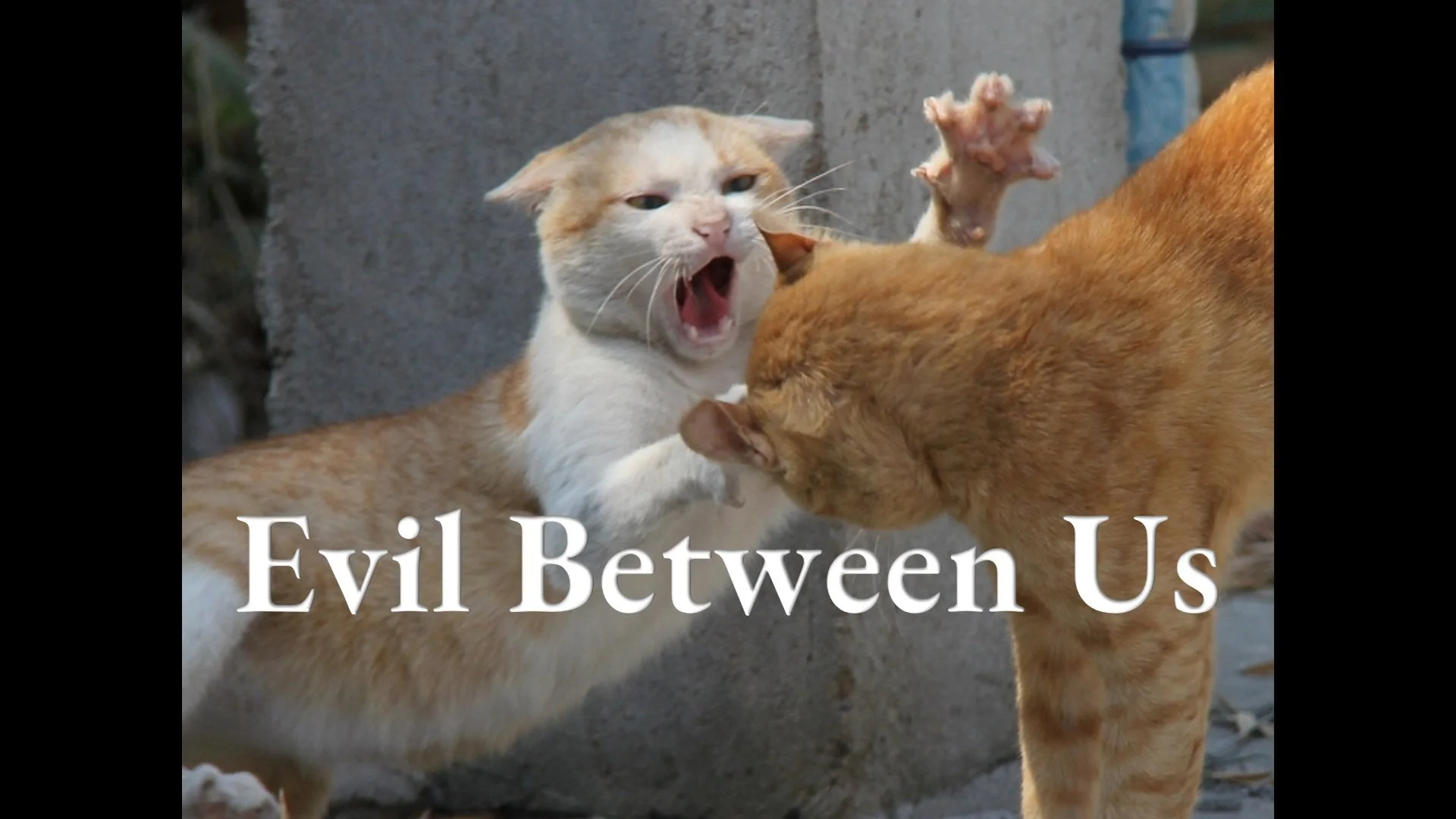
The resources below are examples of evil done by one person to another in an interpersonal way. They are also examples of the need to believe in good and evil as larger moral categories.
For example, two women found out they were dating the same man, who had deceived them. One recalled, “He was super big on the fact that good and evil don’t exist,” she said. “And when things happen, it just is; it’s not bad, it’s not good. Now when I look at that, I’m like, oh my God, he’s trying to justify dating two women at the same time.” Reported by Avery Kleinman, They Learned They Were Dating the Same Man. They Dumped Him, Took a Vacation Together. Washington Post, Sep 30, 2022 (italics ours).
Examples like this illustrate our needs. We need a loving God to tell us what loving boundaries, responsibilities, and responses are. But that’s not all. We need a loving God to heal human nature in a loving way that has interpersonal integrity.
The following clips are from our 2019 Conference: Healing Atonement. The first highlights the importance of stories where good triumphs over evil, and what they reveal about us. The second highlights what Jesus has done with human nature to retell and heal our stories.
Spotlighted Resources
What Made Chadwick Boseman’s T’Challa So Heroic — And His Vision for Wakanda’s Gift (link to YouTube video)
This is part 4 of our series on our video series The Theology of Marvel’s Black Panther. The video looks at T'Challa, who was heroic -- but why? Was it because he honored women? Because he honored tradition and the ancestors? Because he challenged his ancestors? Because he sought to include others and the concerns of others? Because he rejected both the imperialistic and isolationist options for Wakanda? Because he allowed himself to be influenced by Nakia and Killmonger? We look at T'Challa's heroism as rooted in his willingness to suffer for others, to descend again and again, which then invites us to compare T'Challa's arc to Jesus' arc.
To see our four part video series (with one more for Wakanda Forever), see our Arts and Theology page, or our YouTube channel, where we put brief descriptions of each video. It’s a great way to engage people who have an appreciation for the movies. Each video has questions for group discussion and/or personal reflection.

A series of case study comparisons. Why does the Bible begin with monogamy as an ideal, when other traditions begin with polygamy? Why does Genesis 2 indicate that marriage must take priority over family of origin in terms of relational priorities, contrary to every other ancient culture? How did the Bible come to stop kidnapping and promote enormous debt-relief, when the leading cause of people falling into enslavement was debt, then and now? The relational vision expressed by the Bible is unexplainable on naturalistic grounds, and is an argument that a good divine Mind was involved in its composition.
See also the slides to this presentation. Given October 2, 2021 to the Reconstruction class. Explores early Christian emancipation and abolition. While Christians did not eliminate all forms of servitude, since servitude for civic penalties, indebtedness, war captivity, and self-indenture persisted, Christians eventually did eliminate what we know as chattel slavery. The presentation examines Old Testament institution of the Hebrew ebed servant, and the New Testament approach to Greco-Roman modes of servitude. We glance at how colonialism and Trans-Atlantic slavery deformed traditional Christian teaching, mindful that more slavery exists today across the globe than every before, and that in the U.S., indebtedness and incarceration show that we have greatly exaggerated the claims that the U.S. has done better than the Bible on “slavery” and its constellation of challenges. The following video is taken from our 2022 class, Reconstruction: The Deep Roots of Early Christian Theology.
See also the slides to this presentation. Given May 7, 2022 to the 2022 Reconstruction class, accompanying the video. Greek and Roman views of the inferiority of women began with Plato and Aristotle (4th century BC). But Pulcheria was a Christian woman who became Roman augusta in 414 AD and presided over the Third and Fourth Ecumenical Councils. Empress Theodora was very influential in the 500s. And Irene became Emperor of the Romans by 800 AD. How did this happen? This presentation explores vocation as the main category by which Christians empowered women in roles distinct from family, examining the Catacombs of Priscilla, Irenaeus of Lyons, The Acts of Paul and Thecla, the Martyrdom of Perpetua and Felicitas, Montanism and the orthodox reaction to it, Melania the Elder, Paula of Rome, Nino of Georgia, Brigit of Ireland. The presentation also discusses the disagreements between Irenaeus, Tertullian, and Origen about how to interpret women in 1 Corinthians 11. This presentation and the video are the second of the 2022 Reconstruction class topics on the early church. See also our YouTube channel Reconstruction playlist for all the videos.
-
God as the Foundation of Human Rights
Text of a message on Genesis 1 - 11, which was aware of other Ancient Near Eastern and Mediterranean creation stories, and argued against them, as shown by literary analysis. Topics of disagreement include: the value of every human being; the relations of humans and God/gods; the reason for catastrophes like the Flood; the resolution or movement.
Human Dignity: Does Every Individual Matter?
An essay on how science, philosophy, existentialism, other religions, and double-predestination based theologies mean that some human beings do not matter. Only a fully Trinitarian theology with a medical substitutionary atonement can provide an adequate foundation for the dignity of each human person.
The Role of Jesus in Revolution and the Pursuit of Justice
Text of a message giving examples of twentieth century non-violent resistance movements and how they were influenced or led outright by Christians; explores why that is significant in the era of nation-state-building.
Text and slides of a message about the role Christian faith played in history, bringing about hospitals, abolition of slavery, education, science and technology, beauty and the arts.
Images of God in a Broken World
The following three messages were given at a weekend retreat. Images of God in a Broken World is the first; it explains why, in a broken world, we get the impression that if there is a “god,” that “god” is evil, at least partially. Jesus is the Image of God is the second; it is an explanation of Colossians 1:15 - 20, how Jesus is the accurate and perfect image of God despite our broken world, because he healed human nature in himself via his life, death, and resurrection. In Jesus, We Are God’s Image Bearers is the third; it is from Colossians 3:5 - 4:6, about how Jesus renews the image of God in us by his Spirit, to share God's goodness in a broken world.
A 65 minute podcast recording of a message given by Mako to a church called Reality San Francisco, highlighting how secular thought cannot organize four different principles of justice (meritocratic-retributive; distributive; libertarian; restorative). The second half of the presentation also brings Christian restorative justice in to address what Michelle Alexander identified as “The New Jim Crow.” See also ppts. This shorter version also introduces people to the problem of American mass incarceration and the contrast between restorative vs. retributive justice; examines key passages from the Bible, especially Old Testament passages.
The Kingdom You No Longer Want
Text and slides of a message on Luke 13:17 - 21 given at Neighborhood Church of Dorchester on August 13, 2017, the day after the white supremacist march in Charlottesville, Virginia.
Reflections on parenting, faith, and cultures after the terrorist attack on September 11, 2001.
-
If you would like examples of interpersonal evil playing out between people, see the examples below. They are organized in order of publication. Warning: This could make you sad or angry.
Robert Hanley, Donor Apologized to Sister for Seduction of Husband. New York Times, Jan 13, 2005. re: Charles Kushner, who hired a prostitute to seduce his sister’s husband, video recording it, and sending it to her, because he was cooperating in a federal investigation against Kushner
Alice Park, College Students Short on Empathy. Time, May 28, 2010.
Milton Rokeach, The Three Christs of Ypsilanti: A Psychological Study. NYRB | Amazon page, 2011. Originally written in 1964.
“In 1959, at Ypsilanti State Hospital in Michigan, the social psychologist Milton Rokeach brought together three paranoid schizophrenics: Clyde Benson, an elderly farmer and alcoholic; Joseph Cassel, a failed writer who was institutionalized after increasingly violent behavior toward his family; and Leon Gabor, a college dropout and veteran of World War II. The men had one thing in common: each believed himself to be Jesus Christ. Their extraordinary meeting and the two years they spent in one another's company serves as the basis for an investigation into the nature of human identity, belief, and delusion that is poignant, amusing, and at times disturbing. Rokeach draws us into the lives of three troubled and profoundly different men who find themselves "confronted with the ultimate contradiction conceivable for human beings: more than one person claiming the same identity.””
In the 1981 edition of the book, Milton Rokeach added an afterword, "Some Second Thoughts About the Three Christs: Twenty Years Later." In it, he described a lecture he had given shortly after the experiment ended, during which he accidentally said there had been four gods under study rather than three. He came to see this as a Freudian slip—an unconscious acknowledgment that he himself had been operating under a delusion of omnipotence. By 1984, he was ready to apologize. "I really had no right, even in the name of science, to play God and interfere round the clock with their daily lives," he wrote in a new afterword. "While I had failed to cure the three Christs of their delusions, they had succeeded in curing mine—of my God-like delusion that I could change them by omnipotently and omnisciently arranging and rearranging their daily lives." The experiment had been designed to break open the patients' beliefs. Instead, it revealed something about belief itself—its extraordinary resilience, its capacity to absorb contradiction, its role in protecting the self from unbearable realities. And it revealed something about the researcher, too: the ease with which a person convinced of his own righteousness can cause harm while believing he is doing good.
The Three Christs of Ypsilanti has since been adapted into a stage play, two operas, and a 2017 film starring Peter Dinklage. The original Cessna Bird Dog that Leon might have called a machine-operated corpse-Christ now hangs in a museum of a different kind—the museum of psychological history, where we keep the experiments we're no longer sure we should have conducted. What remains most striking about the story is not the failure of the experiment but its unintended success. Rokeach set out to prove that identity delusions could be broken by confrontation with reality. What he proved instead was that our sense of self is far more creative than we imagine—capable of rewriting the world before it will rewrite itself. Three men believed they were Jesus Christ. When forced to confront each other, not one of them concluded he might be wrong. Each simply decided the others were not real. Perhaps that's the most human response of all.”
Martin Spice, Ugly Side of the Human Ego. The Star Online, Aug 5, 2011.
Paul Vale, Zimbabwe: Man Collapses After Ordering Prostitute, Only To Be Met By His Daughter. Huffington Post UK, Nov 30, 2011.
Cary Tennis, My Narcissistic Wife is Ruining My Life. Salon, Jan 25, 2012.
Bianca Bosker, Life as an OKCupid Moderator. Huffington Post, Oct 21, 2012. The ugly and awkward things people do.
Megan Gannon, What Kind of Men Go to Prostitutes? Live Science, Mar 25, 2013. “When the Kinsey report on male sexual behavior was published in 1948, it revealed among its then-scandalous findings that up to 69 percent of American men had paid for sex at some point in their lives.”
Vinita Mehta, Why Are Mean People So Successful? Psychology Today, Oct 9, 2013.
Paul Resnikoff, I’m Charlotte Church. And This Is How Women Are Routinely Demoralized by the Music Industry. Digital Music News, Oct 15, 2013.
Natalie KSL, 20 Signs You Really Hate People. Natalie KSL blog, Oct 20, 2013.
Amanda Marcotte, "Men's Rights" and "Revenge Porn" Sites Seethe With Anger Over Women's Autonomy. Truthout, Dec 18, 2013.
Rebekah Campbell, The Surprisingly Large Cost of Telling Small Lies. New York Times, Mar 11, 2014.
Huffington Post, Two-Thirds of Cheaters Would Have an Affair With a Boss If This Was At Stake. Huffington Post, Mar 26, 2014.
Zachary Fine, My So-Called Opinion. New York Times, Apr 6, 2014.
Julie Suratt, The Terrifyingly Nasty, Backstabbing, and Altogether Miserable World of the Suburban Mom. Boston Magazine, Apr 2014.
Lauren Wolfe, Abuse of Power: Sexualized Violence Against Girls is Going Unchecked in Schools Around the World. Foreign Policy, Apr 14, 2014.
Eric Jaffe, Eight Depressing Bike Theft Statistics Show Just How Bad the Problem Is. The Atlantic Cities, Apr 16, 2014.
Taryn Hillin, 9 Breakup Texts That Just Might Test Your Faith in Humanity. Huffington Post, Apr 16, 2014.
Danielle Kurtzleben, People Who Think They're Attractive Tend to be More Comfortable With Economic Inequality. Vox, Apr 17, 2014.
David Moye, Sandy Hook 'Truther' Tells Victim's Mother Her Daughter Never Existed. Huffington Post, May 14, 2014.
Anneli Rufus, Low Self-Esteem is Good for You! We've Been Too Successful at Making People Feel Good. Salon, May 24, 2014.
Danika Fears, Indian Women Invent Anti-Rape Jeans to Battle Attack Epidemic. New York Post, Jun 26, 2014.
Shaunti Feldhahn, Dancing Into Disaster. Patheos blog, Jul 7, 2014.
Nuala Calvi, I Was Sold By Mum and Dad To Make Images of Child Abuse. The Guardian, Oct 4, 2013.
John Tierney, A Cold War Fought by Women. New York Times, Nov 18, 2013.
A Moore, 8 Successful and Aspiring Black Communities Destroyed by White Neighbors. Atlanta Blackstar, Dec 4, 2013.
Amanda Hess, Why Women Aren't Welcome on the Internet. Pacific Standard, Jan 6, 2014.
Michelle Goldberg, Feminism's Toxic Twitter Wars. The Nation, Jan 29, 2014.
Mark Molloy, Awkward: Italian Man Hires Escort … Turn Out to Be Son’s Girlfriend. Metro UK, Mar 7, 2014.
Amanda Hess, The Pick-Up Artist Community’s Predictable, Horrible Response to a Mass Murder. Slate, May 24, 2014.
Patrick May and Heather Somerville, Use of Illicit Drugs Becomes Part of Silicon Valley's Work Culture. San Jose Mercury News, Jul 25, 2014.
James Estrin, A Graphic Photo Spurs Reflection: Indian Women Raped and Hanged. New York Times, Jul 24, 2014.
Scott Alexander, Meditations on Moloch. Slate Star Codex, Jul 30, 2014. “Moloch is introduced as the answer to a question – C. S. Lewis’ question in Hierarchy Of Philosophers – what does it? Earth could be fair, and all men glad and wise. Instead we have prisons, smokestacks, asylums. What sphinx of cement and aluminum breaks open their skulls and eats up their imagination? And Ginsberg answers: Moloch does it. There’s a passage in the Principia Discordia where Malaclypse complains to the Goddess about the evils of human society. “Everyone is hurting each other, the planet is rampant with injustices, whole societies plunder groups of their own people, mothers imprison sons, children perish while brothers war.””
Ruzwana Bashir, The Untold Story of How a Culture of Shame Perpetuates Abuse. I Know, I Was a Victim. The Guardian, Aug 29, 2014.
Ivan T., Allegory of the Long Spoons. Ivan T., Sep 1, 2014. a short video
Preston Ni, 10 Signs That You're in a Relationship with a Narcissist. Psychology Today, Sep 14, 2014.
Liam O'Ceallaigh, When You Kill Ten Million Africans You Aren't Called 'Hitler'. Films for Action, Sep 15, 2014.
Robert Emmet Meagher, Killing from the Inside Out: Moral Injury and Just War. Amazon page, Sep 15, 2014.
Renee Jacques, 'Texts From Your Ex' Perfectly Maps Out The Awkward Phases Of Your Breakup. Huffington Post, Oct 3, 2014.
Brittany Wong, If You've Ever Received An Unwanted Sext, This Is For You. Huffington Post, Oct 3, 2014.
Melissa Dahl, Emotional Abuse Can Be As Damaging As Sexual Abuse. New Yorker Magazine, Oct 8, 2014.
ABC News, California Mother Catches Bad Nanny on Camera. ABC News, Oct 15, 2014.
ABC News, Undercover for Alleged Underage Prostitution Raid at Colombia Villa. ABC News, Oct 15, 2014.
Rheana Murray, The Scary Ways Online Dating Can Go Wrong. ABC News, Oct 20, 2014.
Whitney Fleming, 5 BS Excuses Parents Make for Mean Girls. Huffington Post, Oct 23, 2014.
Primo Levi, Heartbreaking, Heroic Answers to the Most Common Questions He Was Asked About "Survival in Auschwitz". New Republic, Oct 23, 2014.
Rebecca Leber, For Women, the Internet Can Be a Scary Place. New Republic, Oct 24, 2014.
Rafia Zakaria, Polygamy and Child Wives: Women's Rights Are Going in the Wrong Direction in Pakistan. New Republic, Oct 24, 2014.
Nina Bahadur, 'Bye Felipe' Beautifully Calls Out Online Dating's Worst Guys. Huffington Post, Oct 30, 2014.
Tara Fowler, Woman Finds Husband 9 Years After He Disappeared - Married to Another Woman. People, Nov 10, 2014.
Brittany Wong, These 13 Stories About Discovering an Affair Are Heartbreaking. Huffington Post, Nov 24, 2014.
Nick Baumann, Jenna McLaughlin, Patrick Caldwell, & Mariah Blake, "Rectal Feeding," Threats to Children, and More: 16 Awful Abuses From the CIA Torture Report. Mother Jones, Dec 9, 2014.
Michael Brendan Dougherty, The Rape Culture Everyone Ignores. The Week, Dec 9, 2014.
Lindy West, What Happened When I Confronted My Cruellest Troll. The Guardian, Feb 2, 2015.
Charlotte Laite, I Was the Maid of Honor For a Girl I Bullied Mercilessly. Time, Feb 2, 2015.
Mary Stanton, From Selma to Sorrow. Southern Studies website, Mar 9, 2015. about the only white woman martyred whose name is on the Civil Rights Memorial in Montgomery, AL
Chris Mooney, The Science of Protecting People's Feelings: Why We Pretend All Opinions Are Equal. Washington Post, Mar 10, 2015.
Monica Lewinsky, The Price of Shame. TED talk, Mar 20, 2015. Re: cyber-bullying
Moment of Truth, Girl Ruins Her Marriage on Game Show. video, Mar 30, 2015.
Dr. Phil, How a Social Media Post Led a Teen Into Sex Trafficking. Huffington Post, Apr 10, 2015.
NBC News, Florida Sheriff: Beach Gang Rape Video is Disgusting, Sickening. NBC News, Apr 12, 2015.
Martha C. White, Airplane Seat Swapping Turns Rough and Tumble. New York Times, Apr 13, 2015.
Laurence Weinbaum, Confronting Chilling Truths About Poland's Wartime History. Washington Post, Apr 21, 2015.
Ira Glass, Same Bed, Different Dreams. NPR, May 5, 2015. Re: feuding airlines stewardesses
Donald Miller, How Do So Many Good People Get Away With Bad Things? Storyline blog, May 11, 2015.
Maureen Callahan, Inside the Bizarre Life of an Upper East Side Housewife. New York Post, May 24, 2015.
Yvonne Abraham, Internet Has Driven Sex Industry Deeper Into Shadows. Boston Globe, Jul 15, 2015.
Krebs On Security, Online Cheating Site AshleyMadison Hacked. Krebs On Security blog, Jul 15, 2015.
Maya Rhodan, Study Finds That Men Who Attack Women Online Are, Literally, Losers. Time, Jul 21, 2015.
Heidi Priebe, Why Good People Ghost: The Rise Of A Dishonest Dating Culture. Thought Catalog, Aug 12, 2015.
Ariana Eunjung Cha, In Graphic Detail, Medical Journal Describes 'Heavy Overtones' of Sexual Assault in Operating Room. Washington Post, Aug 18, 2015.
Jose Pagliery, The Ashley-Madison Hack Ruined My Life. CNN, Aug 21, 2015.
Tyler Kingkade, We Know One Way To Stop Sexual Assault, But Students Aren’t Doing It. Huffington Post, Sep 23, 2015. on bystanders who do nothing
Yanan Wang, A Female Violinist Exposes 10 Years of Lewd, Fetishizing Messages from Men Online. Washington Post, Oct 21, 2015.
Emily V. Gordon, Why Women Compete With Each Other. New York Times, Oct 31, 2015.
Glynn Custred, Turning Anthropology from Science into Political Activism. John William Pope Center, Feb 17, 2016.
Shahida Arabi, The Secret Language of Narcissists: How Abusers Manipulate their Victims. Elephant Journal, Mar 9, 2016.
Annie Holmquist, Bonhoeffer on the ‘Stupidity’ That Led to Hitler’s Rise. Intellectual Takeout, Apr 8, 2016. “Americans today might do well to heed Bonhoeffer’s warning.”
Gay Talese, The Voyeur's Motel. New Yorker, Apr 11, 2016. A man who bought a motel and filmed guests
Diane Langberg, Narcissism and the Systems It Breeds. Forum of Christian Leaders Online, May 5, 2016.
Claudia Lauer, Arkansas Judge Resigns After Nude Photos Of Defendants Found On Computer. Talking Points Memo, May 10, 2016.
Michael Barbaro and Megan Twohey, Crossing the Line: How Donald Trump Behaved with Women in Private. New York Times, May 14, 2016.
Natasha Lennard and Adrian Parr, Our Crime Against the Planet, and Ourselves. New York Times, May 18, 2016.
Hilary Hanson, How 3 Badass Women Stopped an Alleged Rape Attempt. Huffington Post, May 28, 2016.
Adam Grant, Unless You're Oprah, 'Be Yourself' is Terrible Advice. New York Times, Jun 4, 2016.
Sean Illing, Persuasive Proof That America Is Full of Racist and Selfish People. Vox, Jun 13, 2017.
Shahida Arabi, 20 Diversion Tactics Highly Manipulative Narcissists, Sociopaths and Psychopaths Use to Silence You. Thought Catalog, Jun 30, 2016.
Brad Evans and Gayatri Chakravorty Spivak, When Law Is Not Justice. New York Times, Jul 13, 2016.
Paul Barnwell, Students' Broken Moral Compasses. The Atlantic, Jul 25, 2016.
Eve Tushnet, There is No Cure for Vice. The American Conservative, Jul 29, 2016. Media portrayals of anti-heroes
Neil Swidey, These Wealthy Neighbors Have Been At War for Nearly 25 Years. Boston Globe, Aug 10, 2016.
Nora Caplan-Bricker, Flight Risk: Airlines Are Surprisingly Ill-Equipped to Handle Accusations of Sexual Assault on Their Planes. Slate, Aug 31, 2016.
Gabriel Sherman, The Revenge of Roger’s Angels. New York Magazine, Sep 2, 2016.
Brad Evans and Simona Forti, Who Is ‘Evil,’ and Who Is the Victim? New York Times, Sep 16, 2016.
Kayleigh Roberts, The Psychology of Victim-Blaming. The Atlantic, Oct 5, 2016. people want to believe the world is just, and bad things won't happen to them
Lauren Varela, Brooke Dickens, Alika Keene, Haley Washburn, Emily Mosbacher, A Letter from the Harvard Women’s Soccer Team. New York Times, Nov 7, 2016.
Sara Peters, Ex- Neo Nazis And Skinheads Share The Moment They Realized They Were Horribly Wrong. Knowable, Nov 16, 2016.
Alan Mozes, Sexism Could Harm Men's Health: Study. US News & World Report, Nov 21, 2016.
Rick Noack, 27% of Europeans Think Rape May Be Acceptable in Some Circumstances. Washington Post, Nov 29, 2016.
PBS News Hour, How a Georgia County Became a Site of Racial Cleansing. PBS, Jan 16, 2017. “In 1912, news of a violent sexual assault enraged the residents of Georgia's Forsyth County and led to a lynching and the execution of two African American teens, as well as a campaign of terror to drive out the entire black community. Special correspondent Duarte Geraldino talks with Patrick Phillips, author of “Blood at the Root,” about healing from a history of racial cleansing.”
Stephanie Sarkis, Gaslighting: Know It and Identify It to Protect Yourself. Psychology Today, Jan 22, 2017.
Power of Positivity, 7 Signs Someone Is Trying to Psychologically Manipulate You. Power of Positivity.
Mallory Ortberg, The Simplex Truth. Slate, Mar 6, 2017. a woman lied about a herpes test to get her boyfriend to confess infidelity
Rod Dreher, Everyone Knows, But No One Will Say. The American Conservative, May 10, 2017.
Yudhijit Bhattacharjee, Why We Lie: The Science Behind Our Deceptive Ways. National Geographic, Jun 2017.
Conor Friedersdorf, The Highest Form of Disagreement. The Atlantic, Jun 26, 2017. Illustrates laziness and coalition building rather than real dialogue.
Jerry Useem, Power Causes Brain Damage. The Atlantic, Jul/Aug 2017. How powerful people lose mental capacities because they insulate themselves from disagreement.
Paul Bloom, The Root of All Cruelty? The New Yorker, Nov 20, 2017. Perpetrators of violence, we’re told, dehumanize their victims. The truth is worse.
Olga Khazan, Why Do Women Bully Each Other at Work? The Atlantic, Sep 2017.
Jeff Maysh, A Catfishing Story With a Happy Ending. The Atlantic, Oct 19, 2017.
Esther Perel, Why Happy People Cheat: A Good Marriage Is No Guarantee Against Infidelity. The Atlantic, Oct 2017.
Sabrina Siddiqui, Sessions Says He Knew of Ex-Trump Aide's Russia Ties, Despite Testimony. The Guardian, Nov 14, 2017.
Mark Townsend, Harvey Weinstein Had Secret Hitlist of Names to Quash Scandal. The Guardian, Nov 18, 2017.
Sean Illing, Why Humans Are Cruel. Vox, Jan 16, 2018.
Jon Schwarz, Washington Breaks Out the "Just Following Orders" Nazi Defense for CIA Director-Designate Gina Haspel. The Intercept, Mar 15, 2018.
Julia Carrie Wong, YouTube Shooting: Apparent Motive Highlights Tension with Video ‘Creators’. The Guardian, Apr 4, 2018. “Shooting suspect appears to be a frustrated YouTuber who claimed the site censored her views through its ‘monetization’ policies”
David Moskowitz, Who's Afraid of the Big Bad Wolf Scientist? New York Times, Jul 5, 2018. shows how human machismo and retributive impulses to kill alpha wolves wind up making wolf predation worse
Troy Wolverton, The Memoir by Steve Jobs' Daughter Makes Clear He Was a Truly Rotten Person Whose Bad Behavior Was Repeatedly Enabled by Those Around Him. Business Insider, Aug 26, 2018.
R. Brian Ferguson, War Is Not Part of Human Nature. Scientific American, Sep 1, 2018. Ferguson argues that collective killing depends on cultural and political conditions of large societies that emerged 12,000 years ago. Intriguing, but might diminish the significance of individual murders or homicides.
Olga Khazan, Why Men Sexually Harass Women. The Atlantic, Oct 5, 2018. Khazan makes an argument from culture.
George Scialabba, Did Capital Punishment Create Morality? The New Yorker, Feb 13, 2019. "A new book argues that violence—specifically, the killing of alpha males—laid the foundation for virtue" - this is a review of Richard Wrangham, The Goodness Paradox: The Strange Relationship Between Virtue and Violence in Human Evolution. Amazon page, Jan 29, 2019., which is a variation on Nietzsche
Valerie Strauss, He’s Known in Silicon Valley for ‘Ethical Investing’ - Read What He’s Charged With Doing in the College Admissions Scandal. Washington Post, Mar 13, 2019.
Vicky Baker, The Preachers Getting Rich from Poor Americans. BBC, May 29, 2019.
Hannah Knowles, A Father Jumped in Front of a Train Holding His 5-year-old. Commuters Pulled Her Out Alive.Washington Post, Sep 24, 2019. Note, “Someone stole his bag as he helped the girl to safety, he said.”
Associated Press, Arrested Japanese Stalker Used Pupil Image Reflections. Associated Press, Oct 11, 2019. to find out where she lived
Sloane Ryan, I’m a 37-Year-Old Mom & I Spent Seven Days Online as an 11-Year-Old Girl. Here’s What I Learned. Medium, Dec 13, 2019.
Amy Grappell, Two Couples Tried a Group Marriage. It Didn’t Work. The Atlantic, Feb 13, 2020. “In the end, ego trumped idealism, and the relationships unraveled.”
Filup Molina and Tommy Bechtold, The Mandalorian Season 2, Episode 7 Reaction! Chapter 15. The New Rockstars, Dec 11, 2020. explores the question, “Are we sure we’re the good guys?” The Believer, the title of this episode, is the character Mayfield, who comes to believe that the Empire is not the same as the Republic, that not all forms of order are the same, which is what he believed before. Filup Molina and Tommy Bechtold do a great job exploring color, costume, etc. in the Star Wars universe to substantiate their point. The Believer is also Mando Din Djarin, who is coming to believe in another variation of the Way of the Mandalore, and the way of the Force. See also James Hunt, Who Is The Believer? The Mandalorian Season 2, Episode 7 Title Explained. Screen Rant, Dec 11, 2020. “The Mandalorian season 2, episode 7 is called "Chapter 15: The Believer," and the title applies to several characters in the installment.” This points to the personal investment we have to believe we are on the side of “the good guys” in the end. Something in us wants to believe it. That something, in Christian theology, is the image of God.
Matt Petrillo, Northeast Philadelphia Woman Admits To Posing As Fake Immigration Attorney, Scamming Immigrants Out Of $11,000. CBS Philly, Jan 21, 2020.
Sarah Viren, The Accusations Were Lies. But Could We Prove It? New York Times Magazine, Mar 18, 2020. “When the university told my wife about the sexual-harassment complaints against her, we knew they weren’t true. We had no idea how strange the truth really was.”
Charlie Tyson, Why Are We So Spiteful?. The Atlantic, May 13, 2021. “Our culture is pettily vindictive in part because it is unequal. But we cannot punish our way to a more just society.”
Ryan Arey, Loki: Tragedy of a Hero Born to Lose, Over and Over and Over and Over | Marvel Character Breakdown. Screen Crush, Jun 4, 2021. Ryan Arey explores Loki’s character arc as trapped in a loop, because of self-protection. Only through his relationship with Thor, his brother, was he able to reach acceptance and break the loop. This is a helpful example of how in Scripture, sin sets a person into a loop, from which we need to break free.
Sprouts, Bonhoeffer‘s Theory of Stupidity. Sprouts, Oct 15, 2021. features nationalist and ethno-fascist jingoism
A. Powlowski, When a Medical Crisis Strikes, Divorce Can Follow — Especially if the Wife is Sick. Today, Apr 14, 2022. “But a marriage falling apart is far more common when the wife is the patient, researchers have found. A woman is six times more likely to be separated or divorced soon after a diagnosis of cancer or multiple sclerosis than if a man in the relationship is the patient, researchers at the Seattle Cancer Care Alliance reported in the journal Cancer.”
Ted Van Green, Growing Share of Americans Say Their Side in Politics Has Been Losing More Often Than Winning. Pew Research Trust, Oct 3, 2022.
Jeffrey Kaplan, Peter Singer -- Ordinary People Are Evil. Jeffrey Kaplan, Jan 20, 2023.
Paula Span, For Older Americans, the Pandemic Is Not Over. New York Times, Feb 11, 2023. Seniors are increasingly left to protect themselves as the rest of the country abandons precautions: “Americans do not agree about the duty to protect others.
Lise LeBlanc, 12 Favorite Phrases of Female Covert Narcissists. Lise LeBlanc, Mar 20, 2023.
Cold Fusion, How This 31 Year Old Woman Scammed JP Morgan. Cold Fusion, May 12, 2023. “In this episode, we take a look at the story of Charlie Javice. A young entrepreneur who lied her way into a deal with the largest bank in America, JP Morgan. The bank quickly found out about the fraud and she could now be facing 100 years in jail.”
Jake Tapper, Tapper Compares Cassidy Hutchinson Leaving Trump Administration to 'Leaving a Cult'. CNN, Oct 2, 2023. Cassidy Hutchinson, at the end of this interview, talks about accepting complicity and narrates a conversation in which she is challenged by the framework of “human becoming.” Very important.
Tim Miller, Why We Did It: A Travelogue from the Republican Road to Hell. Harper | Amazon page, June 2022. Miller and others used the word “evil” -- that is not a projection or moral judgment from outside. “From ruminations on the mental jujitsu that allowed him as a gay man to justify becoming a hitman for homophobes, to astonishingly raw interviews with former colleagues who jumped on the Trump Train, Miller diagrams the flattering and delusional stories GOP operatives tell themselves so they can sleep at night. With a humorous touch he reveals Reince Priebus' neediness, Sean Spicer's desperation, Elise Stefanik and Chris Christie’s raw ambition, and his close friends’ submission to a MAGA psychosis.” See interview by Walter Isaacson, Why We Did It: Former RNC Spokesman on GOP’s Descent Into Trumpism. Amanpour and Company, July 12, 2022. As more is revealed about the inner workings of Trump’s White House, our next guest lifts the lid on the moral divisions within the Republican Party. In his new book, "Why We Did It," Tim Miller details his involvement with the GOP and how political staffers were able to justify the new brand of politics, as he explains to Walter Isaacson.
Sam Seder and Emma Vigeland, Krystal Ball Shreds RFK's Israel Propaganda. The Majority Report, Dec 20, 2023. RFK Jr.’s proclivity towards conspiratorial thinking is influencing his perception of the Hamas-Israel war, and his process of moral reasoning. This is evidence about the danger of self-deception: Self-deception will lead to the attempt to deceive others.
Richard Beck, The Incoherence of Post-Christian Morality. Experimental Theology | Substack, Mar 19, 2024. On the lack of moral absolutes and metanarrative, yet moralism and judgmentalism especially from “the progressive left.”
Bill Adair, Beyond the Big Lie: The Epidemic of Political Lying, Why Republicans Do It More, and How It Could Burn Down Our Democracy. Atria Books | Amazon page, Oct 2024. See interview with Tim Miller, How the Lying Got Out of Control in Politics. The Bulwark, Oct 22, 2024. Bill Adair, founder of Politifact, discusses his new book, and why Republicans lie more than Democrats. Tim explains why he admitted in 2012 for Mitt Romney's campaign, and why truth will always prevail. Bill Adair says the Republican Party was influenced by Newt Gingrich, who started an “everything goes” politics.
Jeff Jacoby, For Many Leading Conservatives, ‘Never Trump’ Didn’t Mean Never. Boston Globe, Nov 10, 2024. In the end, abandoning their principles was good for business.
Angelique Chrisafis, ‘A Rapist Can Be in the Family’: How Dominique Pelicot Became One of the Worst Sexual Predators in History. The Guardian UK, Dec 11, 2024. How he might have been caught earlier. How men cooperated.
Bandy X. Lee, Evil. Bandy X. Lee | Substack, Jan 16, 2025.
Thom Hartmann titled his recent newsletter: The Fatal Flaw: Believing You Can Negotiate with Evil Without Becoming Its Victim. Evil doesn’t negotiate—it devours.
He states what my colleagues and I have tried to warn, that: “There’s no compromising with evil…. Evil, by its very nature, will always win in such situations, even when it appears to have compromised or cooperated.”
Psychiatrists, especially forensic psychiatrists, add another dimension to the concept of “evil”. The addition of a certain pathology, or predisposition to evil, makes it much more powerful, devious, and all-engulfing beyond what one can achieve through rational decision making. As long as one knows the difference between right and wrong, evil is a choice, which is why in legal contexts the most debilitating condition known to psychiatry—psychopathy or sociopathy—does not make one eligible to be, “not guilty by reason of insanity.” Mental unfitness is a different matter; anyone with psychopathy is by definition unfit for any task or office that deals with people…
Hartmann concludes, “But this incoming administration is being run by a man with 34 felony convictions, a credible allegation of rape, who himself cheated on each of his three wives just like [his choice for Secretary of Defense, Pete] Hegseth allegedly did. Evil, it turns out, flows from the top down. And the only way to counter it now is to cultivate, from bottom up, our collective Soul.
Aaron Bastani, Silicon Valley Insider Exposes Cult-Like AI Companies | Aaron Bastani Meets Karen Hao. Novara Media, Jun 29, 2025. From the 1:11:49 mark. What is the impact on people who work as content moderators of AI and social media? Author Karen Hao says they had to categorize content and degrees of: hate speech, harassment, violent content, sexual content. The work destroyed their lives. It left them with PTSD, completely changed their personalities, and damaged their families and communities.
Kyle Kulinski, Trump’s Desperate Lies Are Completely Out Of Control. The Kyle Kulinski Show, October 27, 2025. Kyle demonstrates recent examples of Trump’s lies. Both external and internal guardrails have fallen.
Alan E. Godwin, Ties That Blind: Unraveling Stories That Keep Us in the Dark. Outskirts Press, Oct 2025. On collective mass deception, peer pressure, etc.
In Ties That Blind, Psychologist Alan Godwin attempts to answer such questions by looking at the nature of collective deception. There's a difference between what's true and a story that's false but sounds true. The propagation of a false story begins by telling people what they want to hear and then appealing to their coalitional instincts-the natural human desires to congregate with like-minded others. Their attachment needs pull them into a story where truth becomes less valued than the warm embrace of crowd inclusion. Barricaded inside what Dr. Godwin calls a "story-based fortress," they come to accept a distorted reality which they now call "truth" and label all fortress outsiders as liars or fools. Worse still, they become propagators of the falseness themselves.
Dr. Godwin tells two emotionally resonant stories.
The first is that of an actual, real-life individual who was deceived in a close, personal relationship. She grew up in a train-wreck of a family that was admired by others, but life inside the family was vastly different from what those outside it perceived. While the first story is set in the context of trauma, abuse and narcissistic parenting, family dynamics are not the central focus. Rather, it's how manipulation occurs between individuals, be they relatives, spouses, friends, co-workers, employers, teachers, or even preachers. The principles spelled out can be applied to any up-close relational situation where manipulation occurs.
The second narrative is Dr. Godwin's own story of growing up in the collectively deceptive world of Jim Crow Mississippi. There, he was gaslighted, not by a power-hungry demagogue, but by a demagogic system in which anyone refusing to accept the green-sky fiction of racial hierarchy could suffer banishment, injury or even death. He became so complicit that he normalized the abnormal, defended the indefensible, and justified that which can't be justified. This second story exemplifies how we can become swirled up in the delusion of a crowd.
Though there are certainly differences between the two narratives, the processes of being blinded by a false story and eventually unraveling the blinders are essentially the same. Understanding the first story helps explain the second. Through the exploitation of vulnerabilities, people are unwittingly sucked into dramas that look and sound like real life but leave drama participants with distorted realities and later wondering how they could've been so blind.
Dr. Godwin contends that blinding need not be permanent. People can come to their senses, change, and eventually proclaim along with John Newton-former slave ship captain and later abolitionist-that they can now see having once been blind. There is such a thing as acquiring sight we once didn't have.
Collective deception has happened in the past, is happening now, and will keep happening in the future. How, why, and what to do about it are the questions this book attempts to answer. It is hoped that readers of Ties That Blind might acquire the courage to become lone standouts arguing for blueness.
Matthew Shaer, He Tried to Protect His Son From Bullies. He Didn’t Know How Far They Would Go. New York Times, Dec 15, 2025. “After his son was repeatedly attacked, Rick Kuehner reached out to his suburban school, to the police and to other parents. The violence only got worse.
Greg Sargent, Inside Stephen Miller’s Dark Plot to Build a MAGA Terror State. The New Republic, Dec 15, 2025. “He is descended from Russian Jews—you know, the kind of people who were once denounced as alien and unassimilable. Today, his project is to unleash government persecution of those he deems alien and unassimilable. How far will Miller’s sadistic designs go?”
Monica Potts, Who Is JD Vance? (No, Seriously. Who Is He?). The New Republic, Dec 25, 2025. “The vice president is a cynical shapeshifter, willing to say anything—and be anybody—to become the most powerful person in America.” Including about his wife and kids.
Greg Sargent, Transcript: Trump’s Agents Kill Citizen—Then Damning New Info Emerges. The New Republic, Jan 8, 2025. “This administration treats brazen lying as kind of an assertion of power in itself”
Will Saletan, The Worst Interview of the Trump Administration So Far. The Bulwark, Jan 19, 2026. Treasury Secretary Scott Bessent tried to justify Trump’s threat to take Greenland.
Valerie Jacobsen, Relativism. Facebook, Jan 25, 2026.
“Do you remember? Midwestern anti-lockdown protests in 2020 were recorded in this photo and others like it, of men showing up at state capitals and other public locations, in full military-style tactical gear, with very big guns and lots of ammo, peacefully protesting the government.
Do you remember what the federal government did? It left them alone. Do you remember what state governments mostly did? They left them alone. Do you remember any government official claiming that *because those men were armed*, they were there to kill people? Do you remember any government official treating them like they were there to kill people? No. The protestors stood around for awhile, and they went home alive.
But that was 2020, an eon ago. A lot of propaganda and a lot of manipulation have effectively changed the minds of the same people who supported and even participated in those *armed protests*. And they were "armed protests" in the sense that 1) people were armed, and 2) people were protesting.
Alex Pretti joined a very small peaceful protest, carrying a single concealed weapon. Alex didn't point his weapon at anyone. He didn't brandish it. He didn't display it. He didn't even touch it.”
Drew Harwell, He Made a Fake ICE Deportation Tip Line. Then a Kindergarten Teacher Called. Washington Post, Feb 20, 2026. “A Nashville comedian’s deportation hotline, set up as a joke, has gone viral among viewers who say it shows the “banality of evil personified.””
Bart D. Ehrman, Love Thy Stranger: How the Teachings of Jesus Transformed the Moral Conscience of the West. Simon & Schuster | Amazon page, Mar 24, 2026. See discussion by C.J. Cornwaithe and Bart D. Ehrman, Jesus Had 1 Core Teaching; Christianity Ignored It. C.J. Cornwaithe and Bart D. Ehrman, Apr 17, 2026. Ehrman does grant that Jesus drew on Jewish law, especially Leviticus 19:18, and expanded its scope.
Matthew Goldstein and Sharon Otterman, Meet the Woman Who Stands to Inherit Much of Jeffrey Epstein’s Fortune. New York Times, Jul 26, 2026. “Karyna Shuliak, 37, is a complicated and unusual figure in the disgraced financier’s world who has been trying to blend into obscurity since his death.”
Max, The Treasury Secretary Who Can't Get It Right. UNFTR, Sep 9, 2026. “Scott Bessent can’t do anything right. He just announced a paltry bond buyback that fell flat with the market responding by pushing rates higher. Bessent also proclaimed that he is “the house” and that people shouldn’t bet against him because he has inside information about what the Bank of Japan is going to do. Interesting. The guy doesn’t know what our central bank is going to do but he has the inside track on the BOJ? The market there is also telling him to get lost. And after he said he would cripple the Iranian regime in a matter of weeks or months with sanctions, the Iranians have been striking back and have now declared that they’re going to cripple our economy. Bessent is going to go down in history as the worst Treasury Secretary we’ve ever had.”
-
These are the images used in artistic physical displays. They are survey questions and conversation starters that are topically and thematically organized. They demonstrate how Jesus is relevant to each topic or theme. You can also just view the images on your device. If you would like, see all our Conversation Stations; below are the ones that relate to the topic of Evil Between Us.
Whose Justice? (and instructions and Christian Restorative Justice Study Guide)
Whose Justice? for Harvard Law School
What Can We Do About Evil? (and instructions and conversation tree) and smaller version and brochure version
Que Podemos Hacer Sobre La Maldad? for the Asociacion Dominicana de Estudiantes Evangelico, 2014
Is a Good Friend Hard to Find? (and instructions and conversation tree)
What Story Do You Live In? (and associated message)
Does the Good Outweigh the Bad? (and instructions)
Race What's the Problem? (and instructions) and brochure version
Find Your Heart's Desire? (and instructions and theological essay)
Evil: Topics:
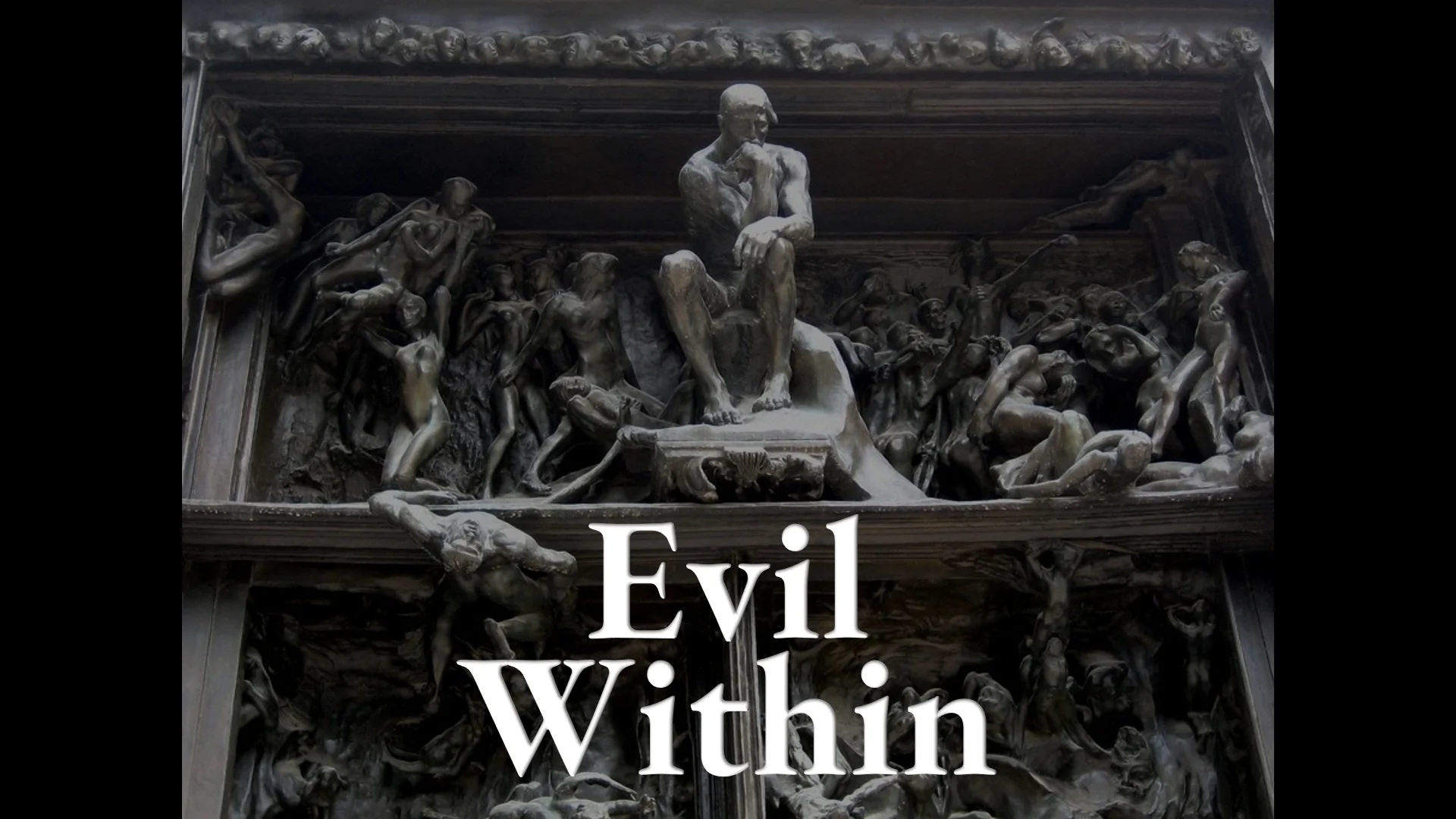
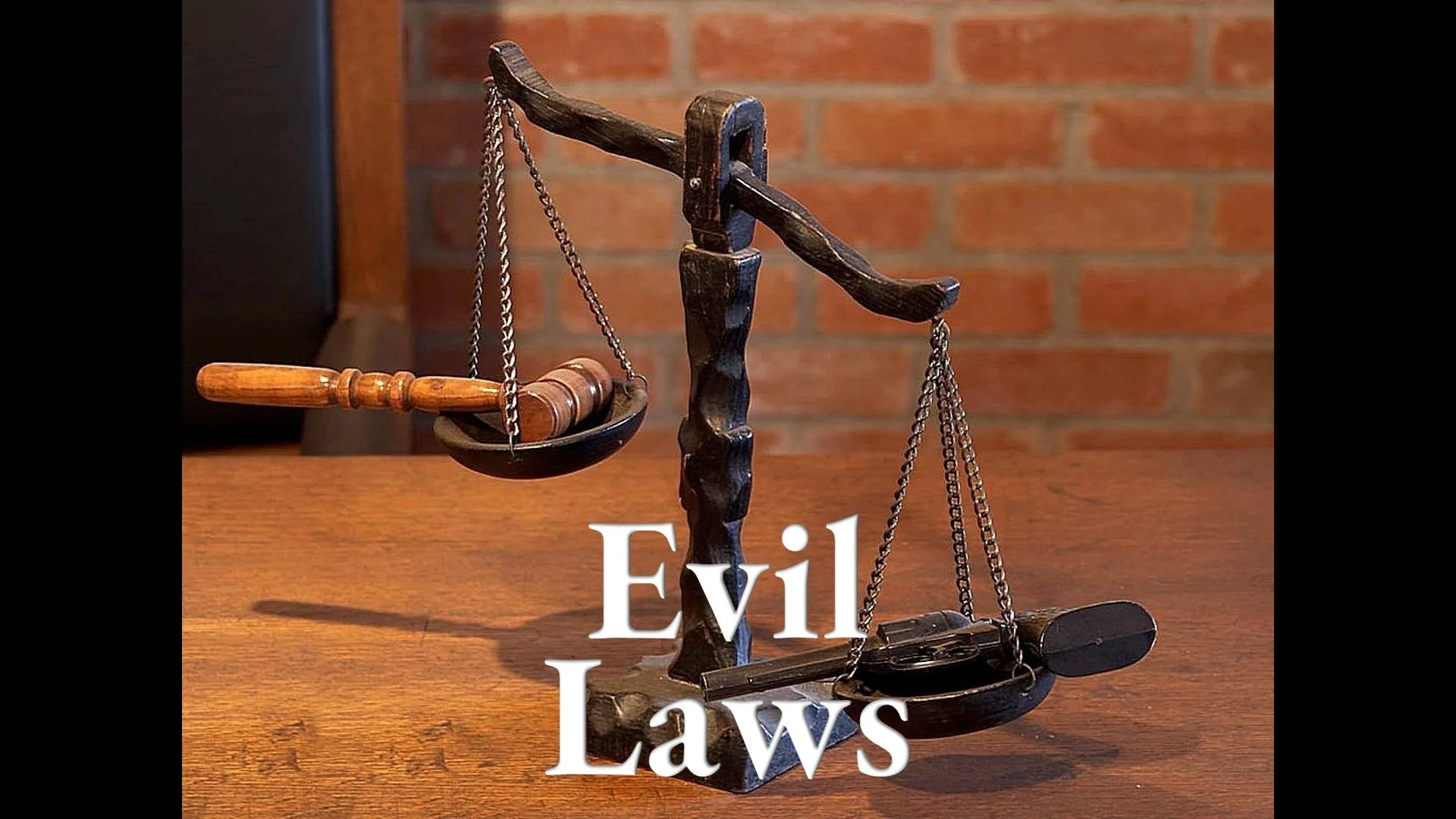
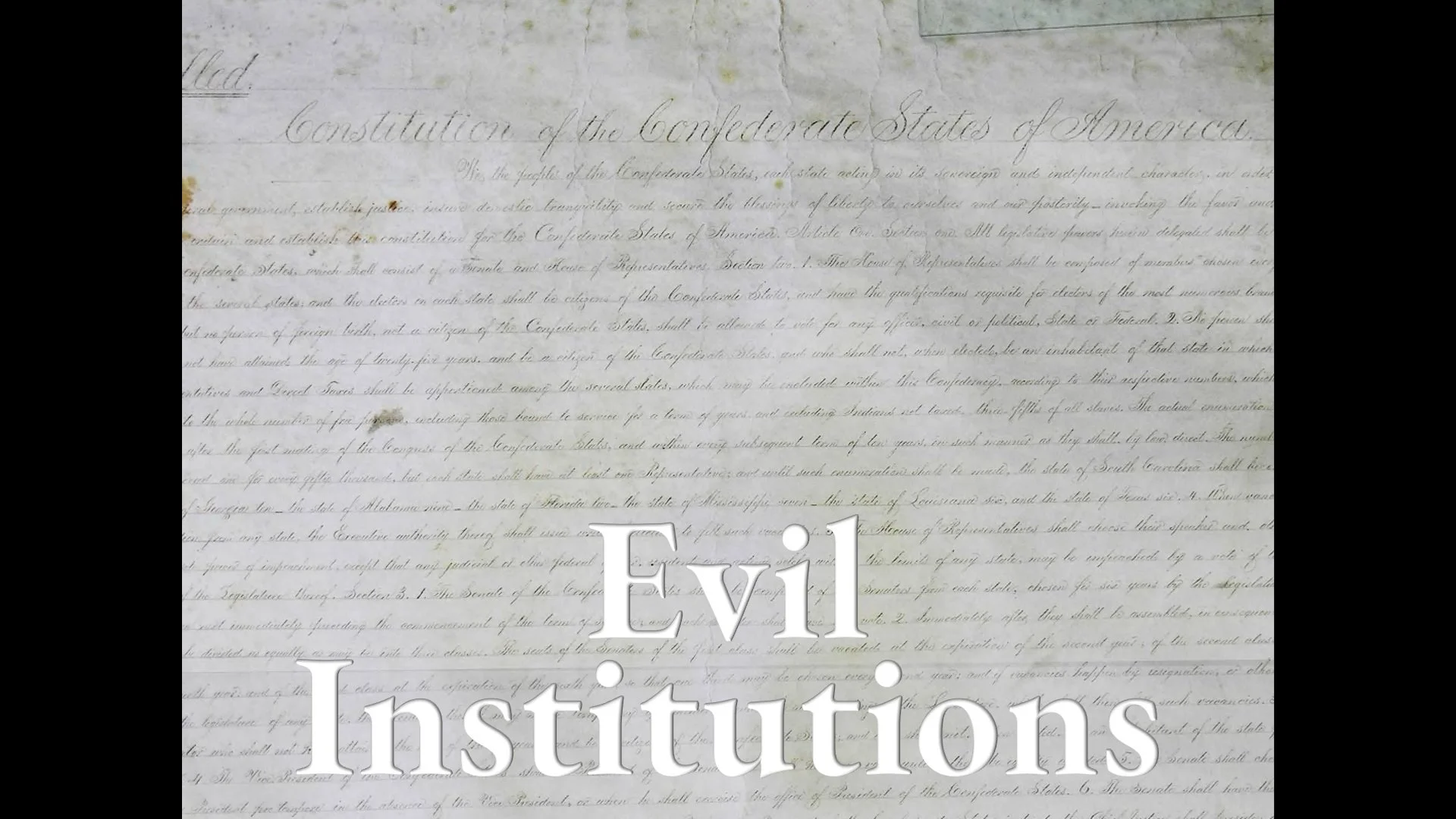
Christian teaching explains the Evil Within as the source of the Evil Between, Evil Laws, and Evil Institutions. Evil and God’s Goodness spotlights God’s call for our partnership in undoing evil, via the theme of divine fire in Scripture. So if you are on a spiritual search, consider browsing through our materials in that sequence.