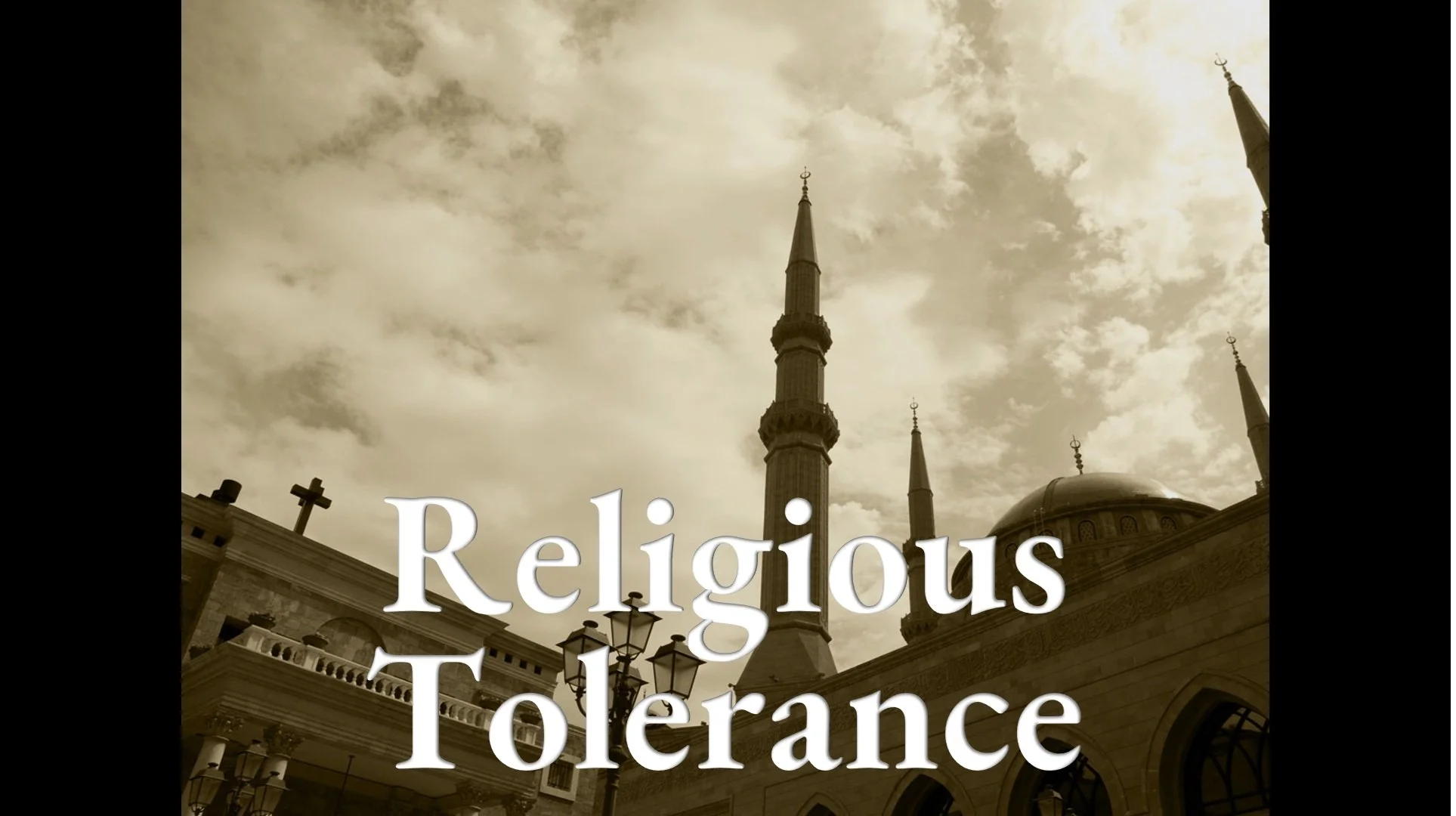
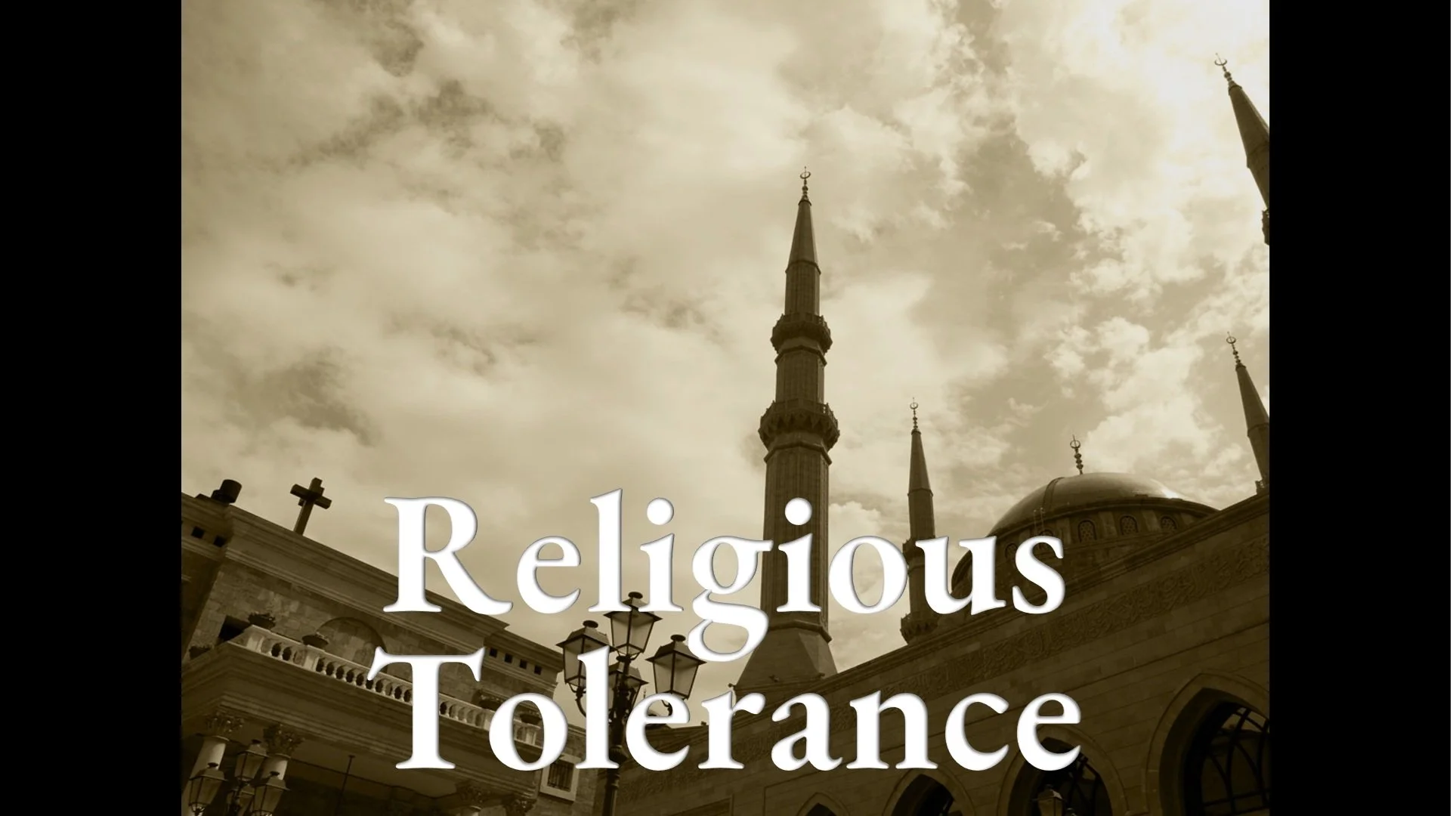
Photograph: Church and mosque next door to each other in Beirut, Lebanon. Photo credit: anjči | CC2.0, Wikimedia Commons.

Introduction
These resources explore ethical and moral problems related to having a principled religious political pluralism. Christian faith including Constantine but prior to Augustine offers a foundation; it is unclear whether atheism/agnosticism per se can offer a foundation. By comparison, see Authoritarianism: Augustine’s Authoritarian-Theocratic Synthesis and Tribalism: The Chosen People-Racist Synthesis.
Messages and Resources
See also the slides to this presentation. Given to the 2022 Reconstruction class. The introduction features John Winthrop vs. Roger Williams to highlight the debate over freedom of religious Conscience vs. Christendom. The presentation highlights Christian accomplishments in health and hospitals, education and schools, land ownership and economic justice, and criminal justice reform.
See also the slides to this presentation. Given December 11, 2021 to the Reconstruction 2021 class. This presentation is a deep dive into Romans 9 - 11 based on literary and biblical-intertextual exegesis, and patristic interpretation. Everyone but Augustine of Hippo believed that God granted and maintained human free will, because we are partners with God in shaping our own human nature. Romans 9 - 11 refers to God accomplishing His purposes in history, delivering Israel from Egypt and delivering Jesus from sin and mortality. Romans 9 - 11 does not refer to God accomplishing a “double predestination” into the realm of the eternal. This argument demonstrates that Paul’s directives to the Roman Christians regarding Judaism/Israel (Romans 9 - 11) is really a substantive exploration of Christian ethics towards Jewish people, and thus a major anchor point for Christian political theology. It would have led to a principled political pluralism that could have extended to other belief systems, and prevented Europe’s Wars of Religion. This exegesis confirms Oliver M.T. O’Donovan’s work on political ethics.
Christian Faith, Not Secularism, as the Basis for Political Pluralism and Economic Progressivism
A brief outline explaining from both biblical texts and early church precedent why Christian faith leads to a political posture of human rights without theocracy. There is a vision for relational obligations, and principled respect for other religions.
Why Question Atheism from a Political and Moral Perspective?
A presentation on how the Enlightenment tradition gave birth to racist liberal democracies on the one hand, and Marxist communism/state-capitalism on the other. The Enlightenment tried to dethrone Christian faith from political theory and the Christian church from political power. Thus, the ideology of the individual and the nation-state went to these two extremes, colored by the presumption of cultural, intellectual, and spiritual superiority that Europeans had about themselves.
The Role of Jesus in Revolution and the Pursuit of Justice
This is an evangelistic message that highlights the Christian-led and Christian-influenced non-violent resistance movements throughout the world in the 20th century. They show the connections and spiritual vitality of Christian faith under empire or empire-like oppression.
Slavery in Christianity, Part 1: Slavery in the Bible, Slavery Today
Notes and slides and Slavery in Christianity, Part 2: Abolitionism from the First to Fifteenth Century demonstrate that the Bible is against chattel slavery, and that Christian faith began to abolish slavery immediately, eventually formally abolishing it in northwestern and northern Europe by the 1300’s. This challenges the narrative that Christianity is ambiguous at best on slavery. Rather, Christianity is the only belief system that has generated abolitionist and anti-trafficking movements. See also Slavery in Islam: From the Seventh to Twenty First Century. This raises serious questions for both Muslims and also secularists who might want to argue that all belief systems can be tolerated on neutral, rational grounds.
The Problem of the Body for the Liberal Theory of Personhood: Your Body is Not Just Your Own
A message from 1 Corinthians 6:18 - 20 highlighting how the individualistic view of human bodies does not account for human relationality and relational obligations.
Future Writings:
Pluralism and Liberalism Over Secular Nationalism: The Significance of Christianity's Tether to Judaism (TBD)
Why Islamic Shari'a Exposes the Secular Liberal as Without Foundation (TBD)
Cultural Relativism: Why Western Countries Are Giving Up on Multi-Culturalism and Why Secular Liberalism Can't Help (TBD)
The Church Gave Us Human Rights and Civil Rights: Christianity and the Two Stages of Democratic Development (TBD)
The Limits of Tolerance, the Reality of Coercion, and the Fallacy of the Rational Mind (TBD)
-
Christians Against Christian Nationalism (website) a declaration with signers
Tertullian of Carthage, Letter to Scapula, Governor of Roman North Africa (211 - 213 AD), argues for freedom of religious conscience on Christian grounds
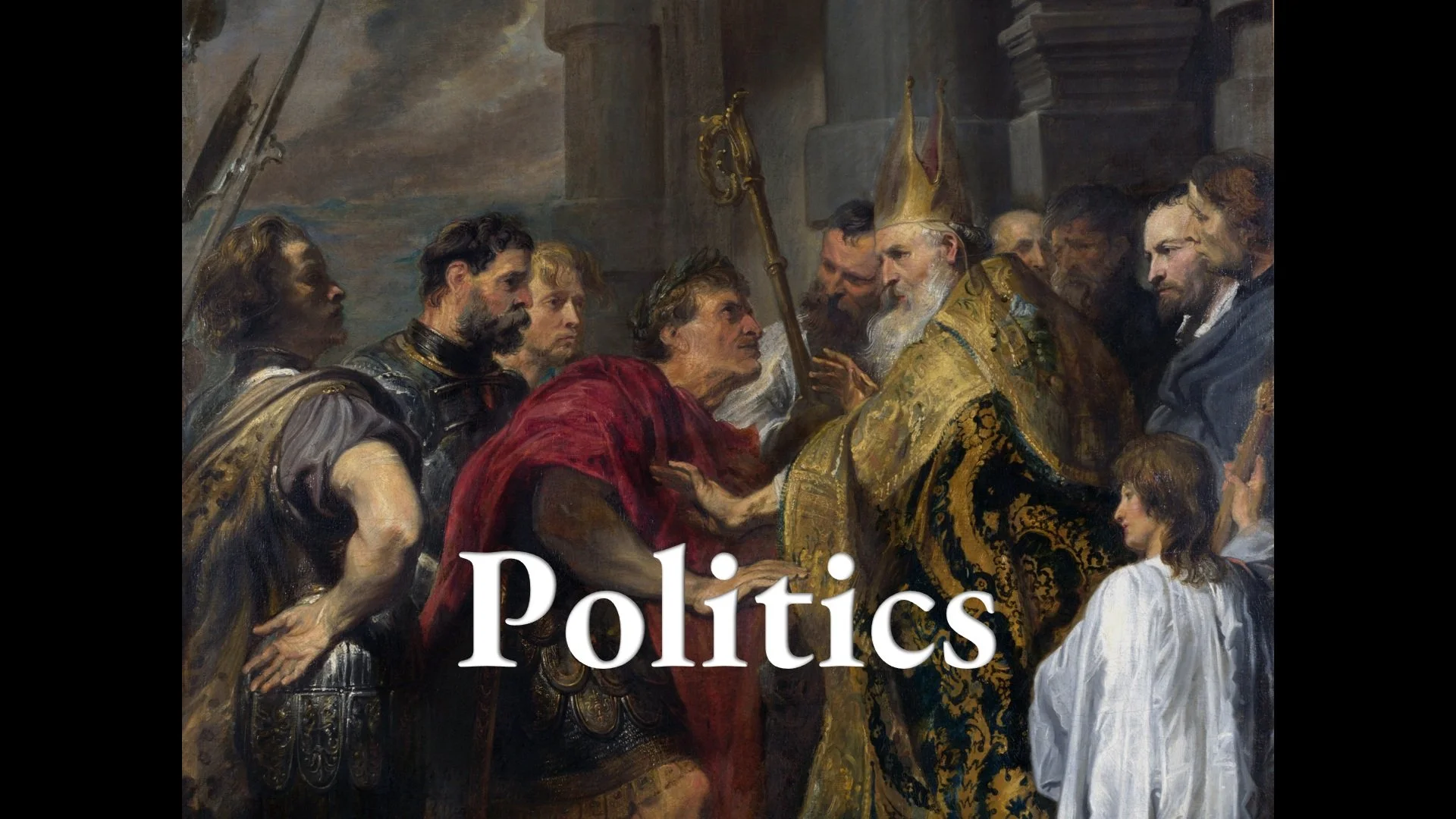
Ambrose of Milan, Letter 17, paragraph 7. New Advent website. Ambrose speaks to the Roman Emperor about not compelling worship against one's free will. See also Ethan Gannaway, Saint Ambrose and Toleration. The Academy for the Study of Ambrose of Milan, Apr 4, 2013. Gannaway makes helpful historical remarks concerning Ambrose, given the bishop's engagement with political events. See also Lance Ralston, Ambrose. Communio Sanctorum, Mar 16, 2014. For a readable and short history on Ambrose's interactions with the Arian Christians and Emperor Theodosius.
Wikipedia, Council of Jews and Christians, a voluntary organization in Britain working against anti-Semitism
Wikipedia, Archbishop Damaskinos of Athens whose actions and advocacy saved thousands of Jews during WW2
Alasdair MacIntyre, After Virtue: A Study in Moral Theory. University of Notre Dame Press | Amazon page, 1981, 1984, 2007.
John W. DeGruchy, Christianity and Democracy: A Theology for a Just World Order. Eerdmans | Amazon page, 1987.
Alasdair MacIntyre, Whose Justice? Which Rationality? University of Notre Dame Press | Amazon page, Mar 31, 1988.
Alasdair MacIntyre, Three Rival Forms of Moral Inquiry: Encyclopedia, Genealogy, and Tradition. University of Notre Dame Press | Amazon page, 1991, 1993, 1995, 1999, 2003, 2006, 2008, 2012.
Paul Freston, Evangelicals and Politics in Asia, Africa, and Latin America. Cambridge University Press | Amazon page, 2001, 2003.
Charles Marsh, The Beloved Community: How Faith Shapes Social Justice from the Civil Rights Movement to Today. Basic Books | Amazon page, 2005.
Jean Bethke Elshtain, Toleration, Proselytizing, and the Politics of Recognition. selected sections, 2008.
Paul Freston, Evangelical Christianity and Democracy in Latin America. Oxford University Press | Amazon page, 2008.
Terence O. Ranger, Evangelical Christianity and Democracy in Africa. Oxford University Press | Amazon page, 2008.
Leuenberg, Human Dignity is Unassailable, Inalienable, and Indivisible. Leuenberg blog, 2008. A response to the Russian Orthodox Church's 2008 statement on human rights
David Halloran Lumsdaine, Evangelical Christianity and Democracy in Asia. Oxford University Press | Amazon book, 2009.
Alasdair MacIntyre, God, Philosophy, University: A Selective History of the Catholic University. Rowman & Littlefield Publishers | Amazon page, 2009. See ch.17
Michael J. Sandel, Justice: What's the Right Thing to Do? Farrar, Straus and Giroux | Amazon page, 2009.
Monica Toft, Daniel Philpott, Timothy Shah, God's Century: Resurgent Religion and Global Politics. W.W. Norton & Company | Amazon page, Mar 14, 2011.
Michael J. Sandel, What Money Can't Buy: The Moral Limits of Markets. Farrar, Straus and Giroux | Amazon page, 2012.
Gabe Lyons, The Next Christians: The Good News About the End of Christian America. Doubleday Religion | Amazon page, 2010.
Ed Stetzer, Proselytizing in a Multi-Faith World. Christianity Today, Mar 28, 2011.
Robert Woodberry, The Missionary Roots of Liberal Democracy. American Political Science Review, May 2012.
Robert Chao Romero, Jesus for Revolutionaries. free pdf book, 2013.
Larry Siedentop, Inventing the Individual: The Origins of Western Liberalism. Harvard University Press | Amazon page, 2014. Siedentop argues that Western Christian theology elevated the dignity of the human person, and further that the Papacy’s political argument with monarchs over spiritual authority laid the foundation for modern human rights.
Andrea Palpant Dilley, The Surprising Discovery About Those Colonialist, Proselytizing Missionaries. Christianity Today, Jan 8, 2014.
Kyle Harper, Robert Woodberry, Donald Miller, and Daniel Philpott, Christian Views on Dignity, Slavery, Proselytism, and Democracy. Berkley Center at Georgetown University, Jan 28, 2014.
Kyle Harper, Christianity and the Roots of Human Dignity, argues that public Christianity began after Constantine. Harper discusses slavery, sexual coercion, and poverty. On slavery, he argues that Gregory of Nyssa is significant because of his critique of slavery, though he favors literary, intellectual history and not the embodied, practiced history of the Christian community prior to that. On sexual coercion, Harper notes that bishops take the victim’s point of view and preach that human freedom is essential to the definition of sin, exonerating those who lack freedom. Emperors Theodosius then Justinian ban sexual coercion. On poverty, Christians argue that human beings have certain entitlements that demand a material response to poverty.
Robert Woodberry argues that many positive social outcomes attributed to the Enlightenment really are due to Christian missionaries. The major contributions are literacy, printing, and religious freedom. Freedom for conversion and religious liberty is a major factor for elites to give up power and wealth in the long term. East Asia had movable font metal type before Europe, but book publishing didn’t spread beyond Mahayana Buddhist circles; Jews and Catholics were present and printed works in Asia, but no one copied them because religious motivations made the difference. Woodberry focuses on colonial history and missions, studying concrete examples of missionaries’ legacy from a sociological perspective.
Donald Miller studies Pentecostals, and argues the Pentecostal movement increases religious vitality. They are not disproportionately poor, and just as politically progressive. It has a democratizing effect on churches focusing on the experience of the laity and appeal to youth.
Daniel Philpott argues that Christians from 1800 - 2000 favored liberal democracy; the stereotype that Christians were predominantly stragglers or reactionaries of liberal democracy must be revised.
Joanna Moorhead, Conscientious Objectors: Men Who Fought a Different Battle. The Guardian, Apr 25, 2014.
David Zahl, A Few Thoughts on Righteous Minds and Religious Tolerance. blog, Jul 11, 2014.
William Barber, A Moral Monday Letter to Ferguson. Red Letter Christians blog, Oct 13, 2014.
David Gelernter, Why Should a Jew Care Whether Christianity Lives or Dies? First Things, Mar 24, 2015.
John Inazu, What to Expect After the Supreme Court's Marriage Decision. Christianity Today, Apr 28, 2015.
Rebecca Onion, Rules of Business Ethics for Early 19th Century Christian Merchants. Slate, Apr 29, 2015.
Russell Moore, Why the Church Should Neither Cave Nor Panic About Gay Marriage. Washington Post, Jun 26, 2015.
Denver Catholic, Court Rules Against Little Sisters of the Poor. Denver Catholic, Jul 14, 2015.
Ryan T. Anderson, Same-Sex Marriage and Heresy. First Things, Jul 16, 2015.
Unfundamentalist Christians, Your “Deeply Held Religious Belief” Isn’t Biblical. Patheos, Jul 17, 2015.
Hanna Kozlowska, Pope Warns Churches to Take In Refugees - Or Else. Quartz, Sep 16, 2015.
Associated Press, United Methodists, Catholic Leaders Support Syrian Refugees. Kansas City Star, Nov 20, 2015.
Bishop Roy Sano, Amid Hysteria, a Call for Hospitality. United Methodist Church News, Nov 23, 2015. A response to Roanoke, VA mayor David Bowers' citation of the internment of Japanese Americans as a positive national security precedent
Marv Knox, Editorial: The Flaws in "Religious Liberty" Laws. Baptist Standard, Apr 4, 2016.
Thomas Kidd, The United States: A "Christian Nation"? Patheos, Apr 5, 2016.
Beth Allison Barr, Did Medieval Christians Accommodate Paganism? Patheos, Apr 6, 2016. Gregory the Great, Letter to Mellitus and Augustine of Canterbury (601 AD)
Amy Butler, When Religious Liberty Ceases to be Legitimate. Baptist News Global, Apr 19, 2016.
Andrew Doran, When Christianities Collide: Persecuted Churches of the East Need Dialogue With the West. The American Conservative, Jun 9, 2016.
Rod Dreher, Religious Liberty Includes Muslims Too. The American Conservative, Jun 15, 2016. A clip of Russell Moore
Duane Liftin, Christians Don't Want to Stop Serving Their LGBT Neighbors. Christianity Today, Jul 13, 2016.
Peter Beinart, When Conservatives Oppose Religious Freedom. The Atlantic, Apr 11, 2017. Christian conservatives who defend Muslim rights have come under fire by their ideological brethren
Chris Baynes, More Than 200,000 Children Married in US Over the Last 15 Years. UK Independent, Jul 8, 2017. This is a conundrum for both the left and the right; why do some white evangelicals defend this practice in the name of religious liberty? See Fraidy Reiss, Why Can 12-Year-Olds Still Get Married in the United States? Washington Post, Feb 10, 2017. Joanne Sweeney, Banning Child Marriage in America: An Uphill Fight Against Evangelical Pressure. Salon, Mar 11, 2018. Sweeney spotlights Kentucky.
The Guardian, Jane Addams: The Activist Who Set the Foundation for Modern Social Work. The Guardian, Oct 24, 2017. See Jane Addams (Wikipedia article)
Nathan Thrall, How the Battle Over Israel and Anti-Semitism Is Fracturing American Politics. New York Times Magazine, Mar 28, 2019. The growing prominence of the B.D.S. movement — and the backlash to it — is widening fault lines from college campuses to Capitol Hill.
Roger Scruton, Must Religious Duty Conflict With Political Order? Renovatio, Jun 12, 2019. “In my view, religious freedom, as we have enjoyed it, is itself a legacy of religion. It arose from the sincere recognition of the central place faith will inevitably occupy in the life of its adherents. When faith declines, as it has been declining during our times, there remains only the shell of the political order that grew from it. And people then hunger for the kind of consolation faith alone can provide, while adhering to a political order that offers no such consolation but only the freedom to search for it.”
Emma Green, The Christian Withdrawal Experiment. The Atlantic, Jan/Feb 2020. “Feeling out of step with the mores of contemporary life, members of a conservative-Catholic group have built a thriving community in rural Kansas. Could their flight from mainstream society be a harbinger for the nation?” Reflects the conservative view that secular democracy and Christian faith cannot co-exist.
Jack Jenkins, Citing Rise of ‘Christian Nationalism,’ Secular Democrats Unveil Sweeping Recommendations for Biden. Religion News Service, Nov 30, 2020. Jenkins presents a set of proposals limiting the Department of Education granting taxpayer dollars to private religious schools, applying nondiscrimination policies to some religious organizations like Hobby Lobby, and repealing non-medical religious exemptions to vaccinating children in schools and daycare facilities.
Claire Giangravé, God Does Not Want ‘A World Governed by Religious Laws,’ Pope Tells Canadian Clergy. Religion News Service, Jul 28, 2022. “To overcome secularism and past failures, Pope Francis called on Canadian clergy to embrace the journey toward healing and reconciliation.”
Tom Holland, Why I Changed My Mind About Christianity. Edictum Conference, Mar 14, 2023. A one hour lecture — a personal and professional story of a classical historian who realized that studying the Greek and Roman civilizations was morally disturbing because of the Christian sensibilities and morality that confronted those civilizations. Holland is asked, “How does secularism affect Christianity?” He replies that secularism itself is a Christian development, because Jesus divided the state (Caesar) from the church (people rendering to God), which made space for other people to be considered members of a “religion,” even though they had not thought of themselves that way before.
Christopher Beha, Losing Faith in Atheism. The New Yorker, Feb 14, 2026.
“My own passage into and back out of unbelief—one marked by a close reading of works that earlier illiberal societies had attempted to suppress on religious grounds—has strengthened my liberal commitments. But it’s also made me acutely aware of liberalism’s very real limitations. As a means for allowing people with different conceptions of the good to live together fruitfully and peacefully, liberalism seems unmatched in human history. As a means of generating its own conceptions of goodness that feel compelling to most human beings, its record is quite mixed, perhaps because that’s not what it was ever designed to do.
What’s more, when liberals treat some version of scientific materialism as so self-evidently true that it must serve as the default context for public discourse; when they make allegiance to “reason” and “evidence,” as they define these terms, the price of admission into such discourse; and when they attempt to banish metaphysical or spiritual or even frankly religious talk from our politics and our culture, they are not practicing liberalism as its greatest exemplars understood it. They are eliminating from our shared vocabulary many of the concepts on which any justification for liberalism beyond the purely practical would have to depend.
I am not suggesting that the solution to our problems is for secular liberals to find God. But I am suggesting that religious believers be considered natural allies in the fight against irrational illiberalism, rather than its primary cause. This need not mean abandoning secularism, and it certainly doesn’t mean abandoning liberalism. It means, perhaps, seeing liberalism as so many liberals wish believers would see their faith: not as the expression of a universal truth to which every person must eventually submit but as a human construction—one of the finest we have ever made—worth defending even when it is helpless to defend itself, yet capable of being swept away by the same hands that built it in the first place.”
-
The Newseum Institute (website) on religious freedom
Wikipedia, Lyman Beecher (Wikipedia). An example of racism and anti-Catholicism in the American Protestant nationalist tradition
Wikipedia, Virginia Statute for Religious Freedom (Wikipedia)
Wikipedia, Same-Sex Marriage Under U.S. Tribal Jurisdictions (Wikipedia)
Vaclav Havel, "Politics, Morality, and Civility" from Summer Meditations. 1993.
Stephen L. Carter, "Defending" Marriage: A Modest Proposal. Yale Law School, Jan 1, 1998.
Joel Brady, "Land Is Itself a Sacred, Living Being": Native American Sacred Site Protection on Federal Public Lands Amidst The Shadows of Bear Lodge. American Indian Law Review, 2000.
Chris Seiple, Alfred Stephan, Peter Awn, Democracy, Terrorism, and Religious Freedom. Veritas Forum video, Oct 2008.
Thomas Albert Howard, Protestant Theology and the Making of the Modern Germany University. pdf book, 2009.
R. Emmett Tyrrell, Jr., Another Peaceful Solution: Proposition 8 and How Liberals Always Go Too Far. The American Spectator, Jun 17, 2010. argues for the state to do civil unions only
Chilton Williamson Jr., After Tocqueville: The Promise and Failure of Democracy. 2013.
Pierre Manent, Metamorphoses of the City: On the Western Dynamic. 2013.
David Batty, Archbishop of Canterbury Backs Sharia for British Muslims. Guardian, Feb 7, 2008.
Stuart Koehl, An Independent Witness to Marriage. First Things, Jul 16, 2010.
Gregory Jensen, Finding the Balance: Privacy and Civil Society. Acton Institute blog, July 21, 2010.
John M. Barry, God, Government and Roger Williams’ Big Idea. Smithsonian, Jan 2012. re: the separation of church and state
Christine Gross-Loh, Have American Parents Got it All Wrong? Huffington Post, May 7, 2013.
Daniel J. Mahoney, Don't Despair of Democracy. The American Conservative, May 30, 2013. Review of Chilton Williamson Jr., After Tocqueville: The Promise and Failure of Democracy
Politifact, Wedding Vendors Have Been Forced to Participate in Same-Sex Marriages Under Threat or Even Jail. Politifact, Jun 30, 2013.
Marshall Sahlins, China U.: Confucius Institutes Censor Political Discussions and Restrain the Free Exchange of Ideas. The Nation, Oct 29, 2013.
Amy Davidson, The Stakes in the Hobby Lobby Case. The New Yorker, Nov 27, 2013.
Daniel J. Mahoney, The Political Form of Freedom. The American Conservative, Dec 5, 2013. Review of Pierre Manent, Metamorphoses of the City: On the Western Dynamic
Politifact, To comply with non-discrimination laws, the government is "forcing people in business to make wedding cakes" for anyone. Politifact, Dec 19, 2013.
Bari Weiss, Camille Paglia: A Feminist Defense of Masculine Virtues. Wall Street Journal, Dec 28, 2013. showing how gender still matters
Joey Ayoub, What Did Palestine Look Like in 1896? blog, Feb 11, 2014.
Steve Robinson, Bowdoin College to Christians: Get Lost! The Maine Wire, Feb 17, 2014.
Emma Green, What's So Weird About a Conservative Atheist? The Atlantic, Feb 26, 2014.
Michelle Goldberg, Columbia University Fired Two Eminent Public Intellectuals. Here's Why It Matters. The Nation, Mar 12, 2014.
Mark Silk, The Conservative Shift on Religious Liberty. Religion News Service, Mar 13, 2014.
Emily Bazelon, In Defense of Religious Liberty. Slate, Mar 14, 2014.
Rod Dreher, Religious Liberty and the Sacrament of Sexual Freedom. The American Conservative, Mar 17, 2014.
Ross Douthat, The Challenge of Pluralism. New York Times, Mar 19, 2014.
Naomi Lamoreaux and William Novak, Getting the History Right: Tracking the Real History of Corporate Rights in American Constitutional Thought. Slate, Mar 24, 2014.
Patrick Deneen, Even if Hobby Lobby Wins, We Lose. The American Conservative, Mar 25, 2014.
New Yorker Magazine, Out Loud: Malcolm Gladwell on the Limits of American Religious Tolerance. New Yorker Magazine, Mar 24, 2014.
Yuval Levin, Beneath the Religious Liberty Debates. National Review, Mar 28, 2014.
David Gushee, Do For Profit Corporations Have Religious Liberties? American Baptist Press News, Apr 8, 2014.
Ross Douthat, Why Liberalism Needs Pluralism. New York Times, Apr 10, 2014.
Ross Douthat, Diversity and Dishonesty. New York Times, Apr 12, 2014.
Mark Joseph Stern, Religious Liberty Hypocrisy: North Carolina Forbids Churches from Performing Gay Weddings. Slate, Apr 28, 2014.
William Saletan, Kenya's Polygamy Problem. Slate, May 5, 2014.
Andrew Bostom, U.S. Sacrificing U.S. Citizen Toddler to Sharia in Sudan? PJ Media, May 14, 2014.
Stephen L. Carter, Thanks for Not Disinviting Me. Bloomberg, May 15, 2014.
Stephen L. Carter, Smeared by Gay Rights Activists. Bloomberg View, Jun 5, 2014.
Michael Paulson, Colleges and Evangelicals Collide on Bias Policy. New York Times, Jun 9, 2014.
Lyle Deniston, Opinion Analysis: Does the New Religious Exemption Go Far Enough? SCOTUS blog, Jun 30, 2014.
Jack Jenkins, Why the Hobby Lobby Decision Actually Hurts People of Faith. Think Progress, Jun 30, 2014.
Kim Bhasin, Christians Call Out Hobby Lobby for Hypocrisy. Huffington Post, Jul 1, 2014.
Richard Reich, Freedom, Power, and the Conservative Mind. Huffington Post, Jul 2, 2014.
Manny Schewitz, SC Restaurant Owner Refuses to Serve Blacks, Cites Religious Beliefs. Forward Progressives, Jul 2, 2014.
Adam Liptak, Birth Control Order Deepens Divide Among Justices. New York Times, Jul 3, 2014.
Evan Allen, Gordon College Leader Joins Request for Exemption to Hiring Rule. Boston Globe, Jul 4, 2014.
Scott Alexander, I Can Tolerate ANew York Timeshing Except the Outgroup. Slate Star Codex blog, Sep 30, 2014.
Yuval Levin, Taking the Long Way: Disciplines of the Soul Are the Basis of a Liberal Society. First Things, Oct 2014.
Rachel Lu, Why Liberalism is so Illiberal. Crisis Magazine, Oct 22, 2014.
Brandon O'Neill, Free Speech is So Last Century. Today's Students Want the Right to Be Comfortable. Spectator, Nov 22, 2014.
QPolitical, Seconds After He Says “Jesus Died For My Sins”, CNN Silences NFL Star In The Rudest Way Imaginable. QPolitical, Dec 1, 2014.
Luke Savage, New Atheism, Old Empire. Jacobin Magazine, Dec 2, 2014.
Elena Glassman, Neha Narula, and Jean Yang, MIT Computer Scientists Demonstrate the Hard Way That Gender Still Matters. Wired, Dec 19, 2014.
Amy R. Buckley, Why You Should Be a Christian Feminist. Relevant Magazine, Dec 31, 2014.
Institute for Canadian Values, Corporate Discrimination: No Christians Allowed. Canadian Values website.
Patrick Deneen, Classical Liberalism - Contemporary Voices. The American Conservative, Feb 5, 2015.
Rahel Gebreyes, The Unfortunate Consequences of Banning Sharia Law. Huffington Post, Mar 3, 2015.
Todd Starnes, San Francisco Demands Catholic Schools Stop Teaching Catholic Doctrine. Fox News, Mar 9, 2015.
Eboo Patel, In Promoting Campus Diversity, Don't Dismiss Religion. Chronicle of Higher Education, Mar 11, 2015.
Conor Friedersdorf, Gays, Traditionalists, and the Feeling of Being Under Siege. The Atlantic, Apr 6, 2015.
Lisa Miller, Why Kids Need Spirituality. New York Magazine, Apr 16, 2015.
Conor Friedersdorf, The Liberty to Feed the Poor. The Atlantic, Apr 21, 2015.
Dawn Stefanowicz, A Warning from Canada: Same-Sex Marriage Erodes Fundamental Rights. Witherspoon Institute, Apr 24, 2015.
Noah Millman, An Anthropological Approach to Gay Marriage. The American Conservative, Apr 30, 2015.
E.J. Dionne, A Senator's Faith and Humility. Washington Post, May 3, 2015.
T.J. Martinelli, Alabama Senate Passes Bill to Nullify All Sides on Marriage. Tenth Amendment Center blog, May 23, 2015.
K. Hollyn Hollman, Obergefell Decision Does Not Remove Separation Between Church and State. Baptist Joint Committee for Religious Liberty, Jun 26, 2015.
Rand Paul, Government Should Get Out of the Marriage Business Altogether. Time, Jun 28, 2015.
Mark Oppenheimer, Now's the Time to End Tax Exemptions for Religious Institutions. Time, Jun 28, 2015.
Rabbi Shmuley Boteach, Legalizing Gay Marriage in the Supreme Court. Shmuley Boteach, Jul 2, 2015. Argues for civil unions for all, marriage for none
Jonathan Turley, The Trouble With the 'Dignity' of Same Sex Marriages. Washington Post, Jul 2, 2015.
David R. Wheeler, Gay Marriage and the Future of Evangelical Colleges. The Atlantic, Jul 14, 2015.
The Onion, Parents Dedicate New College Safe Space In Honor Of Daughter Who Felt Weird In Class Once. The Onion, Jul 15, 2015. Entertaining satire.
Linda Greenhouse, A Religion Case Too Far for the Supreme Court? New York Times, Jul 23, 2015.
Julia Ioffe, Putin is Down With Polygamy. Foreign Policy, Jul 24, 2015.
David Gushee, Why This Christian Says Christianity Is Harmed by Kim Davis and Her Fans. Religion News Service, Sep 4, 2015.
Rod Dreher, Law For Thee, But Not For Me. The American Conservative, Sep 4, 2015.
Renee K. Gadoua, MA Pastor Scott Lively Faces Possible Fine for Harsh Anti-Gay Efforts in Uganda. Religion News Service, Oct 1, 2015.
Elizabeth Stoker Bruenig, Why the Left Needs Religion. Dissent, Fall 2015.
Jacob Poushter, 40% of Millenials OK with Limiting Free Speech Offensive to Minorities. Pew Research, Nov 20, 2015.
Anthony Esolen, No Room for Sanity at the Inn: Stifling Democratic Debate Over Same-Sex Marriage. Witherspoon Institute, Dec 4, 2015.
Archbishop Jose H. Gomez and Bishop Charles E. Blake, Religious Freedom and the Future of America's Colleges. Angelus, Aug 2, 2016.
Melody Hahm, Uneasy Partners: Religion in the Workplace. Yahoo, Aug 14, 2016.
Anthony Berteaux, In the Safe Spaces on Campus, No Jews Allowed. Washington Post, Sep 15, 2016.
Keith Strahan, Marriage and the State: The Case for Privatization. The Liberty Conservative, Oct 6, 2016.
Celebrity Types, What the H*** is Happening in Western Democracies? Haidt's Analysis. Celebrity Types, Oct 13, 2016.
Jonathan Haidt, Socialism and Human Nature. Cato Institute, Oct 31, 2016. An analysis of libertarians
Evan Lips, Massachusetts Pastor Cheer State's Decision to Drop Churches from Transgender Public Accommodations List. New Boston Post, Dec 15, 2016.
Tom Strode, Congrats, Frank Wolf: Obama Approves Expansion of International Religious Freedom Act. Christianity Today, Dec 16, 2016. And Michael Stone, Obama Signs New Law Giving Protection To Atheists. Patheos, Dec 19, 2016.
Mary Emily O'Hara, First Amendment Defense Act Would Be 'Devastating' for LGBTQ Americans. NBC News, Dec 21, 2016.
Emma Green, The Democrats Have a Religion Problem. The Atlantic, Dec 29, 2016.
Yonatan Zunger, Tolerance Is Not a Moral Precept. Extra Newsfeed, Jan 2, 2017. Tolerance is a peace treaty, not a suicide pact where you tolerate the intolerant; nice historical narrative rooted in Catholic vs Protestant wars; a good rebuttal to the right's accusation that the left should tolerate intolerance.
D.C. Schindler, Freedom from Reality: The Diabolical Character of Modern Liberty. Amazon book, Oct 18, 2017. Helpful social commentary of Western individualistic freedom by a Catholic philosopher
Rod Dreher, White, Male, Educated - and Christianophobic. The American Conservative, Nov 4, 2017.
Sean Illing, An Atheist Muslim on What the Left and the Right Get Wrong About Islam. Vox, Nov 17, 2017. "the left is wrong about Islam; the right is wrong about Muslims"
Robert McNamara and Paul Sherman, The Abortion Case That’s Really About the First Amendment. New York Times, Mar 20, 2018.
Curtis M. Wong, Teacher Says He Was Forced To Quit Over School’s Transgender Student Policy. Huffington Post, Jun 6, 2018.
Kathleen B. Jones, What the Nazis Taught Philosopher Hannah Arendt About the Rights of Refugees. Sojourners, Jul 17, 2018. Explores the context of European ethno-national states as the challenge of post-Imperial Europe.
David French, Colorado Defies the Supreme Court, Renews Persecution of a Christian Baker. National Review, Aug 15, 2018.
The Editors, The Persecution of the Uyghurs. National Review, Aug 24, 2018. re: China's treatment
Steve Warren, State Tells Christian Filmmakers: Make Same-Sex Marriage Films or Spend 90 Days in Jail. Christian Broadcasting Network, Oct 15, 2018. Christian wedding videographers' case
David French, As Religious Separation Increases, Religious Bigotry Will Abound. National Review, Jan 11, 2019. Helpful, although I remain concerned about his lack of recognition that Christian faith requires restitution and reparations for past injustices
Augusto Zimmerman, Why is Facebook Censoring a Conference on Christianity and Religious Freedom? Spectator Australia, Apr 9, 2019. Perplexing given Facebook’s refusal to censor the doctored video of House Speaker Nancy Pelosi, which made her appear drunk or mentally impaired
Nazia Parveen, Birmingham School Stops LGBT Lessons After Parents Protest. The Guardian, Mar 4, 2019. re: Muslim parents
David French, Religious Liberty: Not Just for Social Conservatives. The Dispatch, Feb 5, 2020. “An Arizona federal court flips the script” by ruling that Unitarian Universalists have a religious freedom right to leave water and food for immigrants on foot on federal lands, despite Trump’s argument against
Tyler O’Neill, Virginia Forces Christian Ministries to Adopt 'Government Ideology' or Pay $100K. PJ Media, Sep 30, 2020. “The so-called Virginia Values Act (S.B. 868), which Gov. Ralph Northam (D-Va.) signed on Holy Saturday (the day before Easter Sunday) in the middle of a pandemic, compels churches, religious schools, and Christian ministries to hire employees who do not share their stated beliefs on marriage, sexuality, and gender identity. A companion law (H.B. 1429) requires ministries and others like them to pay for transgender surgery in employee health care plans, a procedure that violates these ministries’ convictions.”
Saagar Enjeti, 2020 List Of Everything He Got Wrong: Polling, Coronavirus Lockdowns, Culture Wars. Rising | The Hill, Nov 10, 2020. Important observations about public opinion against cultural leftism; voters’ real religious commitments seem to be an underlying concern as well; but also perhaps missing the amount of disinformation from the right, as well as white evangelicals spreading Christian identity nationalism to communities of color. See also Kurt Andersen, How America Got Divorced from Reality: Christian Utopias, Anti-Elitism, Media Circus. Kurt Andersen, Oct 8, 2017. On historical examples of magical thinking on the part of white Protestants.
Pew Research, Religion in India: Tolerance and Segregation. Pew Research, Jun 29, 2021. “Indians say it is important to respect all religions, but major religious groups see little in common and want to live separately.” This is an important context in which to understand religious voices, law, and policy.
Chris Gehrz, Christian Opposition to Prayer in Public Schools. The Pietist Schoolman | Substack, Jun 20, 2023. “Revisiting the debate sixty years later, via a former Bethel professor.”
Paul Marshall, Quebec’s Bill 9 Pushes Secularism Further, Moves To Outlaw Public Prayer. Religion Unplugged, Dec 2, 2025.
“Many Quebec governments have not been satisfied merely with virtual disestablishment but have also moved aggressively to completely remove religious expression from public space.
In 2019, it passed Bill 21 forbidding public employees in positions of authority, such as judges, police, and teachers, from wearing religious symbols such as a hijab, kippah, or turban, while at work. It says it plans to extend these prohibitions.
Bill 21 violated the "fundamental freedoms" provided in the Charter of Rights and Freedoms guaranteed in Canada's 1982 Constitution. However, that Constitution, unlike the U.S., but like Israel and the U.K., also has a provision that can counter and circumscribe these rights.”
Christopher Beha, Losing Faith in Atheism. The New Yorker, Feb 14, 2026.“My own passage into and back out of unbelief—one marked by a close reading of works that earlier illiberal societies had attempted to suppress on religious grounds—has strengthened my liberal commitments. But it’s also made me acutely aware of liberalism’s very real limitations. As a means for allowing people with different conceptions of the good to live together fruitfully and peacefully, liberalism seems unmatched in human history. As a means of generating its own conceptions of goodness that feel compelling to most human beings, its record is quite mixed, perhaps because that’s not what it was ever designed to do.
What’s more, when liberals treat some version of scientific materialism as so self-evidently true that it must serve as the default context for public discourse; when they make allegiance to “reason” and “evidence,” as they define these terms, the price of admission into such discourse; and when they attempt to banish metaphysical or spiritual or even frankly religious talk from our politics and our culture, they are not practicing liberalism as its greatest exemplars understood it. They are eliminating from our shared vocabulary many of the concepts on which any justification for liberalism beyond the purely practical would have to depend.
I am not suggesting that the solution to our problems is for secular liberals to find God. But I am suggesting that religious believers be considered natural allies in the fight against irrational illiberalism, rather than its primary cause. This need not mean abandoning secularism, and it certainly doesn’t mean abandoning liberalism. It means, perhaps, seeing liberalism as so many liberals wish believers would see their faith: not as the expression of a universal truth to which every person must eventually submit but as a human construction—one of the finest we have ever made—worth defending even when it is helpless to defend itself, yet capable of being swept away by the same hands that built it in the first place.”
Christian Restorative Justice Critique of the Left: Domestic Policy Topics:







Christian Restorative Justice Critique of the Left: Philosophical Influences: