Photograph: Boston’s Copley Library
202: Did God Abandon Jesus?
202: Start Here
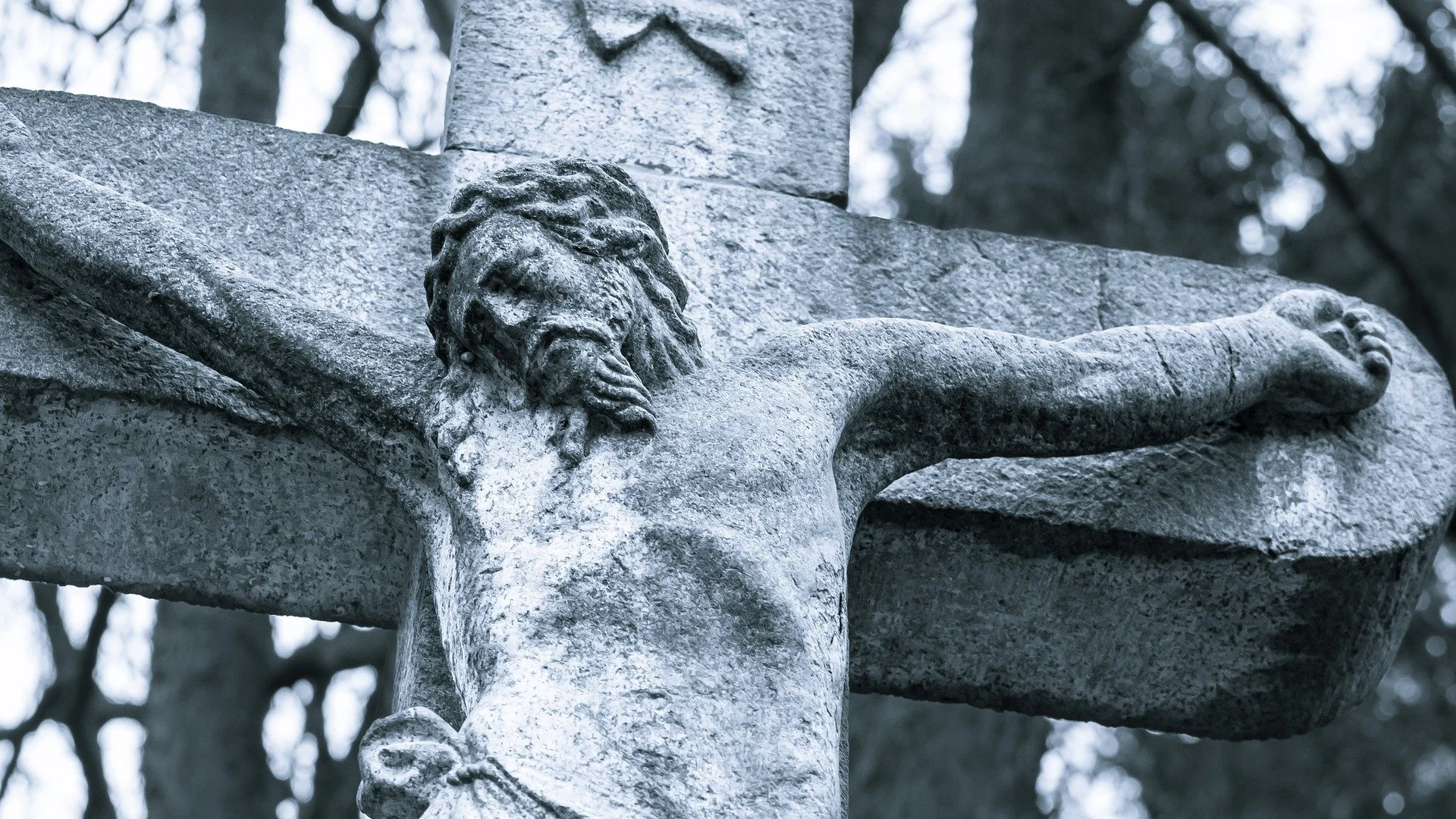
Please watch the following video: God Becomes the Hero: Psalm 22 and How Jesus Retold David’s Story. This is Session Eight from our 2019 conference, Healing Atonement. On the cross, Jesus quoted Psalm 22:1, “My God, my God, why have you forsake me?” This “cry of dereliction” has puzzled some Christians. Advocates of Penal Substitutionary Atonement claim that God the Father turned against or away from the Son in some real sense. But not only does this violate various Scriptures and theological convictions about the Father-Son union flowing from the Nicene Creed, there is a much better explanation, rooted in the pattern of Jesus retelling David’s story. Medical Substitution stresses the active, not passive, obedience of Jesus, and God’s faithfulness to restore that which was broken, lost, and incomplete.
202 Confirm What You Learned
Consider Protestant, Catholic, and Orthodox scholars on the Father-Son relationship.
Protestant: Jason A. Staples, The Father Did Not Turn His Face Away. Details Matter: By Jason A. Staples | Substack, Apr 4, 2026. “Correcting a Common Misreading of the Cry of Dereliction from the Cross.” Staples makes helpful observations about the Gospel of Mark, primarily about the “I am” statements.
Consider reading Thomas H. McCall, Forsaken: The Trinity, the Cross, and Why It Matters. Eerdmans | Amazon page, 2012. Or, for a short summary, see the book review by Ted Johnston at The Surprising God blog, Apr 18, 2012. Johnston says:
“McCall suggests that such statements [about Jesus’ abandonment by the Father] are inconsistent with the gospel and the historic understanding of the Trinity doctrine, and shows why that is so in an analysis of various historic approaches to the subject. In his analysis, McCall notes the "many differences of opinion" on this passage (p27), then offers his own understanding, which is informed by the viewpoint of the Patristic Fathers (such as Athanasius and the Cappadocian Fathers).”
How do PSA advocates respond to this concern? Protestant evangelical PSA defender Kevin DeYoung responded to Thomas McCall on The Gospel Coalition blog in April 2018. Other PSA defenders reposted the article on the 9Marks blog in August 2019. DeYoung concedes that McCall is correct to be concerned about a ruptured Trinity. But DeYoung appeals to early Reformed theologian Francis Turretin (1623 - 1687) who said that Jesus’ experience of divine forsakenness was a real perception Jesus had, without it being real in God:
“As usual, Turretin explains the matter—in this case the “punishment of desertion” (Matt. 27:46)—with careful precision. The desertion on the cross was not “absolute, total, and eternal (such as is felt only by demons and the reprobate), but temporal and relative.” Likewise, the desertion Christ experienced was not with respect to “the union of nature,” nor “the union of grace and holiness.” Neither was Christ deprived of the Father’s “communion and protection.” Instead, God suspended “for a little while the favorable presence of grace and the influx of consolation and happiness.” In other words, the Son’s “sense of the divine love” was “intercepted by the sense of divine wrath and vengeance resting upon him” (Elenctic Theology 13.14.5). Whether McCall would approve of that last line or not, clearly Turretin meant to affirm Christ’s forsakenness in a way that avoids any notion of Trinitarian rupture.”
Now consider:
Is this convincing? Can God switch off the “sense of divine love” and switch on the “sense of divine wrath and vengeance”? Is God a bunch of lightswitches sending different types of current?
Also, was this sense communicated by God the Father to Jesus into his humanity, while Jesus’ divinity remained united and unified with the divinity of the Father? Does this explanation not require a rupture between the divinity and the humanity in Jesus?
What other questions does that raise?
Another major question arises: Is this even how Matthew and Mark portray Jesus speaking on the Cross? Was Jesus explaining his human consciousness and inner feelings at that moment? To whom? Or, as Mako says in the video above, was he countering the mockers? Mako argues that Jesus was referring to David’s pre-enthronement story, to help everyone understand that he was retelling David’s story. David endured vulnerability to the Gentiles before he was enthroned. How much more would the Son of David who fulfilled David’s story endure vulnerability to the Gentiles before he was enthroned? Read Matthew 27 as a whole. Then read the blog posts below.
Consider, also, Jesus’ words in John’s Gospel — that the disciples will leave him at the Cross, but God the Father would not: “Behold, an hour is coming, and has already come, for you to be scattered, each to his own home, and to leave Me alone; and yet I am not alone, because the Father is with Me” (John 16:32). Have Kevin DeYoung, and Francis Turretin, properly accounted for John’s Gospel? Not just one verse, but the entirety of the theme of the unbroken Father-Son relationship in John’s Gospel?
202 For More Learning and Inspiration
Read this blog post series on Jesus’ quote of Psalm 22:1 from the cross, in the telling of Matthew’s Gospel. We go into more depth from the biblical studies angle. We examine the Gospel of John’s witness that the Father never left or leaves the Son, including at the cross (John 16:32), the life of King David, the literary organization of the Book of Psalms. the literary organization of Matthew’s Gospel. Jesus quoted Psalm 22:1 not to express his feelings or lack of conscious awareness of God the Father or God the Holy Spirit, but as a strategic argument against those who were mocking him.



If You Liked This
Rediscover Early Christianity through the videos to our class, Reconstruction: The Deep Roots of Early Christian Theology with us. Learn about why Early Christian theology matters!
Next: Atonement 203: Jesus and the Sacrificial System
As mentioned above, PSA defender Kevin DeYoung, responding to Thomas McCall on The Gospel Coalition blog, said
“Just like the bloody atonement of old, Christ’s death was a fragrant offering and sacrifice to God to atone for our sins (Lev. 1:9, 13, 17; Eph. 5:2). In fact, the very notion of propitiation implies that God’s righteous anger had to be assuaged (Rom. 3:25; Heb. 2:17; 1 John 2:2; 4:10). Christ did not feel forsaken by God for no reason. To be sure, the Trinity was not broken on Good Friday, but it was still “the will of the Lord to crush” the suffering servant (Isa. 53:10). If on the cross as Jesus died, the wrath of God was not satisfied, how was it then appeased?”
We will examine the “bloody atonement of old” and “the very notion of propitiation” next. We will see that God was not bloodthirsty; He was a blood donor. Then, we will see that DeYoung is relying on a poor English translation of the word he thinks means “propitiation.” We will later see how DeYoung is mistaken about what Isaiah’s Suffering Servant endured.