Post 3: The Catholic "Doctrine of Discovery"
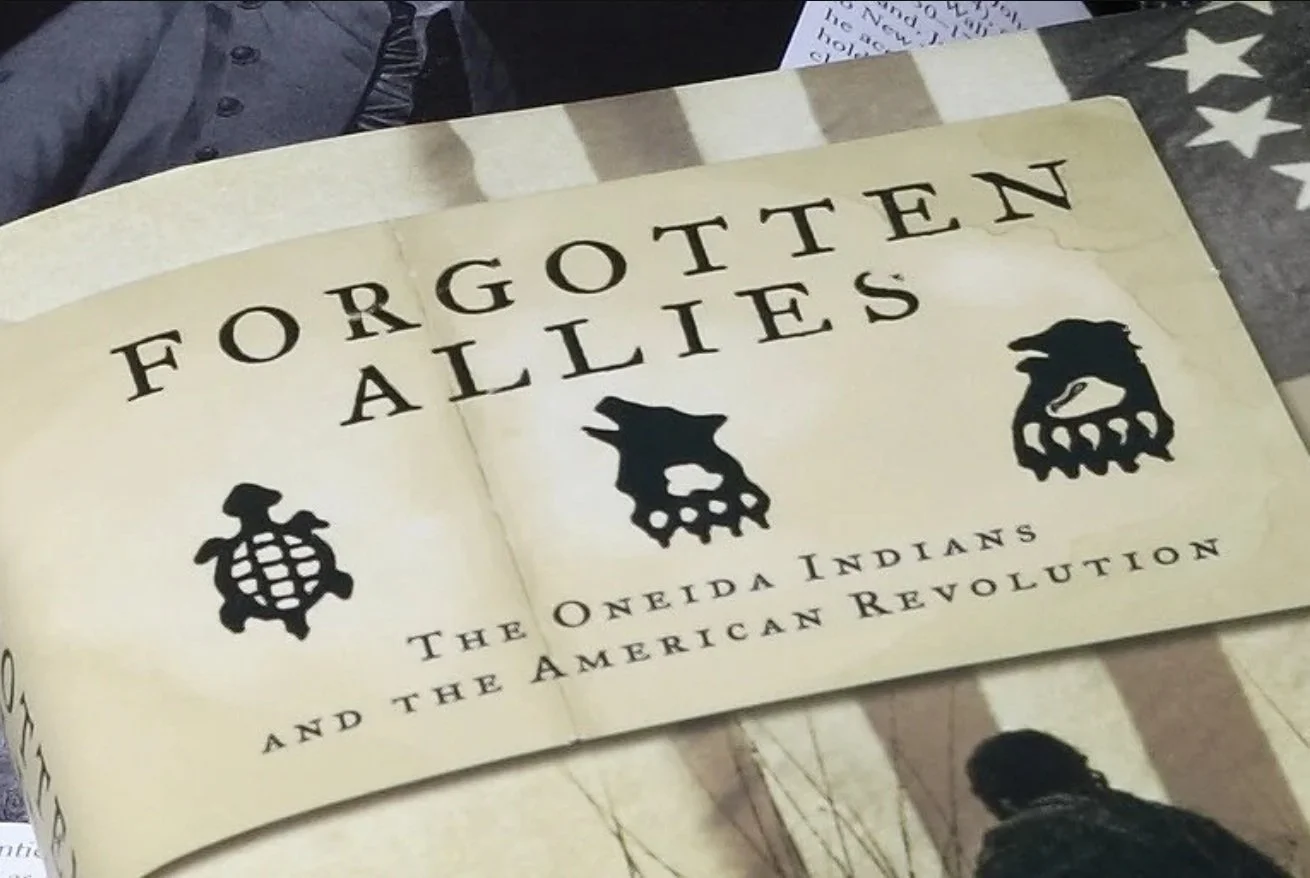
Pictured: Book cover of Joseph T. Glatthaar and James Kirby Martin’s Forgotten Allies: The Oneida Indians and the American Revolution, about the only Iroquois tribe to side with the American Revolution: the Oneida. Sadly, the U.S. Supreme Court invoked the Doctrine of Discovery against them. See below. Photo credit: Oneida Indian Nation.
Introduction: City of Sherrill v. Oneida Indian Nation of New York
In 2005, the Oneida Indians lost sovereignty over their ancestral home based on a Christian declaration made by a Pope over 500 years ago, before the US was even founded. How did this happen?
In 1997, the Oneida Indian Nation of New York, through the open market, purchased back land that had once been part of their historic land. The city of Sherrill, however, demanded that the Oneida owners pay property tax, since the land fell on the city’s lines. In response, the Oneida Indian Nation argued that since the land had originally been tribal land in the first place, the land now fell under tribal sovereignty, exempt from property tax. This case was taken all the way up to the U.S Supreme Court in 2005 where the court ruled ruled 8 – 1 against the Oneida Indian Nation’s attempt to assert immunity from local property taxes on repurchased parcels within the Nation’s historical reservation boundaries.
Justice Ruth Bader Ginsburg, usually a strong liberal advocate of feminism and progressive agendas, cited the so-called “doctrine of discovery” against the Oneida claim. Although the land qualified as Native Indian territory, she said, the Oneida tribe could not reassert sovereignty over the land since they had not owned nor sought judicial relief of the land for over 200 years.
“Under the ‘doctrine of discovery,’ … title to the lands occupied by Indians when the colonists arrived became vested in the sovereign—first the discovering European nation and later the original States and the United States …”[1]
The European nations had virtually called “finders keepers” upon the world but only Europeans qualified as “finders.” According to the “doctrine of discovery,”[2] Native American tribes were no longer sovereign over tribal lands. They were not entitled to property rights because their land had been “discovered” by European colonizers. The discovering European nation gained the rights to seize the land through conquest or (less frequently) purchase, and owned it henceforth. The original Native Americans retained only the right of “occupancy”. This “doctrine” was the same logic that was used by European colonialist to displace the indigenous population and forcibly seize the land that they occupied. Where did it come from? Not from a formal legal system operating in Europe, but by a distorted Christian theology.
The Christian Doctrine of Discovery: Colonization through Theology
Starting from the mid-15th century, European colonizers often relied on the support of the Catholic Church to provide “theological” justifications for the colonization of “new” land and the removal or subjection of indigenous peoples into slavery. The collection of church documents that make up the “Christian doctrine of discovery” gave church-sanctioned permission for European Christian colonialists to “discover” and claim any land that was not inhabited by Christians.
Certain decisions of the Pope, called Papal Bulls, justified the enslavement and military defeat of pagans who could not be “converted” to the Christian faith. Pope Nicholas V explicitly gave King Alfonso of Portugal the “right” to seize land and persons in West Africa. The Papal Bull Dum Diversas of 1452 states:
“We…granted among other things free and ample faculty to the aforesaid King Alfonso — to invade, search out, capture, vanquish, and subdue all Saracens and pagans whatsoever, and other enemies of Christ wheresoever placed, and the kingdoms, dukedoms, principalities, dominions, possessions, and all movable and immovable goods whatsoever held and possessed by them and to reduce their persons to perpetual slavery, and to apply and appropriate to himself and his successors the kingdoms, dukedoms, counties, principalities, dominions, possessions, and goods, and to convert them to his and their use and profit”.[3]
The Papal Bull focused on the religious identity of both the colonizers and the indigenous population. The colonialists’ identity as “Christians” granted them the right to seize “new” land and enslave the indigenous population. The indigenous people, being “non-Christian” made them susceptible to displacement, enslavement, or worse, genocide. Various West African peoples, however, had significant numbers of Christians at the time:
“About 1 in 5 Americans of African descent come from Kongolese stock, with the greatest percentages being concentrated in South Carolina and Louisiana. They carried their [Catholic] religion with them, as well; the Stono Rebellion in 1739, the largest slave uprising in the U.S. before independence, was led by Kongolese Catholics anxious to escape slavery in Protestant South Carolina to freedom in Catholic Florida.”[4]
From a Catholic standpoint, calling the “doctrine of discovery” a “doctrine” is misleading. Papal Bulls are not encyclicals or doctrinal statements where the Pope speaks “from the Chair” (ex cathedra). It is, perhaps, an American idiom. Nevertheless, the series of decisions is significant and grievous.
Pope Leo XIV, in his 2026 encyclical Magnifica Humanitas, acknowledges,
“Already in the early modern period, the Apostolic See of Rome, responding to requests from Sovereigns, intervened several times in order to regulate and legitimize forms of subjugation, and, in certain cases, the enslavement of “infidels.” [174] It was only in the nineteenth century that a formal, absolute and universal condemnation of slavery was clearly articulated, notably under Pope Leo XIII. [175] This development offers a clear example of the Church’s growth in understanding the perennial truths of Revelation that she safeguards. Although there was not always consistency in practice — given that slavery was long tolerated before being unequivocally condemned — there has been a continuous affirmation throughout history of the dignity of every human being, created in the image of God, even if it took eighteen centuries for its full incompatibility with slavery to be explicitly recognized. This constitutes a wound in Christian memory, one from which we cannot consider ourselves detached. [176] It is impossible not to feel deep sorrow when contemplating the immense suffering and humiliation endured by so many in stark contrast to their immeasurable dignity as persons infinitely loved by the Lord. For this, in the name of the Church, I sincerely ask for pardon.”[5]
In his footnote 174, Pope Leo names the decisions and documents that took place over a critical period of 20 years:
“As in the Papal Bulls Sicut Dudum (13 January 1435) and Etsi Suscepti (9 January 1442) of Eugenius IV, and in the Papal Bulls Dum Diversas (18 June 1452) and Romanus Pontifex (8 January 1455) of Nicholas V. Political and, at times, even economic needs overcame the demands of the Gospel. The need for evangelization was frequently compromised or at least misunderstood with regard to the needs of worldly powers, thus relativizing the problematic incompatibility of slavery with the Christian conscience.”
Those decisions and documents contain wounds in Christian memory. The background is the Christian conflict with Muslims in the Crusades. In 1096 – 1291, European Christians tried to militarily “free” the Holy Lands from Muslim control, initially to ensure the safety of Christian pilgrims and then assist the Christians in Constantinople. As a justification, Pope Innocent IV (served 1243 – 1254) argued that the authority Jesus gave him extended to the whole world for the good of their souls such that pagan peoples who forbade the preaching of the gospel were subject to coercion by Christians.
The Catholic Portuguese had begun to conquer the Canary Islands and evangelize their people, including enslavement. They started this in the mid-1300s and continued into the 1400s, when the Genoese, the Catalan-Mallorcans, the Castilians, and the Portuguese were competing for economic trade in the Canary Islands. As the indigenous Guanches people did start converting, Pope Eugenius IV (served 1431 – 1447) stepped in to protect the converts. In Sicut Dudum, also known as Creator Omnium (1434), he ordered Portugal to set free any enslaved Christians, and restore to them their possessions. However, in Romanus Pontifex (1435), under pressure from King Duarte of Portugal, Eugenius allowed the Portuguese to conquer unconverted parts of the Canary Islands. In Etsi Suscepti (1442), Pope Eugenius confirmed and expanded these privileges afforded the Portuguese crown and the military-religious Order of Christ, which was Portugal’s version of the Knights Templar, headed by Prince Henry “the Navigator.”
Pope Nicholas V (served 1447 – 1455) succeeded Pope Eugenius IV and continued in this trajectory. In 1452, Roman (Byzantine) Emperor Constantine XI in Constantinople wrote to Pope Nicholas, asking for help against the Ottoman Empire led by Sultan Mehmed II. In Dum Diversas (1452), as noted above, Nicholas authorized King Afonso IV of Portugal to “attack, conquer, and subjugate Saracens, pagans, and other enemies of Christ wherever they may be found.” Nicholas may have intended Afonso to launch another Crusade against the Ottomans, but in 1453, the Ottomans conquered Constantinople and renamed it Istanbul. Portugal was already involved in trade along the West African coast, where they began competing with the highly profitable trans-Saharan Muslim slave trade. Nicholas in Romanus Pontifex (1455) then tried to prevent competition between Portugal and Castilian Spain. He reaffirmed Dum Diversas (1452), and granted King Afonso of Portugal the right to conquer and convert people from Morocco along the West African coast.[6]
Pope Leo XIV’s words in footnote 174 are worth repeating here:
“Political and, at times, even economic needs overcame the demands of the Gospel. The need for evangelization was frequently compromised or at least misunderstood with regard to the needs of worldly powers, thus relativizing the problematic incompatibility of slavery with the Christian conscience.”
This Catholic pattern became a feature of American law. In 1803, President Jefferson bought the Louisiana Purchase from France. Importantly, France had lost Haiti to the uprising and freedom movement led by Touissant L’Ouverture, and Napoleon wanted to replenish his coffers. For his part, Jefferson supported France’s plans to take back their colony but feared that Napoleon would send troops to New Orleans. In 1800, France had secured the vast territory of Louisiana and the Mississippi economy from Spain on the basis of the “doctrine of discovery.” Not only, then, did the U.S. vastly expand its territory on the legal basis of the “doctrine of discovery,” the “doctrine” continued to play a role:
“That’s how Portugal claimed Brazil (and why the official language of Brazil is Portuguese), how Spain claimed most of Central and South America, how the Dutch claimed New York (New Amsterdam) and South Africa, and how the British claimed the frontier of what became the United States in 1776. When Lewis and Clark left their 1805-1806 winter quarters at Fort Clatsop near the mouth of the Columbia River, they tacked a rudimentary map and a short list of their discoveries on the walls of the compound. They did this for two reasons. First, as exemplars of the Enlightenment, they wanted to make sure that their discoveries would be incorporated into the world’s knowledge base — in geography, ethnology, hydrology — even if they perished on their long return journey. And they were using English peoples’ discovery procedures for establishing an American claim to the lower Columbia basin. As late as 1846, the United States invoked the Doctrine of Discovery to take possession of the Oregon Country from Britain.”[7]
It is one of many examples of how, throughout the era of colonization, Christian theology and the church’s mission became sadly entangled with colonial agendas of racialization and colonization. Therefore, colonialism is not just about social injustice, but about heresy, or “false teachings.” It is not just about history, but church history. And we need to engage in a long repentance for it. We read it as our “family history,” or denomination’s history.
In our next post, we will dive deeper into how the Western church could claim that the persecution of non-Christians was a legitimate way of interacting with them. We will explore how human identity was reshaped, and how it led theologians to create the concept of race.
[1] Footnote #1 of https://supreme.justia.com/cases/federal/us/544/197/opinion.html#F1
[2] The “doctrine of discovery” became formalized into American law in the early 19th century by Chief Justice John Marshall in Johnson v. M’Intosh (1823). Johnson had inherited land purchased from the Piankeshaw tribes, but McIntosh claimed the same land, having purchased it under a grant from the United States. It is important to note that Justice Marshall had financial stakes in the case, and refused to recuse himself. The case was raised on who had the official title to the land and the right to sell the land. The Doctrine of Discovery was used to say that the United States was the lawful owners of the land, having inherited it from the British Empire. Chief Justice Marshall noted:
“On the discovery of this immense continent, the great nations of Europe … as they were all in pursuit of nearly the same object, it was necessary, in order to avoid conflicting settlements, and consequent war with each other, to establish a principle which all should acknowledge as the law by which the right of acquisition, which they all asserted, should be regulated as between themselves. This principle was that discovery gave title to the government by whose subjects, or by whose authority, it was made, against all other European governments, which title might be consummated by possession. … The history of America, from its discovery to the present day, proves, we think, the universal recognition of these principles.” (John Marshall, “Johnson v. M’Intosh”, 21 U.S. 543, 5 L.Ed. 681, 8 Wheat. 543 (1823))
[3] Pope Nicholas V, “Papal Bull Dum Diversas of June 18, 1452”. Translation sourced via http://www.doctrineofdiscovery.org/ (emphasis added). In 1493, one year after Columbus landed on the island of Hispaniola, Pope Alexander VI issued Inter Caetera, which was based on Dum Diversas. Pope Alexander VI gave Spain and Portugal official permission to expand their national sovereignty into Africa and the Western Hemisphere. Spain and Portugal could then make land claims to convert people to the Christian faith, that “the Catholic faith and the Christian religion be exalted and be everywhere increased and spread, that the health of souls be cared for and that barbarous nations be overthrown and brought to the faith itself.”
[4] John K. Thornton and Linda M. Heywood, “A Forgotten African Catholic Kingdom,” The Root, August 12, 2011; https://www.theroot.com/a-forgotten-african-catholic-kingdom-1790865260.
See also Linda M. Heywood and John K. Thornton, Central Africans, Atlantic Creoles, and the Foundation of the Americas, 1585 – 1660 (Cambridge: Cambridge University Press, 2007).
See also Linda M. Heywood, “Slavery and Its Transformation in the Kingdom of Kongo: 1491 – 1800,” The Journal of African History, March 2009, pp. 1 – 22; https://www.cambridge.org/core/journals/journal-of-african-history/article/slavery-and-its-transformation-in-the-kingdom-of-kongo-14911800/C13C2D3671AA721632D91B2F86B2A325
[5] Pope Leo XIV, Magnifica Humanitas (2026), paragraph 176; https://www.vatican.va/content/leo-xiv/en/encyclicals/documents/20260515-magnifica-humanitas.html.
[6] Pius Onyemechi Adiele, The Popes, the Catholic Church and the Transatlantic Enslavement of Black Africans 1418-1839 (Hildesheim, Zurich, and New York: Georg Olms Verlag, 2017), available at: https://www.epafpad.org/images/document/15074871/Vaticaan-N-transatlantische-slavernij-external_content.pdf-605-paginas1.pdf. Robert A. Williams Jr., The American Indian in Western Legal Thought: The Discourses of Conquest (Oxford: Oxford University Press, 1990). See also Mary Elliott and Jasmine Hughes, “Four Hundred Years After Enslaved Africans Were First Brought to Virginia, Most Americans Still Don’t Know the Full Story of Slavery,” New York Times, August 19, 2019; https://www.nytimes.com/interactive/2019/08/19/magazine/history-slavery-smithsonian.html.
[7] Clay S. Jenkinson, “What the Repudiation of the Doctrine of Discovery Means for Indian Country,” Governing, April 9, 2023; https://www.governing.com/context/what-the-repudiation-of-the-doctrine-of-discovery-means-for-indian-country